
Film defects? Not all of them need a polymer processing aid.
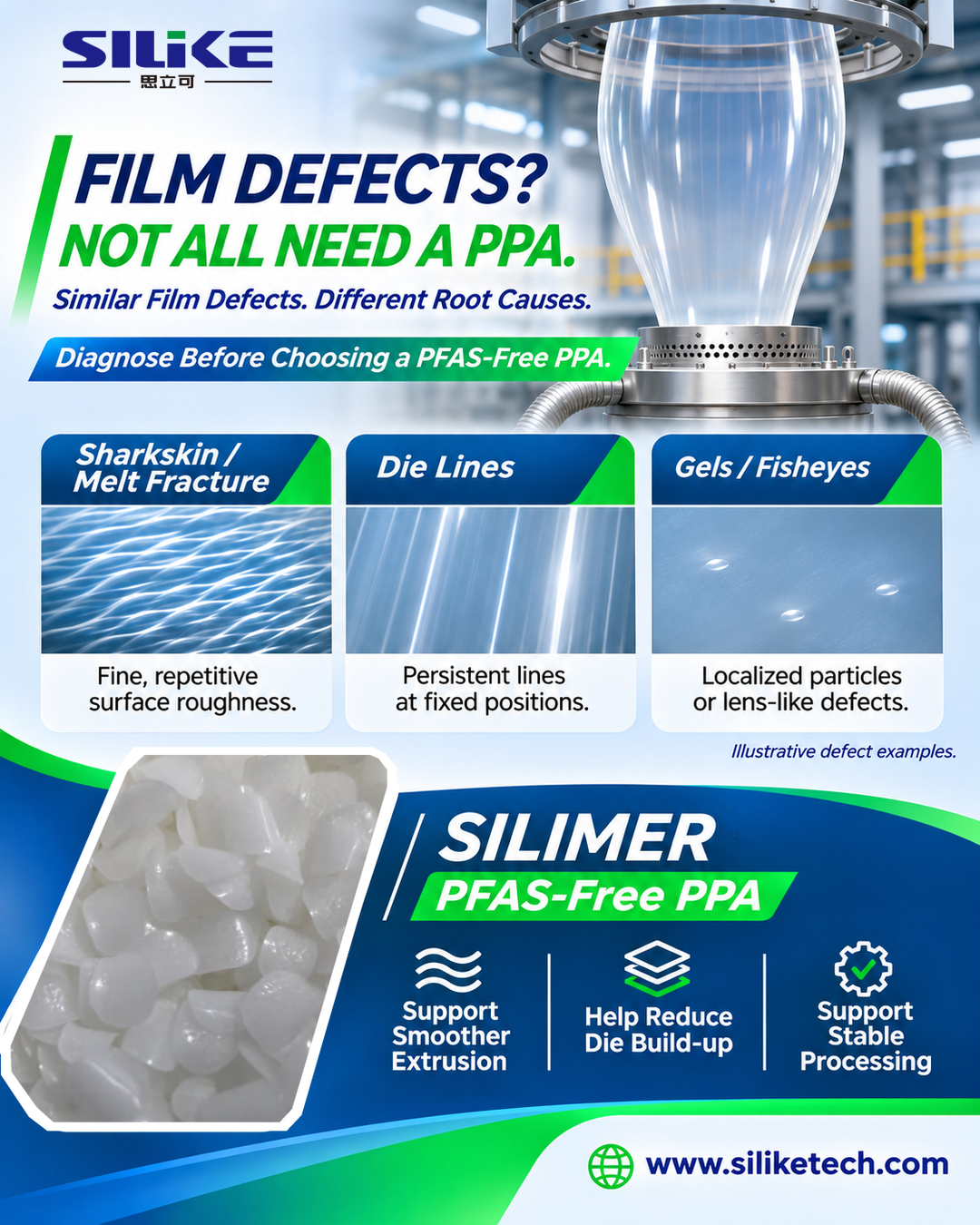
Sharkskin, die lines, and gels can all compromise PE blown film quality. Yet similar-looking defects may have completely different root causes.
For plastics film manufacturers, choosing the wrong corrective action can mean unnecessary additive consumption, repeated production trials, and continued material waste.
The key question is not simply how to eliminate film defects, but how to identify their causes before selecting a solution.
1. Industry Signal: PFAS-Free Processing Requires Better Technical Decisions
As film manufacturers evaluate alternatives to fluoropolymer processing aids, extrusion performance remains a critical consideration.
The EU Packaging and Packaging Waste Regulation (PPWR) began applying on August 12, 2026, including specific PFAS restrictions for food-contact packaging.
These restrictions do not apply identically to every PE film application, and using a PFAS-free PPA alone does not establish finished-packaging compliance.
For manufacturers transitioning to non-fluorinated processing aids, the practical challenge is maintaining acceptable production stability and film quality.
However, not every film defect can be solved by replacing or increasing a PPA.
Understanding the defect comes first.
2. Sharkskin vs. Die Lines vs. Gels: What Is the Difference?
Although all three defects affect film appearance, they require different troubleshooting approaches.
| Film defect | Typical appearance | Possible causes | Can PFAS-free PPA help? |
|---|---|---|---|
| Sharkskin / Melt Fracture | Fine, repetitive surface roughness | Excessive extrusion flow stress, unsuitable processing conditions, or die geometry | Potentially yes, in compatible formulations |
| Die Lines | Persistent lines along the film | Die deposits, contamination, die-lip damage, or nonuniform processing | Sometimes, when related to deposits or flow |
| Gels / Fisheyes | Localized particles, specks, or lens-like distortions | Unmelted polymer, degradation, incompatible material, or contamination | Generally not the first corrective action |
Sharkskin / Melt Fracture: A Flow-Related Surface Defect
Sharkskin typically appears as fine, repetitive roughness on the extruded film surface.
It may become more noticeable when extrusion output increases and the melt experiences higher deformation rates through the die.
Potential corrective actions include reviewing melt temperature, die-lip temperature, die gap, resin characteristics and extrusion throughput.
When processing conditions alone cannot provide an acceptable operating window, a compatible PFAS-free polymer processing aid may help reduce melt fracture and improve surface smoothness.
Die Lines: Check the Die Before Changing the Additive
Die lines may appear as persistent longitudinal streaks or localized surface irregularities.
They can be associated with die deposits, contamination in the melt channel, damaged die lips or nonuniform processing conditions.
Start by checking whether the lines remain in consistent positions and whether there is visible die-lip buildup.
If deposits contribute to the defect, a suitable PPA may help reduce their formation.
However, a processing aid cannot repair damaged die surfaces or eliminate every source of contamination.
Gels / Fisheyes: Often a Material or Melting Problem
Gels are localized defects that distort a film. A fisheye describes a visible, often lens-like appearance around a localized irregularity; it does not by itself establish the defect’s chemistry.
Possible causes include:
- Unmelted polymer particles
- Thermally degraded or crosslinked material
- Incompatible polymer contamination
- Inadequate dispersion or melt filtration
Manufacturers should first investigate raw-material quality, melting conditions, residence time, screw condition and filtration.
A PPA should not be treated as a universal solution to gel defects.
3. How to Identify the Root Cause Before Changing a PPA
A useful troubleshooting approach begins with three observations.
First: Where does the defect appear?
Fine roughness distributed across the film suggests a different mechanism from a persistent line at one position or isolated spots.
Second: How does it respond to processing changes?
Record whether defects change with extrusion output, melt temperature, or die conditions.
Remember that increasing haul-off speed at constant extrusion output is not equivalent to increasing melt flow through the die.
Third: Does the defect follow a resin batch or equipment condition?
Compare representative resin lots, inspect contamination, and review die-cleaning and screen-change records.
When the origin remains uncertain, examination of a retained film sample can help distinguish surface irregularities from embedded material defects.
Diagnose the mechanism before selecting the additive.
4. When Should Manufacturers Evaluate SILIKE PFAS-Free PPA?
At SILIKE, we develop a comprehensive range of alternatives to fluoropolymer-based processing aids (PPAs), including SILIMER pure-active PFAS-free polymer processing aids, fluorine-free PPA masterbatches, pure-active PFAS-free and silicone-free processing aids, and PFAS-free and siloxane-free processing aid masterbatches, designed for various polyolefin extrusion applications.
For PE blown film processing, fluorine-free processing aid masterbatch SILIMER 9301 is one candidate for evaluation.
SILIMER 9301 is an organically modified polysiloxane-based PPA masterbatch with a PE carrier, developed to support:
• Reduced melt fracture and sharkskin
• Reduced die build-up and die drool
• Smoother extrusion and improved processing stability
• Improved film surface appearance
Recommended addition level: 0.5–2 wt% for PPA replacement, processing lubrication, and die-drool reduction; 5–10 wt% when additional reduction in the coefficient of friction is required. The optimum dosage should be determined according to the actual formulation, processing conditions, and target performance.
Importantly, these benefits should be evaluated where the identified defect is related to melt flow, extrusion lubrication, or die deposits.
SILIMER 9301 is not a substitute for resin-quality control, melt filtration, or equipment maintenance.
SILIKE Internal Blown Film Extrusion Comparison
In SILIKE’s internal mLLDPE/LDPE blown film extrusion trials, the untreated resin exhibited visible sharkskin defects.
The addition of different polymer processing aids resulted in varying degrees of film surface improvement under the tested conditions.
Selected SILIKE SILIMER PFAS-free processing aids showed smoother film surfaces compared with the untreated reference. Performance differences were observed among the tested formulations.
The results highlight the importance of selecting suitable processing aids and optimizing dosage and processing conditions for specific PE film applications.
SILIKE Internal Laboratory Test: PFAS-Free vs. Fluorinated PPA – PE Blown Film Surface Comparison
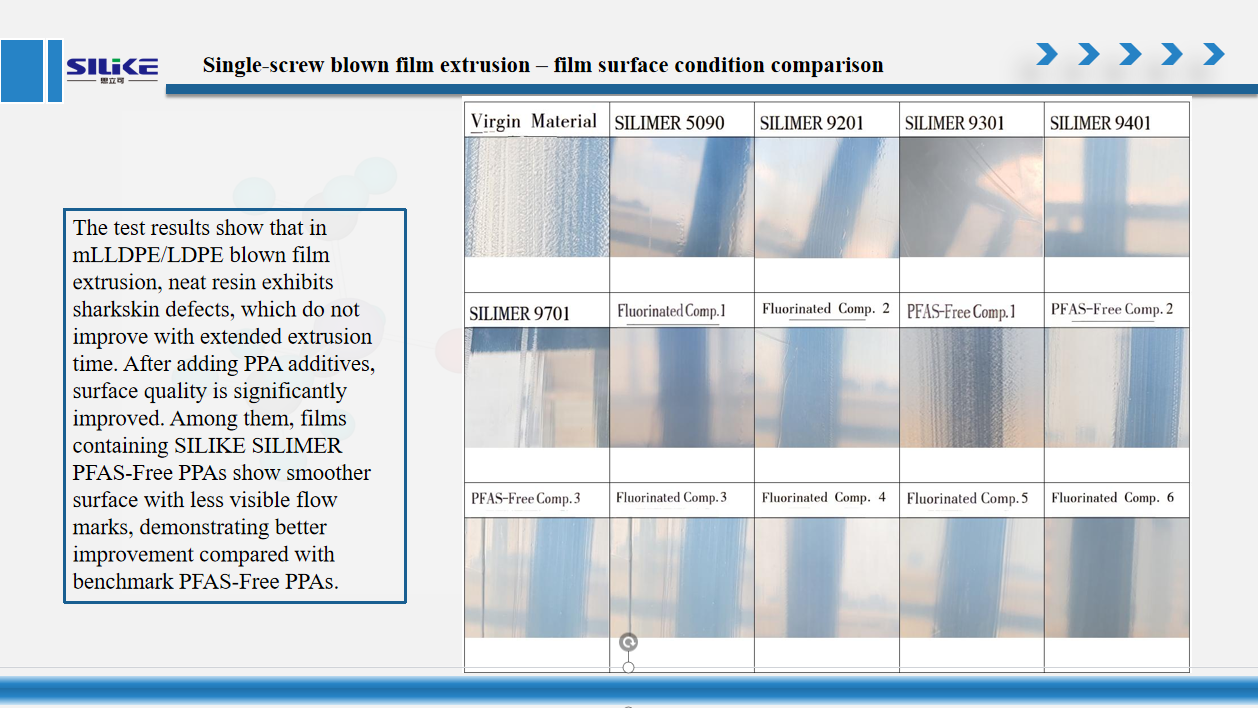
Note: The figure shows a qualitative comparison of mLLDPE/LDPE blown film surface appearance under specific laboratory extrusion conditions. Results may vary depending on resin formulation, additive dosage, equipment, and processing parameters.
Although residual sharkskin defects are visible in the SILIMER 9301 sample, positive flexible packaging and FFS film customer feedback has been reported regarding its ability to help reduce sharkskin defects and die build-up in actual plastic film extrusion applications.
5. How to Verify Whether the PPA Is Working
Once a suitable candidate has been identified, compare the reference formulation and modified formulation under controlled production conditions.
Record the following:
Processing: Extrusion output, melt temperature, die pressure, and operating stability.
Defect performance: Sharkskin severity, die deposits, and the time required to achieve acceptable film appearance.
Final film properties: Optical appearance, mechanical properties, printing, lamination, and heat-sealing performance where relevant.
Use consistent resin, equipment, and operating conditions so that the observed differences can be reasonably attributed to the formulation change.
A successful PPA evaluation should improve the intended processing problem without compromising the required final film performance.
Frequently Asked Questions About PE Film Defects and PFAS-Free PPA
Can PFAS-free PPA reduce sharkskin in PE blown film?
A compatible PFAS-free PPA may help reduce sharkskin and melt fracture in suitable PE formulations. Results depend on resin rheology, extrusion conditions, additive chemistry, and dosage.
Can a processing aid eliminate die lines?
Not necessarily. A PPA may help when die deposits or flow-related effects contribute to the lines. Mechanical damage, contamination, and other causes require separate corrective actions.
Does PFAS-free PPA eliminate gels in polyethylene film?
Not universally. Gels may originate from degradation, unmelted material, or contamination. These causes should be investigated before considering a formulation change.
Discuss Your PE Blown Film Processing Challenges with SILIKE
Struggling with sharkskin, die build-up, persistent film lines, or localized defects in PE blown film extrusion?
Not all film defects have the same root cause. Identifying the right solution starts with understanding your resin formulation and processing conditions.
Share your PE resin grade, film structure, extrusion output, processing temperature, defect photos, and current additive package with SILIKE.
Our technical team can help assess potential causes and discuss whether a SILIMER PFAS-free polymer processing aid could be suitable for your application.
Explore SILIKE PFAS-Free PPA Solutions & Technical Resources
→ PFAS-Free PPA for PE Blown Film Extrusion | SILIMER 9301
→ How to Reduce Die Build-Up and Melt Fracture in LLDPE Blown Film Extrusion
→ PFAS-Free vs. Fluoropolymer PPA: Film Extrusion Replacement Trial Guide
→ PFAS-Free Solutions for EU PPWR Compliance
Ready to Evaluate a PFAS-Free PPA Alternative?
Contact SILIKE to discuss your film extrusion challenges, request technical data, or explore a sample evaluation for your formulation.
Contact: Ms. Amy Wang
Email: amy.wang@silike.cn
Mobile / WhatsApp: +86 151 0828 0799
Website: www.siliketech.com
SILIKE — Helping Improve Polymer Extrusion Performance with PFAS-Free PPA Solutions.
Post time: Nov-20-2026


