
Black Nylon Cable Ties: Addressing White Bloom and Demolding Challenges with SILIMER Silicone Additive
Application Case | Silicone Additives for Nylon Injection Molding
For black nylon injection-molded parts, achieving efficient demolding while maintaining long-term surface appearance can be challenging. Mold-release additives used at high loading levels may affect surface quality, while reducing additive dosage may lead to sticking, difficult ejection, and unstable production.
A manufacturer of industrial black nylon cable ties encountered this challenge during production. After storage, visible white bloom appeared on the surface of finished parts, affecting the appearance of the black molded products. Meanwhile, reducing the existing release additive level resulted in insufficient demolding performance.
To address the balance between processing efficiency and surface appearance, SILIKE offered SILIMER 5133 Easy Mold Release Silicone Wax, a modified copolymerized silicone additive, as an alternative solution.

Compared with the customer’s previous release system requiring approximately 8–10% conventional mold-release masterbatch, SILIMER 5133 achieved the required performance at approximately 3 wt% addition level under the customer’s evaluation conditions.
The results described in this case are based on a specific customer formulation and processing setup. Actual performance may vary depending on nylon grade, formulation design, additive dosage, molding conditions, and storage or conditioning conditions.
Processing Challenge: White Bloom on Black Nylon Cable Ties
The customer specializes in manufacturing black nylon cable ties for industrial applications.
During storage, a visible white deposit gradually appeared on the molded parts. Due to the high contrast between the black surface and the residue, even a small amount of surface accumulation became noticeable and affected product appearance.
To maintain smooth injection molding and reliable part release, the customer previously relied on a conventional mold-release masterbatch system.
However, the formulation created a common challenge:
• Increasing release additive loading improved mold release performance but increased the risk of surface residue.
• Reducing additive loading helped improve appearance but caused sticking, difficult ejection, and unstable production.
The customer required an additive solution that could provide efficient release performance while maintaining stable surface quality.
Understanding White Bloom in Nylon Injection Molding
White bloom on black nylon parts can result from multiple formulation and processing factors, including:
• Additive compatibility with the nylon matrix
• Excessive additive concentration
• Polymer–additive interaction
• Pigment and filler systems
• Processing history
• Storage and conditioning conditions
When a release additive is not sufficiently compatible with the polymer system, higher loading levels may increase the possibility of additive migration or surface accumulation over time.
Therefore, improving surface appearance requires more than simply reducing additive dosage. The key is selecting an additive technology that provides efficient lubrication while maintaining good interaction with the polymer matrix.
Solution: SILIMER 5133 Silicone Additive for Nylon Demolding & Surface Appearance
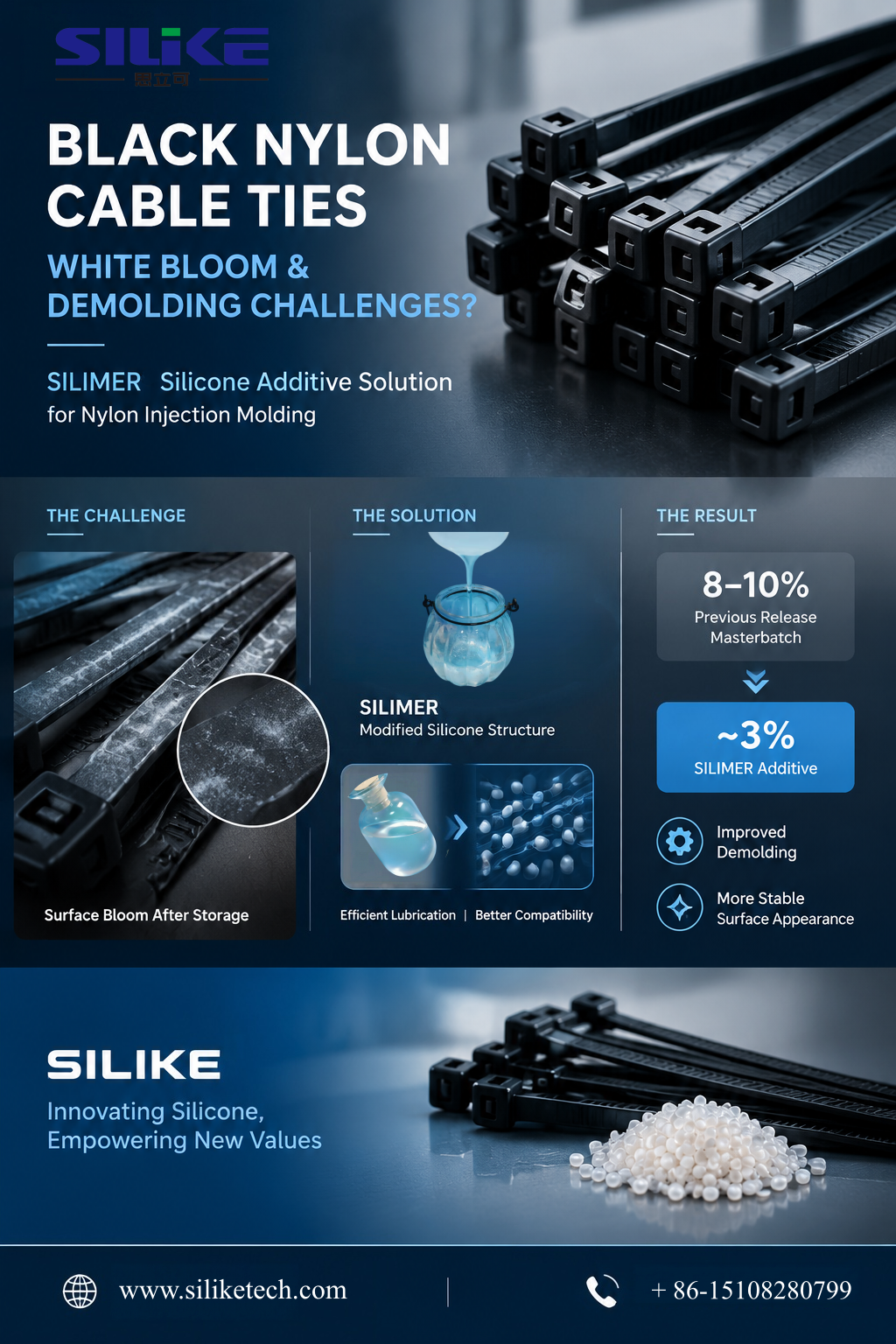
Based on the customer’s requirements, SILIKE proposed SILIMER 5133 Easy Mold Release Silicone Wax as an alternative to the existing release system.
SILIMER 5133 is a modified copolymerized silicone additive designed for thermoplastic processing applications requiring improved release performance and surface properties.
The evaluation focused on balancing:
• Mold release performance
• Additive efficiency
• Surface appearance stability
Unlike conventional release systems that may depend on higher loading levels, SILIMER 5133 provides efficient lubrication and release performance at a lower addition level.
In this customer application, SILIMER 5133 was evaluated at approximately 3 wt% addition level.
Application Results: Improved Demolding and Surface Appearance
Improved Mold Release Performance
During the customer’s nylon cable tie production evaluation, SILIMER® 5133 helped improve injection molding performance.
The customer reported:
• Reduced screw torque
• Smoother molding operation
• Easier mold opening and part ejection
• Reduced sticking-related issues
The results showed that SILIMER 5133 provided effective lubrication and release performance without relying on the previous high-loading release masterbatch system.
More Stable Surface Appearance
After storage and water-conditioning evaluation, the black nylon cable ties maintained a more uniform surface appearance.
Under the customer’s evaluation conditions, no visible white bloom was observed.
This result highlights the importance of balancing:
Lubrication efficiency + Polymer compatibility + Surface appearance
rather than optimizing only mold release performance.
Why SILIMER 5133 Helps Improve Release Performance
The performance of silicone additives depends on molecular structure, dispersion behavior, and interaction with the polymer system.
SILIMER 5133 uses a modified copolymerized silicone structure designed to provide efficient lubrication in thermoplastic processing.
During injection molding, the additive can help reduce friction between:
• Polymer melt and processing equipment
• Polymer melt and mold surfaces
This can support:
• Improved processing behavior
• Easier mold release
• Smoother part ejection
• Enhanced surface lubricity
For appearance-sensitive applications such as black nylon cable ties, selecting the appropriate additive technology helps processors balance:
• Release performance
• Surface consistency
• Long-term appearance stability
Application Considerations for Nylon Injection Molding
The performance of silicone additives can be influenced by:
Nylon resin type
Different PA grades may show different processing behavior and additive compatibility.
Formulation design
Carbon black, fillers, stabilizers, and other additives may affect surface performance.
Processing conditions
Injection parameters, mold design, and temperature settings can influence demolding behavior.
A production trial under actual processing conditions is recommended to determine the suitable additive selection and dosage.
Beyond Black Nylon Cable Ties
Although this case focuses on black nylon cable ties, SILIMER® silicone additives can also be evaluated in other thermoplastic applications requiring improved processing and surface performance.
Potential applications include:
• PA / Nylon injection molding
• PE and PP processing
• PC and PC/ABS components
• TPE and TPU applications
Depending on the selected grade and formulation, SILIMER silicone additives can support requirements including:
• Mold release
• Processing lubrication
• Surface lubricity
• Scratch resistance
• Wear resistance
• Surface appearance improvement
Conclusion
For black nylon cable ties, achieving stable production performance requires balancing processing efficiency and product appearance.
In this customer application, SILIMER 5133 Easy Mold Release Silicone Wax provided an alternative to the previous high-loading release masterbatch system, achieving the targeted demolding performance at approximately 3 wt% addition level under the customer’s evaluation conditions.
The case demonstrates that an efficient silicone additive technology can help processors optimize:
Demolding performance
Additive efficiency
Surface appearance stability
For nylon injection molding applications involving white bloom, difficult demolding, sticking, or surface quality concerns, SILIKE provides silicone additive solutions and technical support.
SILIKE — Innovating Silicone, Empowering New Values
Contact us:
Tel: +86-28-83625089
Email: amy.wang@silike.cn
Website: www.siliketech.com
Post time: Sep-30-2026


