
Introduction
Thermoplastic materials are widely used in automotive interiors, packaging films, cable compounds, footwear, electronics, consumer products, and industrial components. As application requirements become more demanding, resin selection alone is often not enough to achieve the required balance of processing efficiency, surface quality, durability, and appearance.
Common challenges include scratch whitening, abrasion, high friction, unstable coefficient of friction (COF), difficult extrusion, die build-up, surface defects, and insufficient wear resistance.
Silicone-based additives provide one approach to modifying the processing and surface behavior of thermoplastic materials. Depending on their chemistry, molecular structure, carrier resin, and delivery form, they can be used to improve processing behavior, lubrication, scratch resistance, abrasion resistance, slip performance, surface quality, and other application-specific properties.
However, silicone-based additives are not a one-size-fits-all solution. The appropriate technology depends on the polymer matrix, additive compatibility, processing conditions, formulation, dosage, and performance requirements of the finished product.
This guide explains the main types of silicone-based additives, how they are selected for different thermoplastic systems, and how SILIKE technologies are applied across automotive, film, cable, footwear, engineering plastics, elastomers, and other polymer applications.
What Are Silicone-Based Additives?
Silicone-based additives are functional polymer additives containing silicone or siloxane structures that are incorporated into thermoplastic formulations to modify processing behavior or surface properties.
Silicone chemistry is useful in polymer processing because siloxane structures can provide low surface energy, lubrication, low-friction characteristics, thermal stability, and surface modification effects.
Depending on the formulation and delivery form, silicone-based additive technologies may include:
♦ Copolymeric siloxane additives and modifiers
♦ Silicone-based processing additives
♦ Silicone-based anti-scratch and anti-abrasion additives
♦ Silicone-based anti-squeak additives
These technologies can be supplied in different forms, including concentrated masterbatches, powders, or other additive formats, depending on the polymer system and processing method.
Compared with conventional low-molecular-weight silicone fluids, polymer-compatible silicone additive technologies can provide a more controlled way of introducing silicone functionality into thermoplastic formulations. The actual performance, however, depends on the compatibility between the additive, carrier resin, polymer matrix, processing conditions, and target application.
Why Are Silicone-Based Additives Used in Thermoplastics?
The main reason for using silicone-based additives is to modify specific processing or surface characteristics without changing the entire polymer system.
For example, an automotive interior compound may require improved scratch resistance while maintaining appearance and low-emission requirements. A film producer may need controlled slip and anti-blocking performance without compromising optical properties. A cable compounder may need better extrusion behavior when processing highly filled flame-retardant formulations.
The performance target therefore determines the additive selection.
| Processing or Performance Challenge | Typical Additive Direction |
|---|---|
| Scratch whitening and surface damage | Anti-scratch silicone masterbatch |
| Abrasion and wear | Anti-abrasion or wear-resistant additive |
| High friction or difficult material flow | Silicone-based processing or lubrication additive |
| Film handling and unstable COF | Slip and anti-blocking additive |
| Die build-up and melt fracture | Polymer processing additive |
| Squeaking caused by frictional contact | Anti-squeak additive |
| Soft-touch and elastic surface requirements | Thermoplastic silicone elastomer |
| WPC processing and surface quality | Functional processing additive |
The selection should always be based on the complete formulation and processing system rather than on the additive chemistry alone.
Silicone-Based Additives by Application
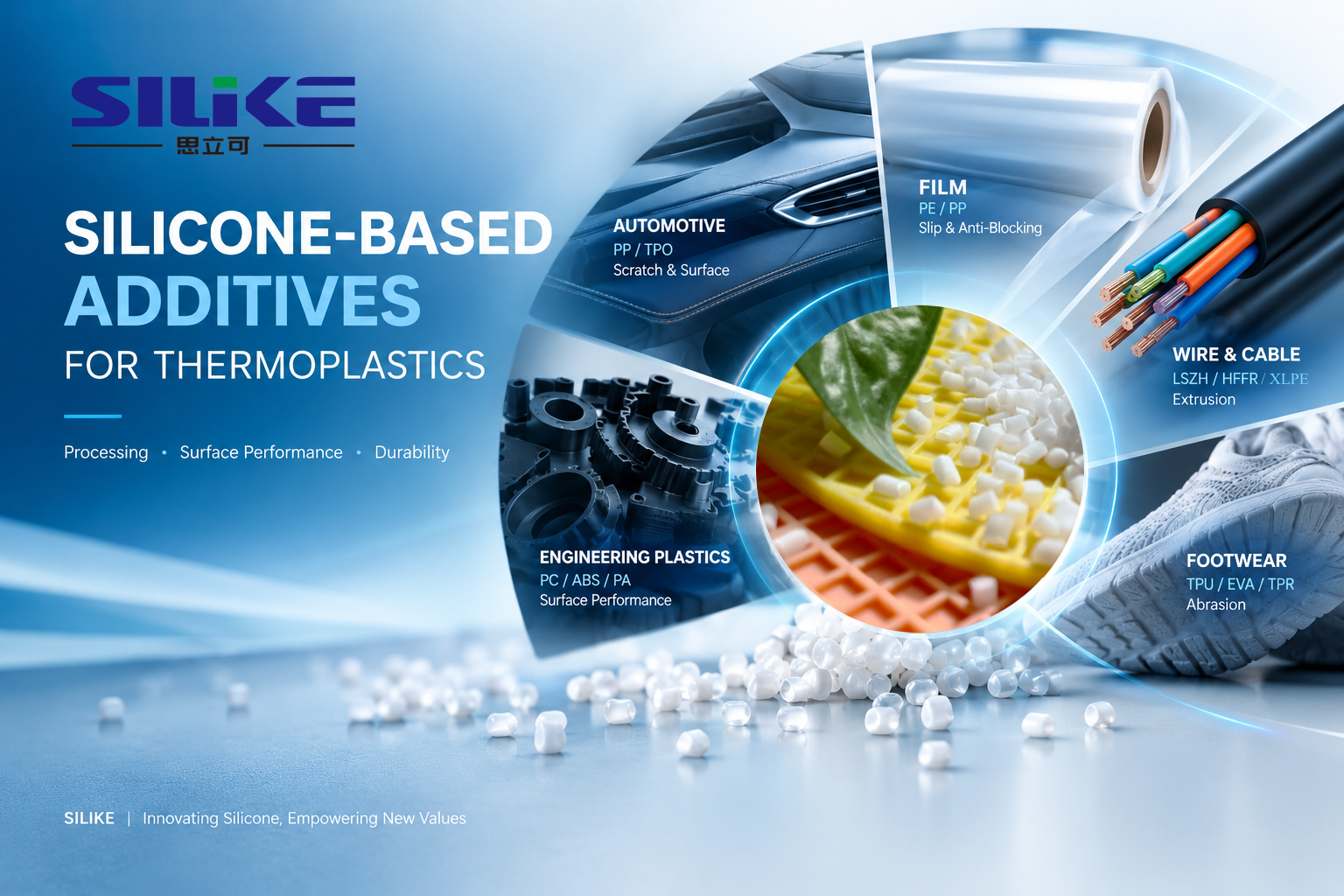
PP and TPO: Scratch Resistance and Surface Durability
PP and TPO are widely used in automotive interior components because of their lightweight characteristics, impact performance, and cost efficiency. At the same time, molded-in-color PP and TPO parts, particularly dark-colored components, can show visible surface changes after scratching.
Typical problems include scratch whitening, mar appearance, gloss change, and loss of perceived surface quality.
Silicone-based anti-scratch masterbatches can modify surface friction and improve resistance to scratching and surface damage. The effectiveness depends on the polymer matrix, filler package, pigment system, surface texture, processing history, additive compatibility, and scratch-test conditions.
Common applications include: Door panels, Instrument panels, Center consoles, Dashboards, Automotive interior trims, Appliance housings, and Other PP-compatible molded components.
SILIKE Anti-scratch Masterbatch technologies include grades developed for PP, TPO, and engineering plastic systems. For automotive applications, product selection should be based on the actual resin formulation and required scratch evaluation method rather than on a generic additive dosage.
Footwear and Polymer Compounds: Improving Abrasion Resistance
Abrasion resistance is a separate performance requirement from scratch resistance and should be treated as an independent additive selection category.
Footwear soles and other high-friction polymer products are exposed to repeated mechanical contact, sliding, compression, and surface wear. Depending on the material system, manufacturers may need to reduce abrasion loss while maintaining flexibility, processing behavior, appearance, and other physical properties.
Silicone-based anti-abrasion masterbatches can be evaluated in materials such as EVA, TPU, SEBS, SBS, TPR, TR, PVC, and other rubber or thermoplastic compounds.
Typical applications include: Shoe soles and outsoles; sports footwear; work and safety footwear; rubber and thermoplastic footwear compounds; high-wear polymer components.
SILIKE offers dedicated anti-abrasion Masterbatch for shoe sole, including grades developed for PVC, TPR, TR, SEBS, SBS, EVA, color rubber, and TPU systems. The appropriate product and dosage depend on the polymer matrix, hardness, filler package, processing method, and required abrasion test.
PE and PP Films: Slip, Anti-Blocking, and COF Control
Film extrusion requires controlled surface friction to support stable winding, converting, stacking, packaging, and downstream processing.
Film manufacturers may encounter:
• Insufficient slip
• Excessive or unstable COF
• Blocking between film layers
• Surface migration concerns
• Optical property changes
• Processing inconsistency
Slip and anti-blocking additives can be selected according to the resin system, film structure, extrusion process, target COF, transparency requirements, and downstream converting conditions.
SILIKE’s functional film additive portfolio includes slip and anti-blocking technologies such as SF Series – High-Temperature Super Slip Masterbatch, SILIMER Series – Non-Migratory Super Slip & Anti-Blocking Masterbatch ,,FA Series – Anti-Blocking & Low Haze Masterbatch, FC Series – Balanced Slip & Anti-Blocking Masterbatch, FSE Series – Cost-Effective Slip Masterbatch. These plastic film additives serve different combinations of slip, anti-blocking, migration, haze, temperature, and processing requirements.
For film applications, additive selection should therefore focus on the required surface behavior rather than simply selecting the strongest slip additive.
Wire and Cable Compounds: Extrusion and Processing Performance
LSZH and HFFR cable compounds contain high levels of flame retardants and fillers, which can increase melt viscosity, extrusion torque, die pressure, and die build-up, while affecting surface quality and processing efficiency.
Silicone-based processing additives can modify melt flow and friction behavior, helping improve extrusion stability and surface performance.
Typical cable compound applications include:
• HFFR and LSZH compounds
• Silane-crosslinkable cable compounds
• Low-smoke PVC compounds
• Low-COF cable compounds
• TPU and TPE cable compounds
Depending on the formulation and processing conditions, potential benefits include:
• Improved melt flow and extrusion stability
• Lower extruder torque and die pressure
• Reduced die build-up and die drool
• Lower processing resistance and energy demand
• Improved surface slip and lower COF
• Better scratch and wear resistance
Performance depends on the polymer matrix, flame-retardant package, filler loading, additive dosage, and extrusion conditions. Evaluation should therefore be conducted using the target formulation and production process.
TPU and TPE: Surface Feel, Wear, and Processing
TPU and other thermoplastic elastomers require a balance between flexibility, elasticity, surface feel, friction, wear resistance, and processing stability.
Depending on the application, manufacturers may need to address:
• Surface wear
• High friction
• Loss of surface quality during repeated use
• Processing difficulties
• Soft-touch requirements
Silicone-based additives can be used to modify the surface and processing characteristics of selected TPU and TPE systems.
For applications requiring a combination of silicone-related surface characteristics and thermoplastic processing, SILIKE also offers Si-TPV thermoplastic silicone elastomer technologies. Si-TPV is a distinct material platform rather than a conventional silicone masterbatch and is designed for applications requiring soft touch, elasticity, wear resistance, and surface durability.
Potential applications include:
• Wearable products
• Sports equipment
• Consumer electronics
• Protective equipment
• Grips and functional components
• Soft-touch products
Engineering Plastics: Surface Performance and Processing
Engineering plastics such as PC, ABS, PC/ABS, PA, and PBT are used where dimensional stability, mechanical performance, heat resistance, or durability are required.
However, engineering plastics can also present surface-related challenges, particularly in applications where appearance, scratch resistance, friction, mold release, or long-term surface quality are important.
Silicone-based additives can be evaluated to modify surface behavior while maintaining the required balance of mechanical properties and processing performance.
Typical applications include:
• Automotive components
• Electronic housings
• Consumer electronics
• Industrial components
• Molded engineering plastic parts
The selection should consider the specific polymer grade, reinforcement or filler system, molding conditions, surface finish, and required mechanical and appearance properties.
Wood-Plastic Composites: Processing and Surface Quality
Wood-plastic composites combine polymer matrices with wood flour or other lignocellulosic fillers. Their high filler loading can influence melt flow, dispersion, surface appearance, extrusion stability, and processing efficiency.
Functional additive masterbatches can be evaluated to improve processing behavior and surface quality in WPC applications.
Typical applications include:
• WPC decking
• Decorative profiles
• Outdoor building products
• Architectural components
The additive selection should consider the polymer matrix, wood-fiber loading, moisture content, extrusion conditions, and required surface finish.
How to Select the Right Silicone-Based Additive
Selecting a silicone-based additive should start with the application problem rather than the additive name.
1. Identify the Polymer Matrix
First determine whether the formulation is based on PP, TPO, PE, TPU, TPE, EVA, PC/ABS, PA, PBT, PVC, rubber, or another polymer system.
Carrier resin compatibility and dispersion behavior can strongly influence the final result.
2. Define the Primary Performance Target
Determine the most important performance requirement:Scratch resistance, Abrasion resistance, Slip, Anti-blocking, Friction reduction, Processing stability, Extrusion output, Surface appearance,Anti-squeak performance,Soft-touch or elastic surface properties.
One additive should not automatically be expected to optimize every property simultaneously.
3. Evaluate Processing Conditions
Important processing variables include:Processing temperature, Injection or extrusion method, Screw configuration, Shear conditions, Production speed, Die design, and Residence time.
The same additive may behave differently in injection molding, blown film, cast film, compounding, extrusion coating, or cable extrusion.
4. Consider the Complete Formulation
The polymer matrix is only one part of the system.
Fillers, pigments, flame retardants, plasticizers, slip agents, processing aids, stabilizers, and other additives can all influence the final performance.
For example, scratch resistance in automotive PP/TPO depends not only on the silicone additive but also on filler loading, pigment system, surface texture, formulation design, and test conditions.
5. Match the Additive Form to the Production Process
Masterbatch, powder, pure additive, and elastomeric material formats are not interchangeable.
A masterbatch may be preferred for controlled dosing and conventional melt blending, while a powder or pure additive may be more suitable for certain compounding or formulation processes.
The carrier resin should also be considered when selecting a masterbatch.
6. Validate the Additive Under Production Conditions
Laboratory screening is useful for narrowing the selection, but the final evaluation should be performed using the actual formulation and production process.
A practical evaluation should compare:Processing behavior, Surface appearance, Mechanical properties, Scratch or abrasion performance, COF or friction behavior, where relevant Odor and VOC requirements ,where applicable Long-term aging, and Production stability.
The optimum dosage should be established through controlled trials rather than assumed from a generic dosage range.
SILIKE Silicone-Based Additive Technologies
Chengdu SILIKE Technology Co., Ltd. is a leading manufacturer and supplier of silicone-based materials and high-performance plastic additives, with more than 20 years of expertise in integrating silicone technologies with thermoplastics.
SILIKE’s silicone-based additive portfolio includes silicone masterbatches, silicone powders, anti-scratch masterbatches, super-slip masterbatches, anti-abrasion masterbatches, anti-squeak additives, silicone waxes, dynamically vulcanized thermoplastic silicone-based elastomers (Si-TPV), PFAS-free polymer processing aids (PPAs), non-migrating slip and anti-blocking solutions, copolymeric siloxane additives and modifiers, hyperdispersants, functional additives for biodegradable materials, processing lubricants for wood-plastic composites (WPCs), matte-effect masterbatches, slip-resistant and wear-resistant functional additives, as well as a broad range of other high-performance additives for polymer processing and surface modification.
Silicone Masterbatch
SILIKE LYSI silicone masterbatch technologies use high-molecular-weight siloxane polymers dispersed in compatible carrier resins. They are designed for applications where processing behavior, lubrication, friction, scratch resistance, abrasion resistance, or surface quality need to be modified.
Key application categories include:
Anti-Scratch Masterbatch
Developed for thermoplastic systems requiring improved scratch resistance and surface durability, particularly PP/TPO automotive interior compounds and selected engineering plastics.
Anti-Abrasion Masterbatch
Developed for high-wear applications such as footwear compounds and other polymer products exposed to repeated friction and abrasion.
Processing and Surface Modification Masterbatch
Selected SILIKE silicone-based additive grades can be used to modify processing behavior, mold release, friction, flow, and surface quality in compatible thermoplastic systems.
The appropriate grade depends on the resin matrix and target performance rather than on silicone content alone.
Silicone Powder
SILIKE silicone powder provides a powder-format silicone additive option for selected thermoplastic and engineering plastic applications.
This format can be considered when a powder additive is more appropriate for the formulation or compounding process than a pelletized masterbatch.
Anti-Squeak Additives
Anti-squeak technology should be treated as a separate functional category from conventional scratch or abrasion additives.
SILIKE SILIPLAS technologies are designed for polymer systems such as PC/ABS where friction-induced noise can result from contact between polymer surfaces or between polymer and other materials.
The mechanism involves modifying friction and surface interaction to reduce stick-slip behavior. Product selection and dosage should be based on the polymer system and the required acoustic evaluation method.
Functional Additives for WPC
SILIKE also develops functional additive technologies for wood-plastic composites, where processing stability, filler dispersion, surface quality, and appearance can be important performance requirements.
These solutions are evaluated according to the polymer matrix, wood-filler system, extrusion process, and target surface finish.
SILIMER Functional Additive Technologies
SILIMER is a broader functional additive platform used for polymer processing and surface modification.
Depending on the grade, SILIMER technologies can address:
♦ Slip performance
♦ Anti-blocking
♦ Processing behavior
♦ Lubrication
♦ Surface quality
♦ Polymer processing requirements
For PE and PP film applications, different SILIMER, SF, FA, FC, and FSE technologies can be selected according to the required balance of slip, anti-blocking, migration, optical properties, and processing conditions.
This portfolio should therefore be selected by performance requirement rather than treating all slip and anti-blocking products as chemically or functionally identical.
PFAS-Free Polymer Processing Aids
PFAS-free polymer processing aids are developed for extrusion applications where processors need alternatives to fluorinated processing aids.
SILIKE’s portfolio includes PFAS-free silicone-based technologies as well as PFAS-free and siloxane-free options for applications where silicone-containing chemistry is not suitable.
Potential applications include:
♦ PE film extrusion
♦ PP film extrusion
♦ Pipe extrusion
♦ Profile extrusion
♦ Cable compounds
♦ Other polyolefin processing applications
Depending on the technology and formulation, potential processing benefits include reduced melt fracture, improved melt flow, reduced die build-up, improved surface quality, and more stable extrusion.
PFAS-free and silicone-free should not be treated as synonymous. The appropriate technology depends on the customer’s regulatory, formulation, and processing requirements.
Si-TPV Thermoplastic Silicone Elastomers
Si-TPV is SILIKE’s thermoplastic silicone-based elastomer technology. Unlike a conventional silicone masterbatch, Si-TPV is an elastomeric material platform designed to combine thermoplastic processing characteristics with silicone-related surface properties.
Depending on the grade and application, Si-TPV technologies can provide combinations of Soft touch, Elasticity, Wear resistance, Surface durability, Matte or silicone-like surface characteristics.
Applications include wearable products, consumer electronics, sports equipment, protective products, grips, and other functional components.
A Practical Selection Framework
For engineers evaluating silicone-based additives, the following sequence provides a practical starting point:
Polymer → Processing Method → Primary Problem → Performance Target → Additive Technology → Dosage Screening → Production Validation
For example:
PP/TPO automotive interior → injection molding → scratch whitening → scratch resistance → anti-scratch silicone masterbatch → formulation screening → scratch and appearance validation
TPU footwear compound → extrusion/injection → outsole wear → abrasion resistance → anti-abrasion additive → dosage screening → abrasion and physical-property validation
PE film → blown-film extrusion → unstable slip/blocking → controlled COF and anti-blocking → slip/anti-blocking additive → film trial → COF, haze, blocking and converting evaluation
LSZH/HFFR compound → cable extrusion → high torque and die build-up → processing stability → silicone-based processing additive → extrusion trial → pressure, torque, surface and output evaluation
This approach makes additive selection more systematic and reduces the risk of choosing a product based only on a generic performance claim.
Conclusion
Silicone-based additives can play an important role in thermoplastic processing and surface modification, but the appropriate solution depends on the relationship between polymer chemistry, formulation, processing conditions, and end-use requirements.
For automotive PP/TPO compounds, the primary requirement may be scratch resistance and long-term surface appearance. For footwear, abrasion resistance may be the dominant requirement. For films, slip and anti-blocking performance may determine the additive selection. Cable compounds may require improved extrusion behavior, while engineering plastics may require a balance of surface performance and processing stability.
The most effective selection process therefore begins with the application problem and polymer system, followed by controlled additive screening under representative processing conditions.
SILIKE provides a broad portfolio of silicone-based and related functional additives covering silicone masterbatch, silicone powder, anti-scratch and anti-abrasion solutions, anti-squeak additives, slip and anti-blocking technologies, PFAS-free polymer processing aids, WPC additives, and Si-TPV thermoplastic silicone elastomers.
For a specific polymer formulation or processing problem, additive selection should be confirmed through application-specific testing rather than based on a general product category alone.
Frequently Asked Questions
What are silicone-based additives used for?
Silicone-based additives are used to modify thermoplastic processing and surface properties. Depending on the technology, they can be evaluated for scratch resistance, abrasion resistance, friction reduction, slip, processing behavior, surface quality, and other application-specific requirements.
Which polymers can use silicone-based additives?
Silicone-based additives can be evaluated in a wide range of thermoplastic systems, including PP, TPO, PE, TPU, TPE, EVA, PC, ABS, PC/ABS, PA, PBT, PVC, and selected rubber or thermoplastic compounds. Compatibility and performance should be confirmed for the specific formulation.
Are silicone masterbatch and Si-TPV the same type of material?
No. Silicone masterbatch is an additive technology typically used to modify the processing or surface properties of a compatible polymer system. Si-TPV is a thermoplastic silicone-based elastomer material platform designed for applications requiring combinations of elasticity, soft touch, wear resistance, and surface durability.
Is PFAS-free PPA the same as silicone-free PPA?
No. PFAS-free describes the absence of PFAS-based chemistry, while silicone-free describes a different chemistry requirement. A PFAS-free processing aid may be silicone-based. SILIKE also offers PFAS-free and siloxane-free processing-aid options for applications where silicone-containing chemistry is not suitable.
How should I select a silicone-based additive?
Start with the polymer matrix and processing method, then define the primary performance problem. The next steps are to identify the appropriate additive technology, evaluate compatibility and dosage, and validate the result under representative production conditions.
For more information, technical data, or application test results, please feel free to contact Ms. Amy Wang.
Email: amy.wang@silike.cn
WhatsApp / Mobile: +86 151 0828 0799
Post time: Sep-29-2026


