
PC, ABS and PC/ABS are widely used in automotive components, consumer electronics, appliances, housings and other molded products where appearance is almost as important as mechanical performance.
Yet a material that performs well in tensile, impact or dimensional-stability tests can still develop visible scratches, whitening, gloss changes or surface wear during assembly and daily use.
This is why improving scratch resistance is rarely as simple as increasing surface hardness or adding a lubricant.
The final result depends on the interaction among polymer morphology, toughness, surface friction, pigment, texture, processing history and contact conditions. For PC, ABS and PC/ABS, the most effective formulation strategy is therefore one that improves surface behavior without creating new problems in molding, appearance, painting, bonding or mechanical performance.
Polymer-compatible, high-molecular-weight silicone-based additives provide one possible route. When the additive chemistry and carrier are matched to the resin, they can modify frictional behavior while supporting processing and demolding.
Why Do PC, ABS and PC/ABS Surfaces Scratch?
Scratch damage develops when a harder object applies concentrated force to the polymer surface. Depending on the formulation and contact conditions, the result may appear as whitening, shallow grooves, gloss change, plastic deformation or, under more severe conditions, localized cracking.
The appearance of a scratch does not depend only on how deep it is. Color and surface finish can make relatively small defects highly visible.
Black and other dark-colored plastic parts are particularly sensitive because deformation of the surface changes the way light is reflected and scattered. A shallow scratch that is difficult to notice on a natural-color plaque may appear as a highly visible white line on a black housing or decorative component.
Surface texture introduces another variable. High-gloss parts reveal fine scratches readily, while grained surfaces may respond differently according to grain depth, geometry and the direction of contact.
Processing can also influence the result. Residual stress, flow orientation, weld lines, difficult demolding and incomplete mold filling can all affect local surface behavior. Some defects that appear to be poor scratch resistance may therefore originate partly from processing rather than from insufficient surface hardness alone.
Scratch Resistance, Wear Resistance and Friction Are Different Properties
Scratch resistance, wear resistance and coefficient of friction are related, but they should not be treated as interchangeable.
Scratch resistance normally describes the response of the surface to a concentrated contact, such as a stylus moving across a molded plaque. Depending on the method, performance may be expressed through scratch width, depth, visual rating, color change or critical load.
Wear resistance describes what happens after repeated movement between two surfaces. A material can perform well during a single scratch event yet behave differently after hundreds or thousands of sliding cycles.
Coefficient of friction measures resistance to sliding between two contacting materials. Lowering friction can reduce tangential force during certain scratch or wear events, which may help reduce visible damage.
However, lower friction does not automatically guarantee better scratch resistance.
Surface hardness, matrix toughness, pigment, fillers, texture, load, counter-material and contact geometry remain important. COF should therefore be treated as part of the mechanism rather than as a substitute for scratch testing.
Why PC/ABS Surface Modification Requires Careful Additive Selection
PC/ABS is widely used because it combines the characteristics of two different polymer systems. This provides an attractive balance of toughness, appearance, thermal performance and processability, but it also means additive compatibility deserves particular attention.
A surface modifier introduced into PC/ABS can influence much more than slip.
It may affect dispersion, morphology, melt flow, demolding, gloss, impact behavior and downstream processes such as painting or adhesive bonding.
This is one reason a generic lubricant or a masterbatch developed for a different polymer family should not automatically be transferred into PC/ABS.
Carrier compatibility matters because the additive must disperse effectively in the matrix while maintaining a stable and uniform surface effect.
For ABS and PC/ABS in particular, the objective is usually not simply to achieve the lowest possible friction. It is to improve visible surface durability while preserving the overall property balance that made the material attractive in the first place.
Common Approaches to Improving Scratch and Wear Resistance
Several formulation strategies can be used.
Increasing surface hardness may improve resistance to certain scratch events, but an excessively rigid formulation can influence toughness or impact behavior.
Changing polymer blend ratios can also affect whitening and deformation, although this may alter flow, heat resistance and mechanical properties.
Fillers and reinforcements can increase stiffness but may create local variations in surface hardness or stress if their size, orientation or dispersion is not well controlled.
Hard coatings offer another route and can provide excellent protection in demanding decorative applications. However, coating adds processing steps, cost, quality-control requirements and adhesion considerations.
Conventional lubricants and waxes may reduce friction and improve processing, but their influence on migration, gloss, surface energy, painting and bonding should be considered.
For applications where both processing and final-surface behavior matter, a high-molecular-weight silicone-based modifier offers a different mechanism.
Rather than relying mainly on greater hardness, it can modify frictional behavior within a compatible polymer system.
How High-Molecular-Weight Silicone Modifiers Can Help
A silicone-based surface modifier should not be viewed simply as an external slip agent.
When incorporated into the correct polymer through an appropriate masterbatch, the silicone phase can influence both processing and final-surface behavior.
During molding, silicone-based modification can help reduce friction between the polymer and metal processing surfaces. Depending on the formulation, this may contribute to smoother processing, mold filling and demolding.
At the molded surface, the silicone phase can reduce friction and therefore lower the tangential forces involved in some scratching and rubbing events.
This is particularly relevant where visible marks are partly caused by friction-induced deformation.
High-molecular-weight silicone also provides a different formulation route from directly adding low-viscosity silicone oil. A masterbatch allows the silicone component to be incorporated in a pelletized, more easily dosed form and can reduce the risk of uncontrolled migration associated with low-molecular-weight fluids.
The final result nevertheless depends on polymer compatibility, dosage and the complete formulation.
Improving Scratch Resistance Without Sacrificing Processability
The phrase “scratch resistant” should not be evaluated independently from molding performance.
A formulation that produces a lower scratch value but significantly changes melt flow, mold filling, gloss or impact strength may not represent a practical improvement.
For this reason, trials should record processing behavior and final surface properties at the same time.
Changes in injection pressure, mold filling, release, demolding and cycle stability should be monitored during production. After molding, surface appearance should be evaluated in terms of scratch whitening, gloss, texture retention and, where applicable, color change or ΔL.
Mechanical-property retention should also be checked if the application has structural requirements.
Downstream operations are equally important. If a component requires painting, printing, coating, adhesive bonding or overmolding, these processes should be evaluated using the final selected additive level rather than assuming that good scratch performance automatically means good surface-treatment compatibility.
Silicone Masterbatch Solutions for PC, ABS and PC/ABS
SILIKE develops high-molecular-weight silicone masterbatches for processing and surface modification of engineering plastics.
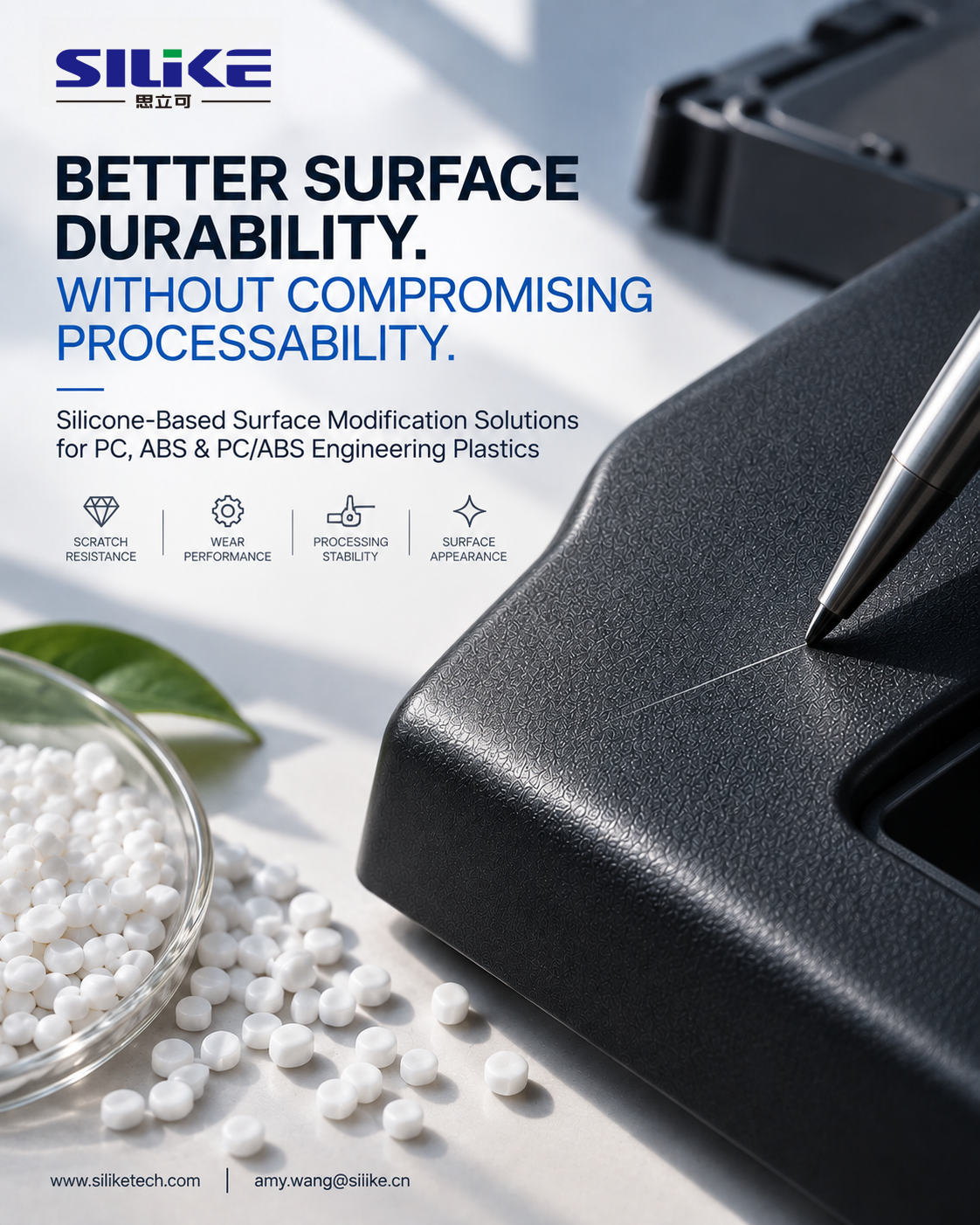
For ABS, PC/ABS and selected PC systems, products such as silicone masterbatch LYSI-405, LYSI-4051, LYSI-413, Copolysiloxane Additives and Modifiers SILIMER 5140, and functionally modified silicon wax SILIMER 5150 can be evaluated according to the resin formulation and application requirements.
These silicone based additives grades are intended to support the development of surfaces with lower friction and improved scratch or wear behavior while also considering processing and demolding performance.
The exact grade should be selected according to the polymer system rather than simply transferring the same product across different resin families.
ABS, PC and PC/ABS differ in polarity, morphology and processing temperature. Resin grade, blend composition, filler package, pigment system and downstream surface-treatment requirements should therefore all be considered during screening.
How to Run a Meaningful PC/ABS Anti-Scratch Trial
A useful trial begins with identifying the actual surface problem.
If the main complaint is scratch whitening, the evaluation should reproduce the production color and surface grain. If the issue is repeated rubbing or wear, a single-pass scratch test may not provide enough information.
The production resin system should be used wherever possible. This includes the actual polymer grade, pigment, fillers, stabilizers and other additives.
Testing only a natural-color laboratory plaque can give misleading results when the commercial part is black, high-gloss or heavily textured.
It is also preferable to evaluate several additive levels rather than only one dosage. This makes it possible to see whether additional additive continues to provide meaningful benefit or begins to affect other properties.
Once a suitable range has been identified, the formulation should be confirmed under representative molding conditions and then evaluated for the final downstream requirements.
This approach is more useful than simply asking whether an additive “passes” or “fails” a scratch test because it identifies the formulation window in which surface performance and processing remain balanced.
What Information Helps Select the Right Additive?
When discussing a PC, ABS or PC/ABS surface problem with an additive supplier, the most useful information includes the base resin and grade, PC/ABS blend ratio where applicable, filler system, pigment and color, surface texture, current lubricant package, molding conditions, scratch or wear test method, target performance and any painting, bonding or overmolding requirements.
Providing these details allows the additive recommendation to be based on the real application rather than only the polymer name.
Frequently Asked Questions
Does lower COF always mean better scratch resistance in PC/ABS?
No. Lower friction may reduce tangential force and therefore contribute to improved scratch behavior, but scratch performance also depends on hardness, toughness, texture, pigment, contact geometry and load.
The final formulation should still be evaluated using an appropriate scratch method.
Can the same silicone masterbatch be used in PC, ABS and PC/ABS?
Not automatically.
Related grades may be suitable for multiple engineering-plastic systems, but compatibility, dispersion and processing should be confirmed in the exact resin formulation.
Can silicone masterbatch improve processing as well as surface performance?
In compatible formulations, high-molecular-weight silicone modifiers can influence polymer-to-metal friction during molding as well as friction at the final surface.
The magnitude of each effect depends on the resin, dosage and processing conditions.
Will silicone additives affect painting or bonding?
They can influence surface characteristics and surface energy.
If painting, printing, adhesive bonding or overmolding is required, the final formulation should be tested under the intended production conditions.
Why does a black molded part show scratches more easily?
Dark surfaces make changes in reflected light more visible. Scratch deformation can therefore appear as a white or lighter-colored line even when the physical groove is relatively shallow.
Pigment formulation, gloss and surface texture all affect the visual result.
Conclusion
Improving scratch and wear resistance in PC, ABS and PC/ABS requires a balance among surface friction, polymer toughness, appearance and processability.
Lower friction can help reduce some forms of surface damage, but it is only one part of the mechanism.
For compatible engineering-plastic systems, high-molecular-weight silicone-based additives provide a practical formulation route for modifying surface behavior while supporting processing and demolding.
The most effective solution is therefore not simply the additive that gives the lowest friction value or the best laboratory scratch result. It is the formulation that provides the required surface appearance while maintaining molding stability, mechanical performance and downstream compatibility.
Looking for a Scratch Resistant Additive for PC, ABS or PC/ABS?
Share your resin system, filler package, color, surface texture, molding conditions, current surface problem, test method and downstream requirements with SILIKE. Our application team can help recommend a polymer-compatible silicone masterbatch and a focused evaluation approach.
Website: www.siliketech.com
Email: amy.wang@silike.cn
Mobile / WhatsApp: +86-15108280799
Post time: Sep-18-2026


