
1. PPWR 2026 PFAS Deadline: Preparing Food Packaging Film Extrusion with PFAS-Free Polymer Processing Aid Solutions
The packaging industry is experiencing a significant transition as sustainability requirements and regulatory expectations continue to evolve.
Under the European Packaging and Packaging Waste Regulation (PPWR), PFAS-related requirements for food contact packaging are becoming an important consideration for manufacturers supplying the European market.
From 12 August 2026, applicable food contact packaging placed on the EU market will need to meet the PFAS restriction requirements defined under PPWR Article 5(5).
The regulation specifies threshold limits including:
♦ Individual PFAS: 25 ppb
♦ Sum of PFAS: 250 ppb
♦ Total Fluorine: 50 ppm
For film extrusion manufacturers, this development encourages a closer evaluation of materials, additives, and processing technologies used throughout the production process.
2. The Role of Polymer Processing Aids in Film Extrusion
Polymer processing aids (PPAs) have traditionally been used in polyolefin extrusion to support processing efficiency and product quality.
In film production, PPAs may help address common extrusion challenges such as melt fracture phenomena, die build-up, processing stability, and surface appearance consistency.
As manufacturers evaluate alternatives to fluorinated processing aids, PFAS-free PPA technologies are receiving increasing attention as one potential pathway for future extrusion processes.
The transition is not simply about replacing one additive with another.
Instead, manufacturers need to consider: resin compatibility, processing conditions, film structure, and production requirements.
3. Selecting a PFAS-Free PPA: Key Considerations for Film Producers
Different extrusion processes require different approaches.
A suitable PFAS-free polymer processing aid should be evaluated based on product format, chemical technology, processing temperature, resin system, and final film requirements.
4. Product Format of PFAS-Free PPA : Pure Additive and Masterbatch Options
SILIKE SILIMER PFAS-free PPA solutions are available in different product formats to meet different processing requirements.
4.1 100% Pure PFAS free PPA / fluorine free Additive Solutions
Pure additive formats provide a higher concentration of active components.
They can be considered for applications requiring flexible dosage adjustment, customized formulation development, and precise control over additive concentration.
4.2 PFAS free / fluorine free Masterbatch Solutions
Masterbatch formats incorporate active processing aid components into polymer carrier systems. SILIMER PFAS-free PPA masterbatches are based on modified copolysiloxane functional technology and are available with different carrier resins, such as PE and PP, to meet various polymer processing requirements.
They are designed to improve handling efficiency, additive dispersion, and feeding consistency during production.
The choice between 100% PFAS-free PPA additives and PFAS-free PPA masterbatch formats depends on the manufacturer’s existing production setup, formulation requirements, and processing objectives.
5. Technology Options: Silicone-Containing and Silicone-Free Approaches
PFAS-free PPA technologies can be developed using different material approaches.
SILIKE SILIMER PFAS-free polymer processing additive technology platform includes both silicone-containing and silicone-free options to address different application considerations.
5.1 Silicone based PFAS-Free PPA
SILIMER Series products are PFAS-free polymer processing aids (PPAs) developed and manufactured by Chengdu Silike Technology Co., Ltd.
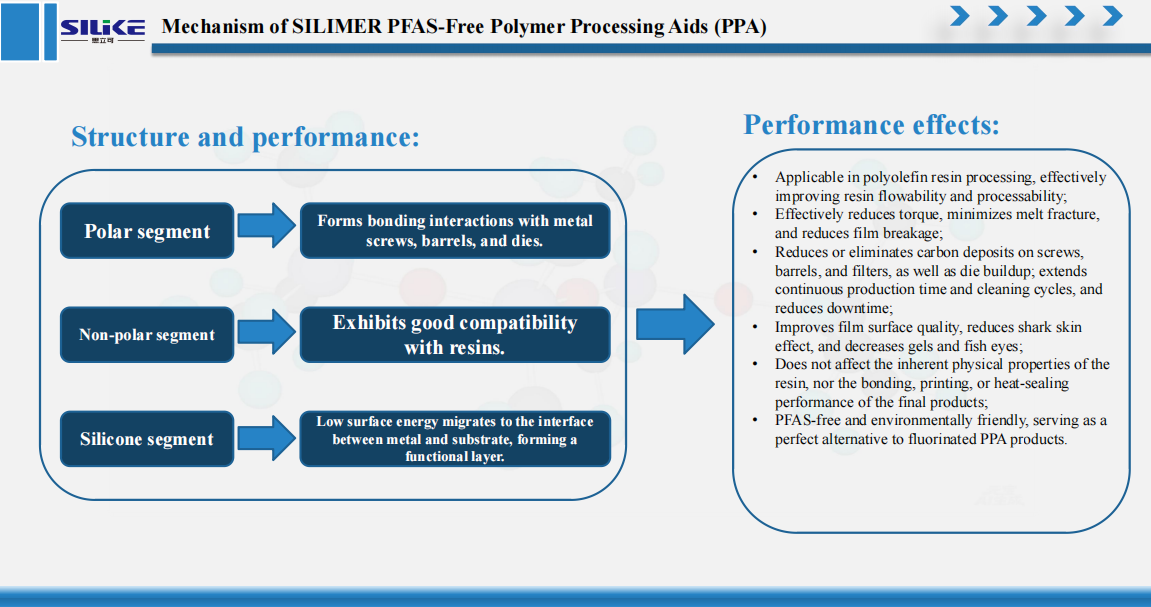
They are silicone-based fluorine-free polymer processing additives developed based on advanced copolymerized polysiloxane technology. Their molecular structure consists of polysiloxane segments, polar segments, and non-polar segments, enabling balanced processing performance and compatibility across various polymer systems.
SILIMER Series products are designed to provide processing advantages comparable to fluorinated PPAs in applications including films, cables, pipes, fibers & monofilaments, artificial grass, masterbatch production, petrochemicals, and polymer compounding.
At low addition levels, they can help reduce melt fracture, improve resin flow and processability, enhance lubrication efficiency, minimize die build-up during extrusion, and alleviate sharkskin effects. They may also help extend screw cleaning intervals, contributing to improved production efficiency, enhanced product quality, and more sustainable polymer processing.
5.2 Siloxane-Free PFAS-Free PPA
For applications where silicone-containing additives may not be suitable, PFAS- and silicone-free polymer processing aid SILIMER 9700 and its masterbatch form SILIMER 9701 provide an alternative approach for extrusion processing.
These technologies are developed to support manufacturers addressing specific material requirements, formulation preferences, and processing objectives.
6. Processing Temperature Considerations
Extrusion temperature is an important factor when selecting a polymer processing aid.
SILIKE SILIMER PFAS-free PPA solutions are developed for different processing temperature ranges.
6.1 Low Temperature Processing (<180℃)
Designed for lower-temperature extrusion conditions, such as certain blown film processes.
Potential benefits include supporting:
• Melt flow improvement
• Processing stability
• Film surface consistency
6.2 Medium Temperature Processing (180–200℃)
Suitable for a wide range of common film extrusion processes, including:
• PE blown film
• PP film extrusion
• mPE-based film applications
Designed to support balanced processing performance across different production conditions.
6.3 High Temperature Processing (>200℃)
Developed for higher-temperature extrusion processes, including:
• High-temperature blown film
• Cast film applications
Designed to support stable processing under more demanding extrusion conditions.
7. SILIKE SILIMER PFAS-Free PPA Solutions for Food Packaging Film Applications
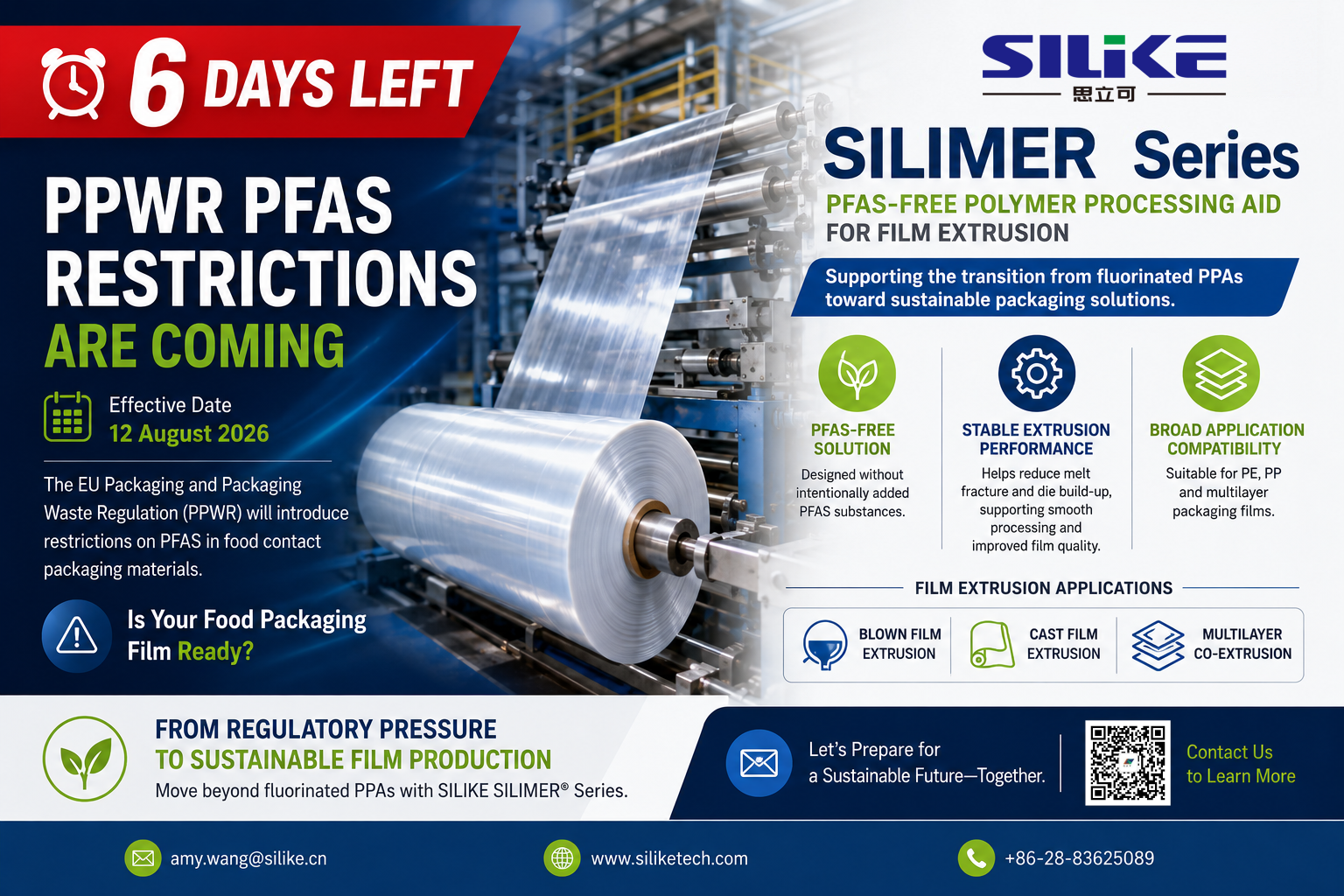
With experience in silicone chemistry and polymer processing, SILIKE has developed the SILIMER PFAS-free PPA technology platform to support manufacturers evaluating alternatives for film extrusion applications.
For food packaging film production, SILIMER solutions are designed to support:
PE Film Extrusion
Including blown film and high-performance PE film applications.
PP Film Extrusion
Supporting stable processing and consistent extrusion performance.
Multilayer Film Structures
Helping manufacturers evaluate processing solutions for complex film structures.
8. Preparing for the PPWR PFAS Transition
The transition toward PFAS-free packaging does not follow a universal replacement approach.
For food packaging film manufacturers, selecting an appropriate processing technology requires evaluation of:
• Regulatory considerations
• Processing performance
• Material compatibility
• Production requirements
The most suitable PFAS-free PPA approach depends on:
• Product format
• Chemical technology
• Processing temperature
• Film performance requirements
From pure additives to masterbatch solutions, from silicone-containing to silicone-free technologies, and from low-temperature to high-temperature extrusion processes, SILIKE SILIMER provides a flexible PFAS-free PPA technology portfolio for different food packaging film extrusion requirements.
As the packaging industry continues to evaluate alternatives to traditional fluorinated processing technologies, selecting the appropriate PFAS-free polymer processing aid will become an important consideration for maintaining reliable extrusion performance while addressing evolving regulatory expectations.
9. FAQ
9.1 What is the PPWR PFAS deadline for food packaging?
The PFAS restriction requirements under PPWR Article 5(5) will apply to applicable food contact packaging placed on the EU market from 12 August 2026.
9.2 Why are food packaging film manufacturers evaluating PFAS-free PPAs?
Increasing regulatory attention toward PFAS substances is encouraging manufacturers to evaluate alternative polymer processing technologies without fluorinated components.
9.3 Can PFAS-free PPAs replace traditional fluorinated PPAs?
The performance of PFAS-free PPAs depends on formulation design, resin system, extrusion conditions, and application requirements. Proper technology selection is required for each production process.
9.4 How should manufacturers select a PFAS-free PPA?
Selection should consider additive format, chemical technology, polymer compatibility, processing temperature, and final film requirements.
9.5 Is SILIMER PFAS-free PPA suitable for food packaging film extrusion?
SILIMER PFAS-free PPA solutions are developed for evaluation in various polyolefin extrusion applications, including PE blown film, PP film extrusion, and multilayer film structures. Final selection should be based on regulatory requirements, material systems, and processing conditions.
10. Explore PFAS-Free PPA Solutions for Your Film Extrusion Process
As PFAS regulations continue to influence packaging material development, selecting the appropriate polymer processing aid technology has become an important consideration for film manufacturers.
SILIKE provides PFAS-free PPA technologies, including silicone-containing and silicone-free solutions, as well as pure additive and masterbatch formats for different polyolefin extrusion applications.
Contact SILIKE to discuss your film extrusion requirements and evaluate a suitable PFAS-free polymer processing aid solution for your production process.
Phone: +86-28-83625089
Mobile / Whatsapp : + 86-15108280799
Email:amy.wang@silike.cn
Website:www.siliketech.com
Post time: Aug-06-2026


