
Replacing conventional fluoropolymer processing aids (PPAs) is becoming an important formulation decision for polyethylene (PE) film manufacturers. While PFAS-free alternatives can help address melt fracture, die build-up, and extrusion instability, successful replacement involves more than achieving a smoother film surface.
For printed and laminated PE films, printability, ink adhesion, lamination bond strength, and heat-sealing performance must also be considered.
A processing aid that performs well during extrusion may not necessarily meet every downstream converting requirement.
This is particularly important when evaluating silicone-based PFAS-free PPAs. Depending on the additive chemistry, concentration, film structure, and processing conditions, silicone-containing additives may influence surface interactions relevant to printing and adhesion.
For film manufacturers, the key question is not simply whether a PPA is PFAS-free, but whether the complete film formulation meets both extrusion and downstream performance requirements.
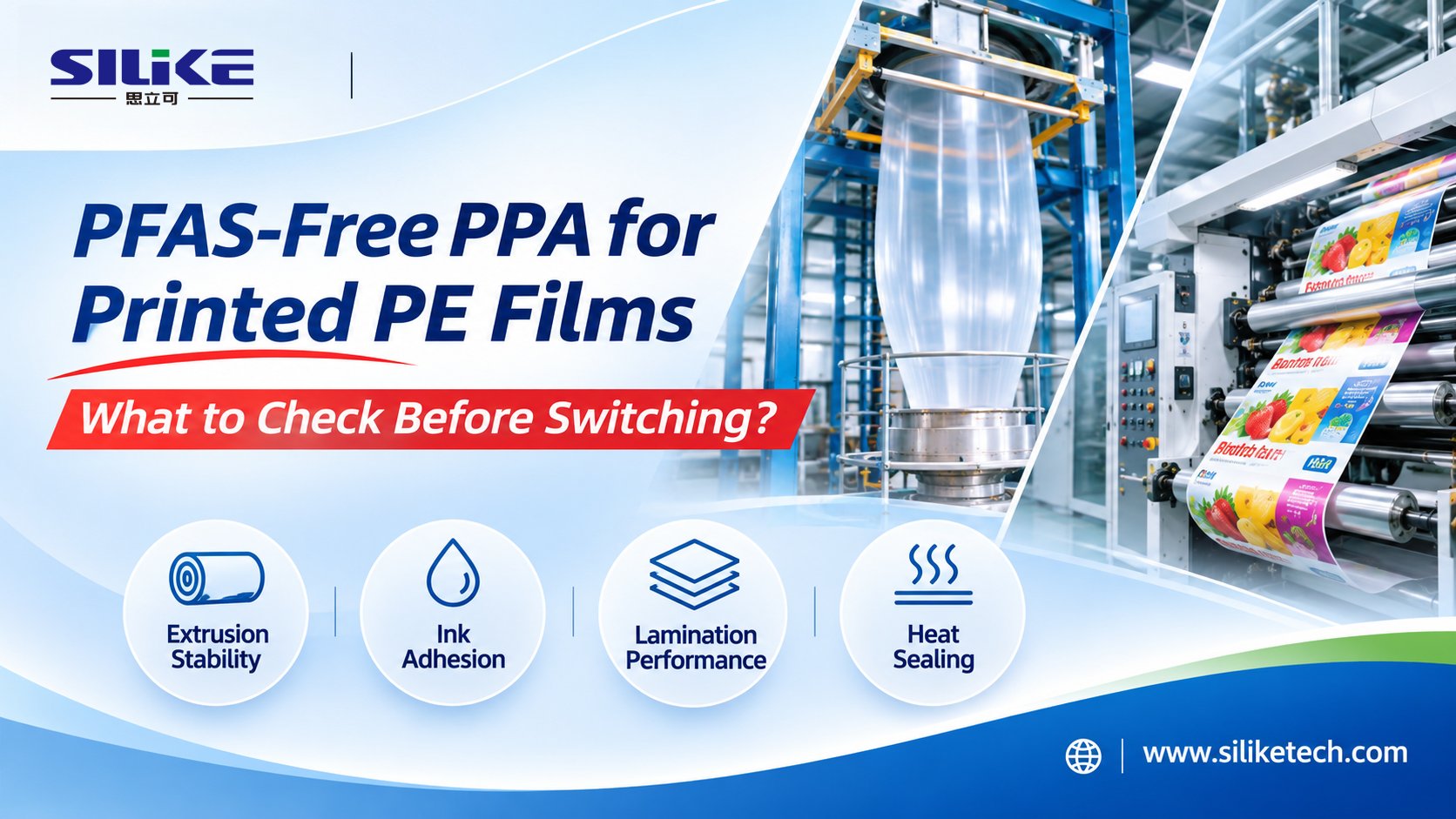
1. Why Is PFAS-Free PPA Selection More Than an Extrusion Decision?
Conventional fluoropolymer PPAs have been used in polyolefin extrusion to address processing challenges such as melt fracture and die-related deposits.
As manufacturers evaluate PFAS-free alternatives, the primary extrusion targets often include:
- Reducing melt fracture and sharkskin.
- Minimizing die build-up and die drool.
- Maintaining stable extrusion pressure and output.
- Improving film surface consistency.
- Supporting longer, more stable production runs.
However, printed and laminated packaging films must also meet requirements beyond the extrusion line.
These may include stable surface treatment, acceptable ink adhesion, laminate bond strength, and appropriate heat-sealing behavior.
For food-contact packaging intended for the European Union, Regulation (EU) 2025/40 also introduces PFAS concentration limits applicable from August 12, 2026. Compliance must be assessed against the applicable requirements for the final packaging, rather than inferred from the processing aid alone.
For PE film producers, extrusion performance and converting performance should be evaluated as separate but connected requirements.
2. Can Silicone-Based PFAS-Free PPA Affect PE Film Printability?
Yes. Silicone-based additives can influence printing-related surface properties under certain conditions.
However, the effect is formulation-dependent and should not be generalized to every silicone-based PPA.
Surface Energy and Ink Wetting
Polyethylene has a relatively low-energy surface, which can make ink wetting and adhesion challenging.
Corona treatment is commonly used to increase surface energy and improve the suitability of PE films for printing and lamination.
Silicone-containing additives may influence the chemical composition or interfacial characteristics of a film surface. Depending on their structure and distribution, these changes can affect the interaction between the treated film and printing inks.
Possible concerns include:
• Reduced or inconsistent ink wetting.
• Changes in ink adhesion.
• Variations in surface-treatment response.
• Differences in printing performance after storage.
These effects are not exclusive to silicone-based processing aids. Slip additives, low-molecular-weight components, contamination, and other formulation ingredients may also influence printability.
Does a Higher Corona Treatment Level Guarantee Better Ink Adhesion?
No.
Surface energy is an important screening indicator, but it does not describe every factor controlling adhesion.
Ink chemistry, substrate surface composition, treatment conditions, surface contamination, and storage history can also affect printing performance.
A film may meet its specified surface-energy requirement while still showing inadequate ink adhesion under the intended printing conditions.
Therefore, dyne-level measurements should be supported by actual ink-adhesion testing.
Can Printing Problems Appear After Film Storage?
Yes.
Some additive systems can change the surface characteristics of PE films over time.
Film manufacturers should consider the interval between extrusion, corona treatment, storage, and printing.
When qualifying a new PPA, evaluating only freshly produced film may not reflect the conditions encountered during downstream converting.
The most useful comparison measures surface treatment and adhesion performance at the actual time the film will be printed.
3. How to Evaluate Printability When Switching to PFAS-Free PPA
A controlled trial should compare the existing formulation with the proposed PFAS-free PPA under representative production conditions.
The evaluation should distinguish changes caused by the PPA from those caused by other formulation or processing variables.
| Evaluation Area | Recommended Checks | Why It Matters |
|---|---|---|
| Extrusion performance | Melt fracture, die build-up, die pressure, output stability | Confirms whether the new PPA addresses the processing problem |
| Film surface | Surface appearance, relevant surface properties, visible deposits | Identifies potential changes following the formulation switch |
| Corona treatment | Treatment conditions and surface energy | Checks whether the film reaches the required treatment level |
| Printability | Ink wetting, print uniformity, ink adhesion | Confirms compatibility with the intended printing process |
| Storage stability | Surface energy and ink adhesion after representative storage | Evaluates performance at the actual converting interval |
| Lamination | Bond strength and relevant failure modes | Checks whether adhesive bonding meets the application specification |
| Heat sealing | Seal strength and other customer-required sealing properties | Confirms performance of the finished packaging structure |
Step 1: Establish the Existing Production Baseline
Record the current resin formulation, layer structure, processing aid, additive dosage, extrusion conditions, and downstream performance.
Retain representative film samples for comparison.
Step 2: Select the PPA and Optimize the Dosage
A PFAS-free PPA should not automatically be introduced at the same dosage as the existing fluoropolymer processing aid.
Select a suitable candidate based on the PE formulation, processing requirements, and downstream specifications.
Where appropriate, evaluate more than one dosage level.
Step 3: Identify the Printing and Sealing Layers
In multilayer PE films, additives may be introduced into different layers according to their intended function.
When planning a trial, identify which surfaces are intended for printing, lamination, and heat sealing.
Evaluate whether additive placement and total formulation design influence the required surface properties.
Layer placement should not be assumed to eliminate downstream interactions without testing.
Step 4: Confirm Converting Performance
Use the customer’s intended printing inks, treatment conditions, adhesives, and heat-sealing parameters wherever possible.
Compare the new formulation with the existing production reference.
Where relevant, test both freshly produced and appropriately aged samples.
The final selection should be based on reproducible extrusion and converting performance, not melt-fracture reduction alone.
4. Silicone-Based vs. Siloxane-Free PFAS-Free PPA: Which Should Film Manufacturers Evaluate?
PFAS-free does not necessarily mean silicone-free.
These terms describe different chemical requirements, and selecting between them depends on the customer’s formulation, performance objectives, and downstream processing needs.
Silicone-Based PFAS-Free PPA
SILIKE’s SILIMER silicone-based PFAS-free processing aids are developed using modified polysiloxane technology.
For suitable PE extrusion applications, they are designed to help reduce melt fracture and die build-up while supporting extrusion stability and surface quality.
They can be considered where silicone-containing processing aids are permitted and their downstream suitability can be verified.
However, successful extrusion performance does not automatically establish compatibility with printing inks or lamination adhesives.
PFAS-Free and Siloxane-Free PPA
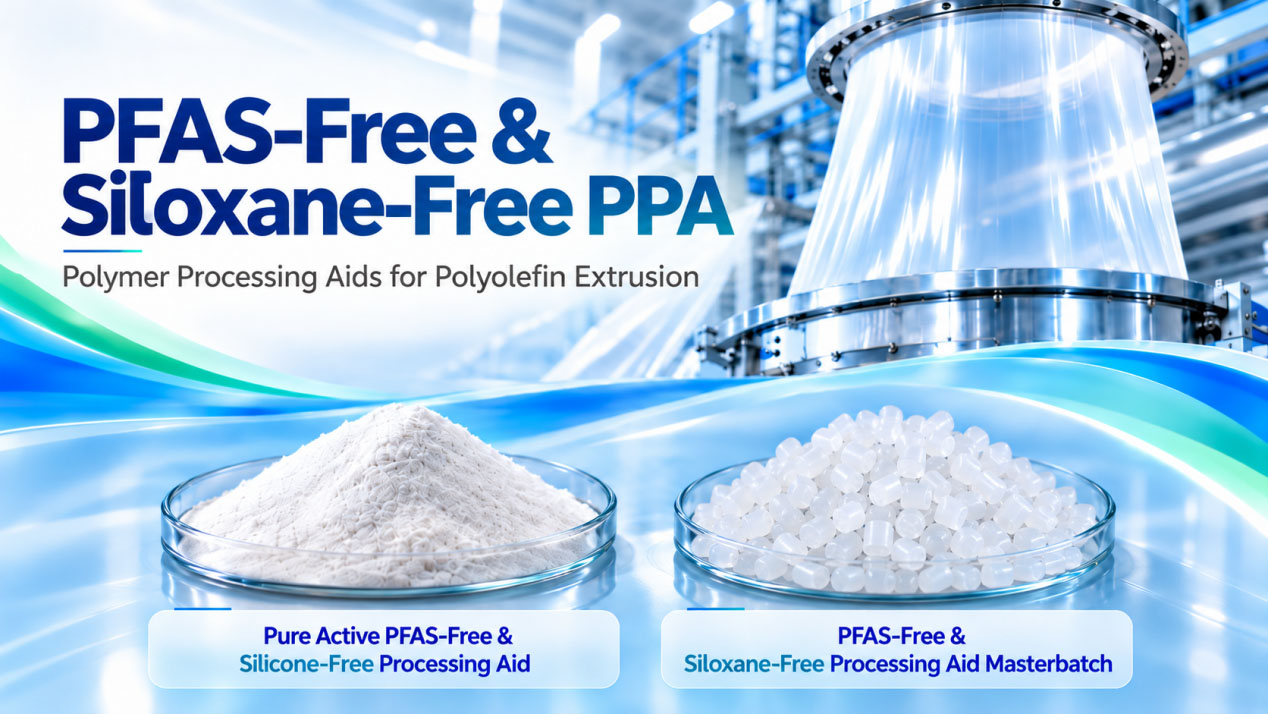
For formulations requiring the exclusion of both PFAS and siloxane chemistry, SILIKE also offers alternative processing-aid technologies.
These include:
• SILIMER 9700: PFAS-free and siloxane-free processing aid in active form.
• SILIMER 9701: PFAS-free and siloxane-free processing aid in masterbatch form.
These products provide additional formulation options when silicone-containing additives are restricted or when an alternative chemistry is required for evaluation.
However, siloxane-free chemistry does not automatically guarantee superior printability or equivalent extrusion performance.
A silicone-based and a siloxane-free PPA may differ in melt-fracture control, die build-up behavior, required dosage, and compatibility with the overall formulation.
The appropriate technology should be selected through application-specific comparison.
Technology Selection Considerations
| Customer Requirement | Suggested Evaluation Direction |
|---|---|
| PFAS-free extrusion, silicone permitted | Evaluate a suitable silicone-based SILIMER PPA and verify downstream performance |
| PFAS-free and siloxane-free chemistry required | Evaluate SILIMER 9700 or 9701, subject to polymer compatibility |
| Melt fracture or die build-up is the main problem | Prioritize extrusion performance during initial screening |
| Printed or laminated PE film | Include surface-treatment, ink-adhesion, and lamination tests |
| Multilayer film with separate functional surfaces | Evaluate additive allocation and relevant layer-specific performance |
| Existing formulation shows printability problems after an additive change | Compare additive chemistry, dosage, surface treatment, and storage conditions |
The preferred PPA is not necessarily the one that produces the lowest die pressure or the smoothest film. It is the formulation that meets the relevant extrusion and downstream specifications together.
5. SILIKE PFAS-Free PPA Solutions for PE Film Extrusion
SILIKE develops silicone-based and siloxane-free PFAS-free processing aids for selected polymer extrusion applications.
For PE film manufacturers, product selection starts with the resin system, film structure, operating conditions, and required downstream performance.
SILIMER 9301 — PFAS-Free PPA Masterbatch for PE Blown Film
SILIMER 9301 is a PE-carried PFAS-free processing aid masterbatch developed for polyethylene blown-film extrusion.
It is designed to help improve melt-flow behavior, reduce melt fracture and die build-up, and support stable extrusion.
For printed or laminated film applications, the recommended evaluation should also include surface-treatment retention, ink adhesion, and other downstream requirements.
Alternative PFAS-Free Processing Aid Technologies
Where formulation requirements, resin combinations, or processing conditions differ, additional SILIMER grades, including SILIMER 9401A, may be considered following technical review.
For applications requiring siloxane-free chemistry, SILIMER 9700 and 9701 provide an alternative technology route.
The selection should consider:
• PE resin grades and blend ratios.
• Monolayer or multilayer film structure.
• Existing PPA chemistry and dosage.
• Extrusion equipment and operating conditions.
• Printing, lamination, and sealing requirements.
• Customer-specific chemical restrictions.
For further background, see SILIKE’s PFAS-Free PPA Selection Guide and Silicone-Based vs. Silicone-Free Processing Aid Guide.
Frequently Asked Questions
Does silicone-based PFAS-free PPA always reduce PE film printability?
No. Its impact depends on additive chemistry, concentration, film formulation, surface treatment, and printing conditions. Potential changes in ink wetting or adhesion should be verified using the intended film and ink system.
Can corona treatment eliminate every printability problem?
No. Corona treatment can improve surface wettability, but adequate surface energy alone does not guarantee ink adhesion. Additive-related surface changes, ink chemistry, contamination, and storage conditions may also affect the result.
Will a siloxane-free PPA provide better printing performance?
Not necessarily. Siloxane-free processing aids eliminate one chemistry consideration, but their effects on extrusion and downstream film performance still require testing.
Can PFAS-free PPA affect lamination or heat sealing?
Formulation changes can influence downstream performance, depending on the film structure, additive system, and converting conditions. Relevant bond-strength and seal-strength tests should be included when these properties are critical.
How should a film manufacturer select a PFAS-free PPA for printed packaging?
Start with the extrusion requirements and identify the intended printing, lamination, and sealing specifications. Compare suitable PPA chemistries under controlled conditions and verify performance at the actual converting stage.
Selecting a PFAS-Free PPA for Printed or Laminated PE Films?
Replacing fluoropolymer processing aids should improve the extrusion process without overlooking the requirements of the finished film.
Whether you are addressing melt fracture, die build-up, inconsistent extrusion, or printability concerns after an additive change, SILIKE can help identify suitable silicone-based or siloxane-free PPA options for evaluation.
Tell us your PE film structure, current processing problem, and printing or lamination requirements. Our technical team can help recommend suitable PPA candidates and discuss a comparative trial.
Contact SILIKE for technical information, formulation guidance, or evaluation samples.
Email: amy.wang@silike.cn
Website: https://www.siliketech.com/
Post time: Nov-04-2026


