
Automotive interior components are expected to maintain a consistent appearance through molding, assembly, transportation, daily contact, cleaning, and years of service.
For PP and TPO compounds, visible scratching can therefore become a significant material-development issue.
Door panels, center consoles, pillars, seat-side trim, and other components may come into contact with keys, luggage, shoes, tools and neighboring parts. On black or dark textured surfaces, even relatively shallow damage can become visible as a light-colored mark.
For compounders and automotive component manufacturers, the objective is not simply to make the surface more slippery.
The real challenge is to reduce visible scratch whitening and maintain appearance after aging without compromising molding behavior, mechanical properties or other automotive requirements.
Dedicated silicone-based anti-scratch masterbatches for PP/TPO provide one formulation approach to this challenge.
Why Automotive PP/TPO Shows Visible Scratch Whitening
PP and TPO offer a useful combination of low density, impact performance, processing flexibility and cost efficiency, which is why they are widely used in automotive interiors.
However, the appearance of these materials can change when a harder object deforms the surface.
During scratching, material can be displaced and the microstructure at the surface can change. This affects how light is reflected and scattered.
On a dark interior component, the damaged area may therefore appear lighter than the surrounding surface.
This visible whitening can be more important to the customer than the actual depth of the scratch.
For this reason, automotive anti-scratch development often focuses on appearance change as well as physical surface damage.
Why Color and Grain Matter So Much
A scratch result obtained from a smooth natural-color plaque does not necessarily predict the appearance of a black grained door panel.
Automotive interior surfaces are deliberately textured to control gloss and create the desired visual and tactile appearance.
When a stylus passes over the grain, local contact pressure changes according to the geometry of the surface. The direction of the scratch relative to the texture can also influence the visible result.
Color adds another variable.
Black, charcoal and dark gray surfaces can show scratch whitening particularly clearly because the contrast between the damaged and undamaged area is greater.
This is why meaningful anti-scratch evaluation should use production-representative color and texture wherever possible.
What Does ΔL Tell Us?
ΔL is commonly used to describe the change in lightness after scratching.
For a dark automotive surface, a greater positive change in lightness can correspond to more visible whitening.
A lower ΔL therefore generally indicates a smaller visible change under the specified test conditions.
However, ΔL is not a universal material constant.
It can change with the PP/TPO formulation, filler content, pigment system, surface grain, additive dosage, scratch load, stylus geometry, conditioning and aging history.
This means two supplier claims cannot be compared simply because both report a ΔL value.
The formulation and test conditions must be comparable.
A result such as ΔL below 1.5 is meaningful only when its test method and material conditions are clearly defined.
Why Friction Is Important in Automotive Scratch Performance
When a hard object moves across a polymer surface, both normal and tangential forces influence deformation.
Higher friction can increase the tangential force acting on the surface and can contribute to greater material displacement or whitening.
Reducing friction can therefore help improve scratch appearance in some PP/TPO formulations.
But friction is only part of the overall behavior.
Polymer stiffness, elastomer content, filler loading, pigment, grain, surface hardness, and aging also contribute.
A lower-friction material should therefore still be validated by the required automotive scratch method rather than judged by COF alone.
The Role of Fillers in PP/TPO Scratch Behavior
Talc and other mineral fillers are widely used in automotive PP compounds to increase stiffness and dimensional stability.
At the same time, filler size, distribution, orientation, and polymer-filler interaction can influence surface behavior.
A formulation with poor dispersion or an unsuitable balance between matrix and filler may show more visible damage even when its bulk mechanical properties are acceptable.
This is why the anti-scratch additive should be evaluated in the complete production compound rather than in an unfilled PP reference resin.
Common Ways to Improve Automotive Scratch Resistance
Changing the base polymer or elastomer content can alter surface deformation, but it can also affect stiffness, shrinkage and impact performance.
Changing filler type or loading may provide another route, although this again affects the broader compound balance.
Surface grain design can influence scratch visibility, but redesigning the mold texture is not always practical once a part has entered development.
Painting or coating can provide strong surface protection but adds processing steps and cost.
Traditional lubricants can lower friction, but long-term migration and changes in surface characteristics may need to be considered.
For molded-in-color PP/TPO, a dedicated high-molecular-weight silicone-based anti-scratch masterbatch therefore provides another route: modifying surface friction from within the formulation while maintaining conventional compounding and molding processes.
Why a PP/TPO-Specific Masterbatch Matters
A silicone masterbatch developed for an engineering plastic such as PC/ABS should not automatically be transferred into PP or TPO.
Carrier compatibility influences how the additive disperses and how the silicone phase behaves during compounding, molding and at the final surface.
For PP/TPO, a dedicated compatible carrier helps introduce the active silicone component into the resin system more uniformly.
This is important not only for initial scratch performance but also for processing stability and long-term surface consistency.
SILIKE Long-Lasting Anti-Scratch Solutions for PPTPO Automotive Interiors
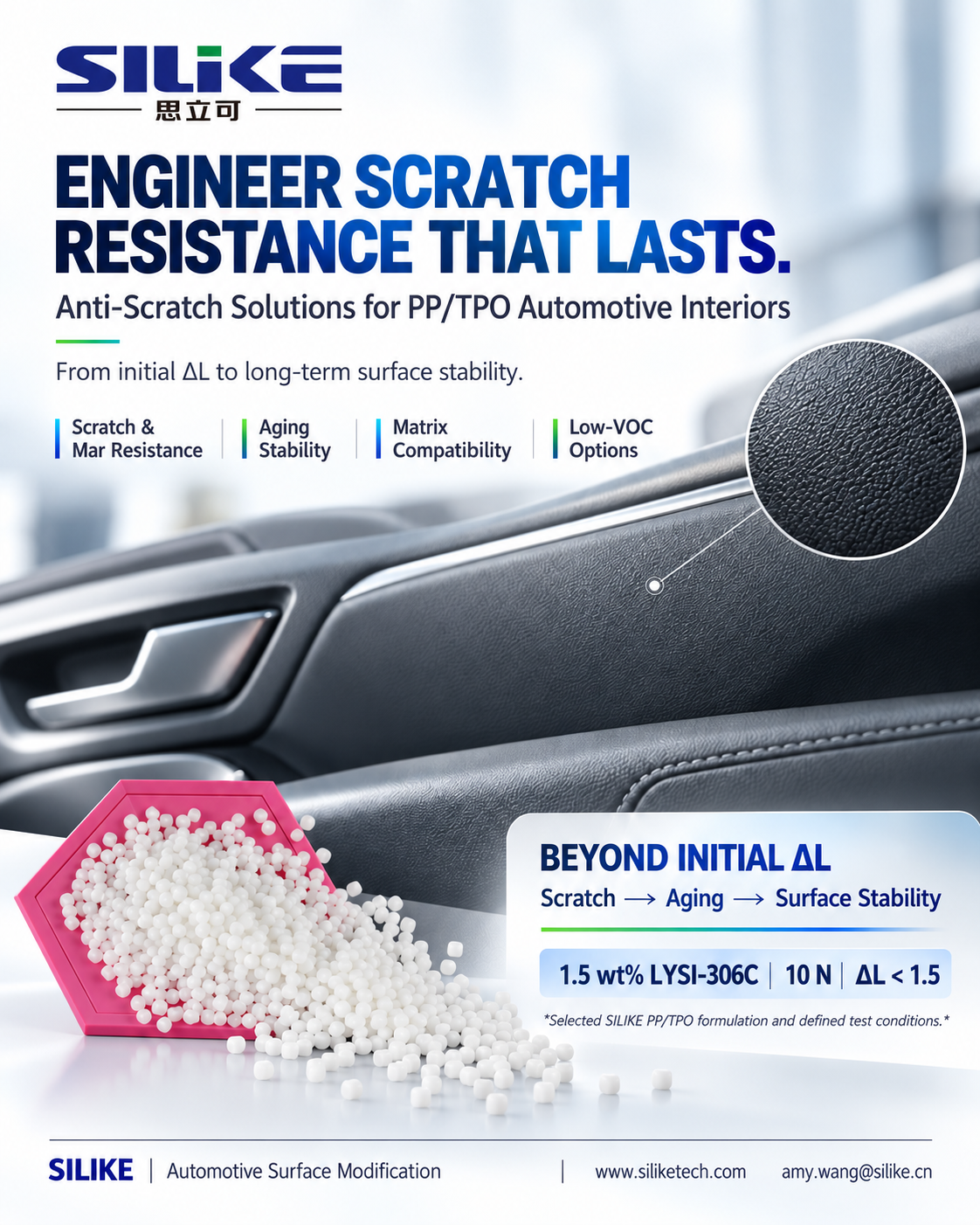
SILIKE develops dedicated silicone-based anti-scratch masterbatches for automotive PP and TPO compounds.
The Anti-scratch Masterbatch series is designed for applications where scratch appearance, surface friction, and long-term appearance retention are important.
In selected PP/TPO formulations, these materials have been evaluated for their ability to reduce visible scratch whitening and maintain low color change under automotive scratch-test conditions.
SILIKE internal evaluations have achieved ΔL below 1.5 in selected formulations, including testing based on recognized automotive methods such as PV3952 and GMW14688.
These results should not be interpreted as a universal specification for every PP/TPO compound.
The final value depends on the resin, filler, pigment, grain, dosage, test load, and conditioning.
For this reason, the most useful way to apply internal test data is as a formulation reference before confirming the customer’s actual production compound.
Why Long-Term Aging Matters
Automotive interiors operate under conditions very different from those experienced by a freshly molded laboratory plaque.
Cabin temperatures can become high, parts may experience repeated UV exposure, and surfaces may be cleaned many times over their service life.
An anti-scratch system therefore needs to be evaluated not only immediately after molding but also after the relevant aging conditions.
This is particularly important when comparing high-molecular-weight silicone systems with lower-molecular-weight lubricants.
If a surface-active component migrates significantly over time, friction, gloss, or surface appearance may change.
A high-molecular-weight silicone masterbatch provides a more stable formulation route, but aged performance should still be validated in the final PP/TPO formulation.
Selected SILIKE PP/TPO anti-scratch systems have maintained effective scratch performance after extended aging and weathering evaluation under internal test conditions.
Typical Automotive Interior Applications
Scratch-resistant PP/TPO compounds may be required in a range of interior parts.
Door panels experience contact from passengers, clothing, bags and shoes. Center consoles may be repeatedly contacted by keys, phones and personal items. Pillar trim can be damaged during assembly or use, while seat-side components experience continuous rubbing from clothing.
In all these cases, the same principle applies: the final production color and grain matter.
A compound that performs well on a smooth plaque should still be validated on a molded surface representative of the commercial component.
How to Design a Meaningful Anti-Scratch Trial
The first requirement is to define the actual automotive specification.
Before comparing additives, the development team should identify the test method, stylus or contact geometry, scratch load, visual or ΔL requirement, conditioning procedure and aging requirement.
The trial should then use the production formulation as closely as possible.
The actual PP grade, elastomer, talc or mineral filler, pigment, stabilizers and other lubricants can all influence the result.
Several additive levels should normally be evaluated because performance does not always improve proportionally with dosage.
The optimum formulation is the level that achieves the required scratch appearance while maintaining processing, mechanical properties and cost targets.
Processing performance should be monitored during compounding and molding, while scratch appearance should be measured before and after relevant aging.
This is particularly important for automotive materials because the best initial result is not necessarily the most stable result over time.
Common Evaluation Errors
One of the most common mistakes is comparing ΔL values generated under different conditions.
A low value from one formulation cannot be directly compared with another unless the polymer, filler, color, texture and test method are equivalent.
Another common mistake is testing only smooth plaques. A production grain can significantly change scratch behavior.
Testing only immediately after molding is also insufficient for applications with demanding heat-aging or weathering requirements.
Finally, additive selection should not be based only on silicone concentration. Molecular structure, carrier compatibility, dispersion, and interaction with the complete formulation all influence final performance.
Frequently Asked Questions
What is a good ΔL value for automotive PP/TPO?
There is no single universal target.
Acceptance depends on the OEM or Tier 1 specification, test method, color, grain, and application.
The target should therefore be defined by the relevant customer requirement.
Can silicone masterbatch reduce scratch whitening?
A PP/TPO-compatible silicone anti-scratch masterbatch can reduce surface friction and may reduce visible scratch whitening under suitable formulation and test conditions.
The production compound should always be tested directly.
Does more anti-scratch masterbatch always give a lower ΔL?
Not necessarily.
Performance can plateau after a certain dosage, while excessive additive may influence other properties.
This is why a dosage screening trial is preferable to selecting one high concentration.
Does initial scratch performance predict long-term automotive performance?
Not completely.
The compound should be retested after the required aging, heat, weathering or chemical exposure because surface behavior can change over time.
Why are black automotive parts particularly difficult?
Scratch-induced surface deformation scatters light differently from the surrounding black surface, making whitening more visible.
Pigment, texture, filler, and additive package all influence this effect.
Can a PC/ABS anti-scratch masterbatch also be used in PP/TPO?
It should not be assumed.
The two polymer families have different compatibility requirements, so dedicated grades should be selected and validated for each system.
Conclusion
Improving scratch resistance in automotive PP/TPO is not simply about reducing friction.
The final appearance depends on the interaction among polymer formulation, elastomer, filler, pigment, grain, contact conditions and aging.
A dedicated high-molecular-weight silicone-based anti-scratch masterbatch provides a practical route for modifying surface friction and reducing visible scratch whitening in compatible PP/TPO compounds.
However, the most meaningful measure of success is not the lowest initial ΔL obtained on a laboratory plaque.
It is the ability of the production compound to maintain acceptable appearance under the required automotive test conditions and after relevant aging.
Looking for an Anti-Scratch Solution for Automotive PP/TPO?
Share your PP or TPO formulation, filler loading, color, surface grain, current additive package, scratch-test method, target ΔL, aging, and VOC requirements with SILIKE.
Our application team can help recommend a suitable automotive PP anti-scratch additive grade and develop a focused validation approach for your automotive compound.
Website: www.siliketech.com
Email: amy.wang@silike.cn
Mobile / WhatsApp: +86-15108280799
Post time: Sep-24-2026


