
High torque during compounding. Rising die pressure during cable extrusion. Rough jacket surfaces that return after the die has been cleaned.
For manufacturers working with highly filled LSZH/HFFR cable compounds, these problems can limit saleable output even when the formulation meets its intended flame-performance requirements.
The challenge is to improve processing while maintaining the mechanical, electrical and fire-performance characteristics required for the finished cable.
A compatible silicone masterbatch may help by modifying friction within the compound and at the melt–metal interface. Its suitability depends on the polymer blend, mineral filler, existing additive package and processing conditions—not simply on the presence of silicone.
This guide explains how to identify the processing bottleneck, select a compatible silicone masterbatch, and evaluate its impact on processing load, production stability, and saleable output.
Why Are Highly Filled LSZH/HFFR Cable Compounds Difficult to Process?
Low-smoke zero-halogen and halogen-free flame-retardant cable compounds often contain substantial quantities of aluminum trihydroxide (ATH) or magnesium hydroxide (MDH). These minerals contribute to fire performance while changing how the polymer blend mixes and flows.
High filler loading can increase resistance to deformation and make wetting, dispersion, and surface control more demanding. The resulting processing window also depends on polymer viscosity, filler particle size and treatment, moisture, coupling agents, and the lubricant package.
This creates a practical trade-off. Manufacturers need sufficient mixing to distribute the mineral phase, but excessive load or temperature can limit production. They also need effective lubrication without disrupting conveying, surface integrity or subsequent operations.
Increasing temperature or adding more lubricant may help under certain conditions, but neither approach addresses every cause of poor processing.
Identify the Production Constraint Before Selecting an Additive
A useful additive trial starts with a clearly defined production problem.
For a compounder, the priority may be controlling torque while maintaining dispersion and pellet consistency. For a cable manufacturer, it may be reducing die-cleaning interruptions or maintaining an acceptable jacket surface at the required line speed.
| Production constraint | What to examine first | Evaluation objective |
|---|---|---|
| High compounding torque | Feeding, filler wetting, screw configuration and actual melt temperature | Manage processing load while maintaining compound quality |
| High or unstable die pressure | Screens, die restriction, temperature and feed consistency | Stable extrusion at the required output |
| Rough or streaked jackets | Dispersion, die condition, deposits and melt-flow stability | Consistent surface quality and dimensions |
| Frequent die cleaning | Deposit source, thermal history and additive interactions | Longer operation before a defined cleaning threshold |
| Restricted line speed | Extruder load, cooling, surface defects and downstream capacity | Higher saleable output within quality limits |
Separate compounding results from cable-extrusion results. A reduction in mixing torque can be useful, but it does not by itself establish a higher cable line speed.
How Does Silicone Masterbatch Improve Processing and Surface Performance?
Silicone masterbatch combines a silicone functional component with a polymer carrier. The carrier provides a solid delivery format that can simplify dosing and incorporation into compatible thermoplastic compounds.
The silicone component can influence both processing lubrication and the surface behavior of the finished material. These functions should be evaluated separately.
Manage Processing Load
In a suitable formulation, silicone lubrication may reduce resistance to flow and change torque or pressure at comparable output.
The desired result is a workable processing window with adequate mixing and consistent material quality. Lower torque alone does not establish improved filler dispersion; dispersion must be assessed using an appropriate method.
Support More Stable Extrusion
Where melt–metal interactions contribute to deposits or surface instability, a suitable silicone additive may help maintain cleaner flow surfaces and more consistent extrusion.
The commercial value depends on sustained performance. Evaluate deposit development and cleaning intervals over a representative run rather than relying only on startup appearance.
Modify Cable-Jacket Surface Behavior
Silicone additives can also be evaluated for surface smoothness, friction, abrasion and scratch behavior.
These properties are related but not interchangeable. A lower coefficient of friction does not automatically demonstrate better abrasion resistance, and a smoother jacket does not establish acceptable marking adhesion or bonding.
The relevant target should follow the cable’s actual handling and end-use requirements.
SILIKE silicone masterbatch Application Evaluation: Processing Response in a Highly Filled LSZH Compound
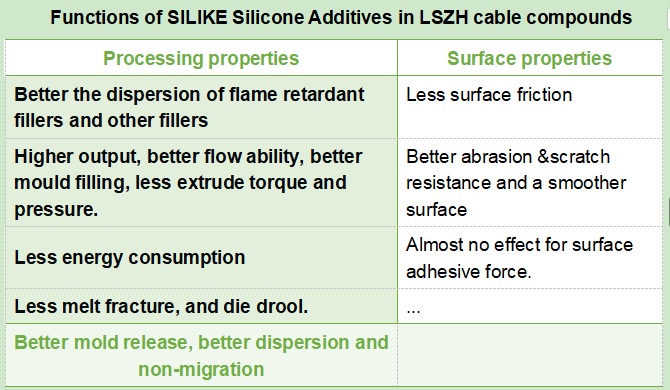
SILIKE’s silicone masterbatch is a kind of functional processing additive with various thermoplastics as carriers and polysiloxane as the functional parts. On the one hand, silicone-based masterbatch can improve the flowability of thermoplastic systems in the molten state, improve the dispersion of fillers, reduce the energy consumption of extrusion and injection molding, and improve production efficiency; On the other hand, this Silicone-based processing aid can also improve the surface smoothness of the final plastic products, reduce the surface friction coefficient, and improve the wear and scratch resistance. In addition, as a processing aid for the thermoplastic industry, silicone masterbatch can achieve an obvious modification effect with a small amount (< 5%), without too much consideration of its reaction with the matrix material.
SILIKE’s internal evaluation program includes a model LSZH formulation containing Silicone masterbatch LYSI-401, comparative flow measurements involving silicone masterbatch LYSI-502C, and a simulation of material accumulation at a cable extrusion die.
These evaluations address different questions: how a formulation responds to an additive, how candidate products compare in lubrication-related measurements, and how additive selection affects accumulation under simulated conditions.
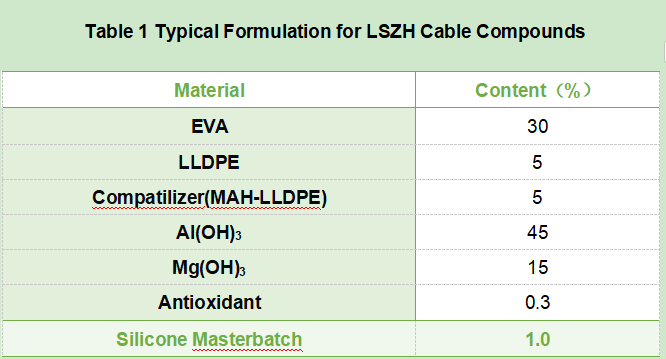
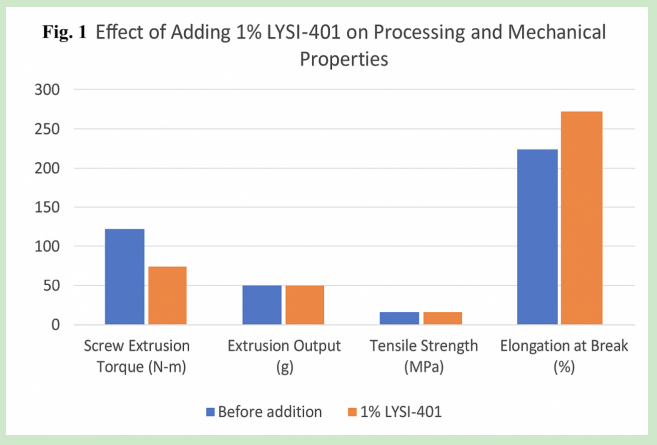
Fig.2 , Fig.3, and Figure 4 show the torque rheometer test of siloxane High Content Silicone masterbatch LYSI-502C added to the common low smoke halogen-free formula and the comparison with the torque, pressure, and shear viscosity of foreign competitive products. It can be seen that LYSI-502C has excellent lubrication performance.
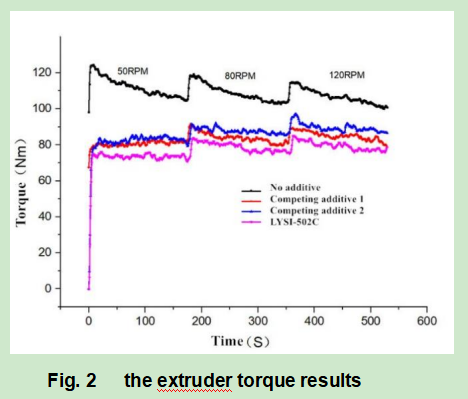

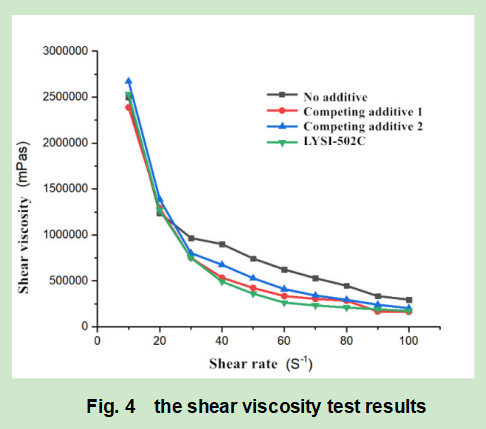
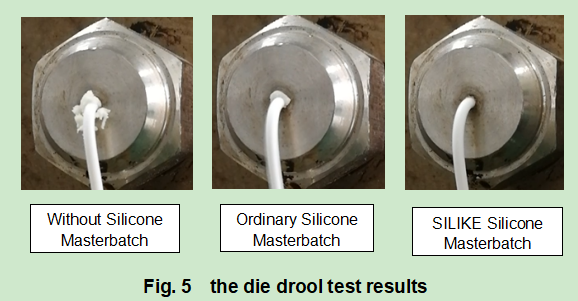
Figure 5 provides a valuable simulation of material accumulation within a cable extrusion die following the addition of the silicone masterbatch. The results reveal that the inclusion of a standard silicone masterbatch significantly reduces die buildup. Furthermore, SILIKE’s high molecular weight silicone masterbatch showcases an even more pronounced effect in minimizing die buildup, indicating its potential for enhanced processing efficiency.
Data note: These are selected findings from SILIKE’s internal evaluations. Results apply to the tested formulations, additive levels, equipment and conditions and may vary in other systems. Laboratory flow measurements and simulated accumulation results do not independently establish production-line energy savings, increased throughput or finished-cable compliance. Contact SILIKE for complete test information and application-specific guidance.
Why Molecular Design and Compatibility Matter
Silicone content alone does not determine how an additive will perform.
The molecular structure of the silicone, its molecular weight, the carrier and the surrounding formulation all influence its distribution and lubrication behavior.
An unsuitable product or excessive addition can upset the balance between internal lubrication, conveying and surface performance. Depending on the system, this may contribute to screw slippage, inconsistent dispersion, surface defects or difficulties with adhesion.
Functionally modified silicone technologies provide another formulation option. Their modified groups are intended to adjust interactions with the surrounding polymer or filler system, with the aim of balancing lubrication and compatibility.
The effect is chemistry- and application-specific. It should not be described as automatic chemical bonding to the matrix or a guarantee against screw slippage.
For LSZH/HFFR applications, the useful question is whether a particular molecular design provides a more stable processing response in the actual compound.
Selecting Among Silicone masterbatch LYSI-401, LYSI-502C and SC930
Product selection should connect the formulation with the production objective.
| Product | Product basis | Main selection consideration |
|---|---|---|
| LYSI-401 | Ultra-high-molecular-weight siloxane in an LDPE carrier | Compatibility with PE-containing systems and the required processing or surface response |
| LYSI-502C | Ultra-high-molecular-weight siloxane in an EVA carrier | Suitability for EVA-containing mineral-filled formulations |
| SC930 | Group-modified ultra-high-molecular-weight siloxane processing aid for LSZH/HFFR applications | Extrusion stability, die-build-up behavior and jacket surface quality |
The different carriers of LYSI-401 and LYSI-502C are relevant to formulation selection; they do not imply that one grade is always superior.
SC930 silicone processing additive offers a further option where the processing challeng, SC 930 is a special processing aid, especially suitable for LSZH and HFFR cable compounds, containing a group-modified ultra-high-molecular-weight siloxane. It has good compatibility with the material and also serves as an anchor, thereby imparting better properties to the substrate. It is applied to improve the processing performance of materials in the LSZH and HFFR system, and is suitable for high-speed extruded cables, improving output and preventing extrusion phenomena such as unstable wire diameter and screw slip, effectively reducing die pressure and reducing die buildup.
The internal results described above should be attributed only to the products actually tested. Results obtained with LYSI-401, LYSI-502C, or an otherwise identified test formulation should not automatically be assigned to silicone masterbatch SC930.
Review the current product technical documentation when selecting a trial range. Masterbatch dosage and active silicone dosage are different quantities, and the carrier must be included in the formulation balance.
How to Transfer Laboratory Findings to a Production Trial
Establish a Stable Control
Document the polymer blend, mineral filler, moisture condition, coupling system, and existing lubricants. Record the operating settings and normal variation in output, load, and quality.
This establishes whether an observed change is meaningful compared with the baseline.
Select a Candidate and a Limited Dosage Range
Choose a grade according to compatibility and the processing objective. Use application-specific technical guidance to define the evaluation levels.
Record whether the additive is introduced on top of the formulation or replaces another ingredient. Changes in total polymer or mineral content can otherwise complicate the comparison.
Compare at Matched Output
First compare processing load and product quality at consistent output and dimensions. If the candidate performs acceptably, explore increased output in controlled steps.
Monitor the complete line: cooling and downstream equipment may remain limiting factors even when extrusion becomes easier.
Measure the Intended Benefit
| Intended benefit | Evidence to collect |
|---|---|
| Lower processing load | Torque, current or pressure under comparable conditions |
| Improved dispersion | An appropriate dispersion assessment |
| Reduced die build-up | Deposit development and time to a defined cleaning threshold |
| Better jacket quality | Surface defects, dimensions and relevant surface measurements |
| Lower energy use | Measured energy per unit of saleable product |
| Higher productivity | Saleable output, rejection rate and production interruptions |
Confirm End-Use Requirements
Qualification should reflect the formulation change and intended application. Relevant checks may include tensile properties, elongation, aging, electrical properties, flame and smoke behavior, marking, stripping and adhesion.
Crosslinkable cable systems also require assessment of cure and scorch behavior. Material tests and finished-cable requirements should be treated as distinct parts of qualification.
Evaluate the Cost of Saleable Production
A higher additive price may be justified if a qualified formulation reduces cleaning, scrap or other production losses. It may offer limited value if the laboratory improvement does not translate into a useful operating change.
Compare additive cost at the intended dosage with:
• Saleable output per hour.
• Cleaning frequency and restart losses.
• Scrap, rework and rejected cable.
• Measured energy consumption.
• Trial and qualification costs.
The business case should follow the measured production benefit. A lower torque curve is useful technical evidence, but the financial value depends on the constraint it helps resolve.
Frequently Asked Questions
Is 1% silicone masterbatch LYSI-401 the recommended dosage for every LSZH compound?
No. It is the reported addition level in the internal evaluation described here. The appropriate level depends on the formulation, dosage basis and application requirements.
Does lower torque prove that filler dispersion has improved?
No. Torque can change with lubrication, temperature, feeding, and other conditions. Dispersion requires its own assessment.
Can a die-accumulation simulation predict the cleaning interval on a cable line?
It can help screen candidates, but it does not directly establish the production cleaning interval. Actual extrusion conditions, deposit sources, and run duration must be considered.
Can silicone masterbatch replace ATH, MDH or a coupling agent?
Processing lubrication does not automatically replace the fire-performance contribution of mineral fillers or the interfacial function of a coupling agent. Such changes require separate formulation development and testing.
Will functional modification eliminate screw slippage?
Not in every system. Molecular design may help balance lubrication and compatibility, but conveying also depends on dosage, formulation, feeding, and equipment conditions.
Discuss Your LSZH/HFFR Cable Application with SILIKE
Are high torque, die pressure, recurring deposits, or jacket defects limiting your production?
Share your polymer blend, ATH or MDH grade and loading, existing lubricant package, processing conditions and main production constraint with SILIKE. Available operating records and defect photographs can help define the comparison.
Chengdu Silike Technology Co., Ltd. is a leading Chinese manufacturer specializing in silicone-based additives for the plastics and rubber industries. With over 20 years of dedicated research focused on the integration of silicone and polymers, Silike has established itself as an innovative and trusted partner for high-performance additive solutions.
SILIKE can review candidate options such as silicone masterbatchLYSI-401, UHMW silicone-based lubricant processing additive LYSI-502C, or Silicone-based additive SC930 and discuss an application trial focused on your required processing and cable-performance targets.
Explore SILIKE processing additives and surface modifiers for wire and cable or contact SILIKE to discuss your formulation.
Website: www.siliketech.com
Email: amy.wang@silike.cn
Mobile / WhatsApp: +86-15108280799
Post time: Sep-16-2026


