
Industry Pain Points: The “B1 Challenge” in LSZH Cable Extrusion
LSZH B1 cable production faces significant processing challenges due to the high loading of halogen-free flame retardants (typically ATH/MDH at 50–70 wt%) required to meet stringent low-smoke, zero-halogen, and flame-retardancy standards. As demand for LSZH cables grows in construction, transportation, rail, and industrial applications, traditional formulations and additives often struggle with high-viscosity melts, resulting in:
• Reduced extrusion speeds and throughput: High filler content increases melt viscosity and extrusion pressure (by 20–30%), requiring lower line speeds, specialized low-compression screws, and higher motor loads to maintain process stability.
• Frequent surface defects: Roughness, bubbles/air holes, pitting, sharkskin (melt fracture), and die buildup occur due to moisture, poor filler dispersion, excessive shear, or temperature sensitivity. These defects increase scrap rates and necessitate additional quality control or rework.
• Unstable melt flow and dimensional consistency: Variations in melt index and flow behavior cause fluctuations in cable diameter, insulation thickness, and mechanical properties (tensile strength, elongation), complicating process control.
• IEC 60332-1 (B1/CPR) compliance risks: Inconsistent dispersion, processing, or char formation can lead to variable test results or failures in vertical flame tests, posing safety and certification challenges.
These issues impact overall production efficiency, increase energy consumption and material waste, extend lead times, and elevate manufacturing costs. Many producers report the need for optimized additives (silicone masterbatches, high-performance lubricants, dispersants), pre-drying protocols, and custom screw designs to mitigate these challenges.
The Solution: SILIKE SC 930 Specially Functionalized UHMW Silicone Masterbatch
SILIKE SC 930 is a high-performance processing aid specifically engineered for LSZH and HFFR (Halogen-Free Flame Retardant) compounds. It is a specially functionalized ultra-high molecular weight (UHMW) silicone-based processing additive, containing special functional groups on a UHMW siloxane backbone. This structure acts as a molecular bridge between the polymer matrix and inorganic fillers, improving compatibility, anchoring within the polymer, and enhancing substrate performance.
SC 930 silicone additive reduces die buildup, stabilizes high-speed extrusion, ensures consistent wire diameters, and prevents screw slip. It optimizes material flow, increases output, and improves processing efficiency, making it ideal for manufacturers seeking enhanced performance and reliability in LSZH B1 cable extrusion.
How It Works of SILIKE SC 930 Specially Functionalized UHMW Silicone Masterbatch
The Specially Functionalized UHMW Silicone migrates to the interface between the melt and the metal die, forming a stable lubrication layer. This reduces friction, allowing highly filled melts to flow smoothly under high-speed conditions, maintaining dimensional stability and surface quality.
Key Performance Benefits of SILIKE SC 930 Silicone Masterbatch for B1 Cable Lines
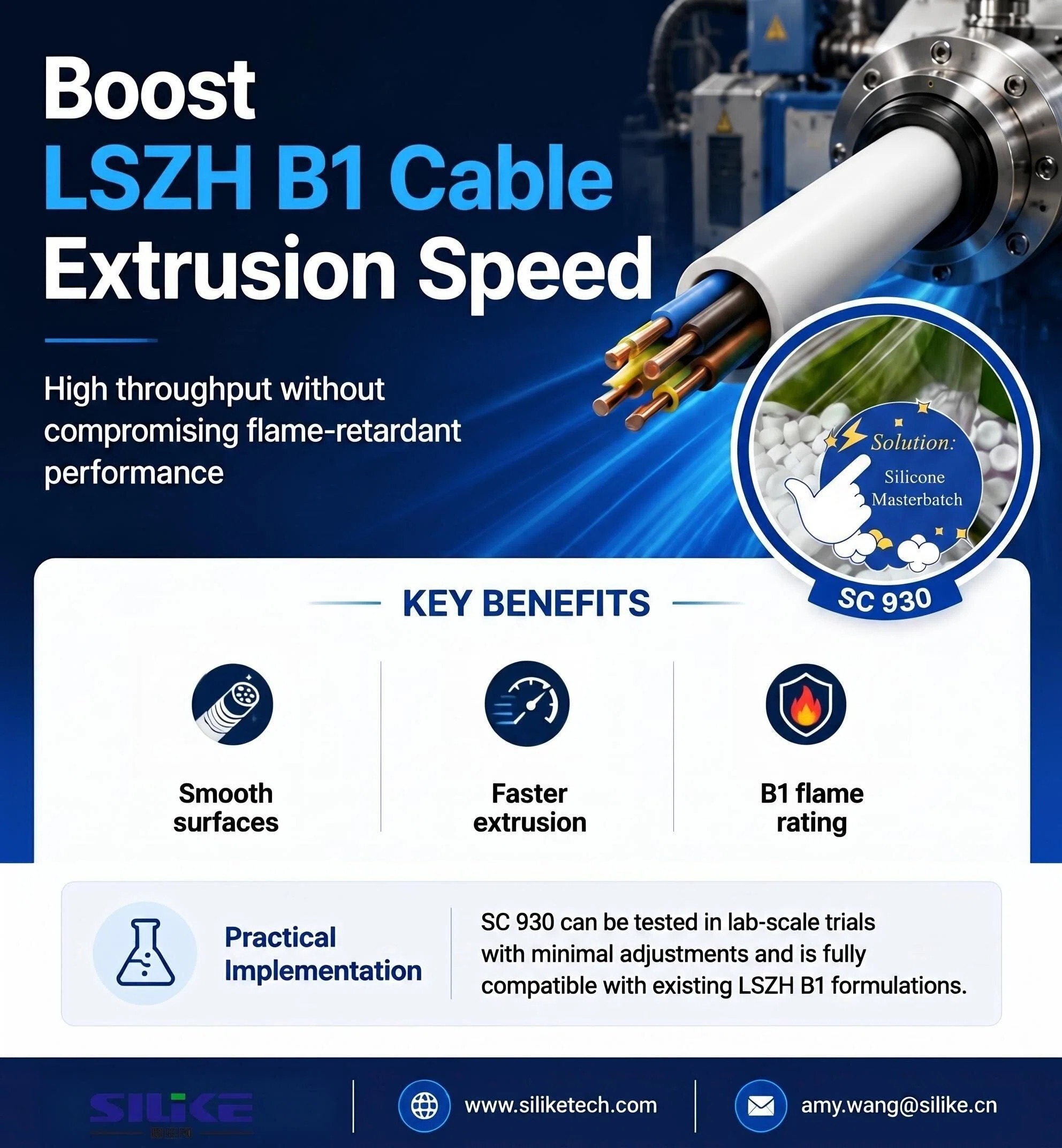
• Significant Throughput Boost: Under identical energy consumption, SC 930 can increase extrusion volume by 15–20%, effectively shortening lead times and lowering unit costs.
• Superior Surface Aesthetics: Eliminates melt fracture (sharkskin) and minimizes die-head accumulation, producing smooth, high-gloss surfaces with improved scratch resistance.
• Enhanced Dispersion & Stability: Organo-functional groups improve wetting of ATH/MDH particles, preventing filler agglomeration and ensuring consistent flame-retardant performance along the cable length.
• Equipment Longevity: By lowering processing temperatures and motor torque, SC 930 silicone-based additive reduces mechanical wear on screws and barrels, extending the extrusion line’s maintenance lifecycle.
FAQ: Technical Clarity for SILIKE SC 930 Silicone Masterbatch in LSZH and HFFR Cable Production for Engineers
Q1: Is SC 930 Silicone Masterbatch compatible with all polyolefin bases used in B1 cables?
A1: Yes. SC 930 Silicone Masterbatch is optimized for PE, EVA, PP, and POE-based HFFR compounds, showing excellent synergy with both ATH and MDH filler systems.
Q2: What is the recommended dosage of SC 930 Silicone Masterbatch for high-speed lines?
A2: After mixing SC 930 Silicone Masterbatch with resin in proportion, it can be formed directly or used after granulation.Recommended addition amount: When the addition amount is 0.5%-2.0%, it can improve the processability, fluidity, and release of the product; When the addition amount is 1.0%-5.0%, the surface properties of the product can be improved (smoothness, finish, scratch resistance, wear resistance, etc…)
Action Guide: Optimize Your LSZH B1 Cable Line Production
Discover how to optimize LSZH B1 cable production using SILIKE SC 930 Specially Functionalized UHMW Silicone Masterbatch. Its siloxane technology can boost throughput by 10–20% and reduce surface defects such as sharkskin.
Request a trial sample of SILIKE SC 930 Silicone Masterbatch to validate improvements in surface quality on your extrusion line. You can visit the website at www.siliketech.com or contact Amy Wang directly via email at amy.wang@silike.cn.
Post time: May-15-2026


