
AI data center expansion is putting new pressure on global power cable supply. With new XLPE cable production lines taking years to develop, how can manufacturers improve extrusion efficiency, reduce production losses, and maintain insulation quality on existing equipment?
For manufacturers facing premature crosslinking, unstable melt flow, die buildup, or insulation surface defects, improving material processability may offer a practical opportunity.
1. AI Data Center Growth: Why Cable Manufacturing Capacity Matters
On October 22, 2026, Reuters reported that Nexans identified cable manufacturing capacity as an emerging bottleneck for AI-driven data center construction.
According to Nexans, establishing a new cross-linked polyethylene (XLPE) continuous vulcanization (CV) production line can take approximately three years.
Meanwhile, French grid operator Enedis has extended certain cable procurement agreements from one year to six or seven years to help secure supply.
The International Energy Agency (IEA) also projects global data center electricity consumption to increase from approximately 485 TWh in 2025 to 950 TWh by 2030.
These developments highlight opportunities across the power cable supply chain, particularly for manufacturers capable of maintaining reliable production and consistent quality.
While new capacity requires substantial investment and long lead times, reducing processing-related losses on existing lines may offer a more immediate opportunity.
Although the CV lines highlighted by Nexans differ from silane-crosslinkable XLPE processing systems, both illustrate why manufacturing stability and efficient use of existing equipment deserve attention.
2. XLPE Cable Extrusion Challenges: Where Do Manufacturers Lose Efficiency?
XLPE is widely used in power cable insulation due to its electrical insulation properties, thermal resistance, and mechanical performance.
However, processing challenges vary with crosslinking technology, material formulation, and operating conditions.
In silane-crosslinkable XLPE cable compounds, manufacturers may encounter:
• Premature crosslinking (scorch): Unwanted reactions can increase melt viscosity and generate pre-crosslinked particles.
• Poor melt flow: Increased processing resistance may raise extrusion torque and cause output fluctuations.
• Screw and die buildup: Material accumulation may increase cleaning frequency and unplanned downtime.
• Insulation surface defects: Pre-crosslinked particles and unstable flow can contribute to rough surfaces and quality rejection.
What Causes Premature Crosslinking in Silane-Crosslinkable XLPE?
In a typical two-step Sioplas-type process, Material A contains silane-grafted polyethylene, while Material B contains the catalyst masterbatch. A commonly used blending ratio is A = 95:5 by weight, depending on the formulation.
Unintended moisture exposure before the intended curing stage can trigger premature hydrolysis and condensation reactions.
The resulting viscosity increase, gel formation, and material buildup may reduce extrusion stability and increase production losses.
Simply increasing temperature or screw speed may aggravate these problems.
For cable manufacturers, frequent cleaning, insulation defects, and rejected products can reduce saleable output even when equipment operates at its intended speed.
The challenge is therefore to improve processability while maintaining final crosslinking and insulation performance.
3. SILIKE LYPA-208C: Processing Aid for Silane-Crosslinkable XLPE Cable Compounds
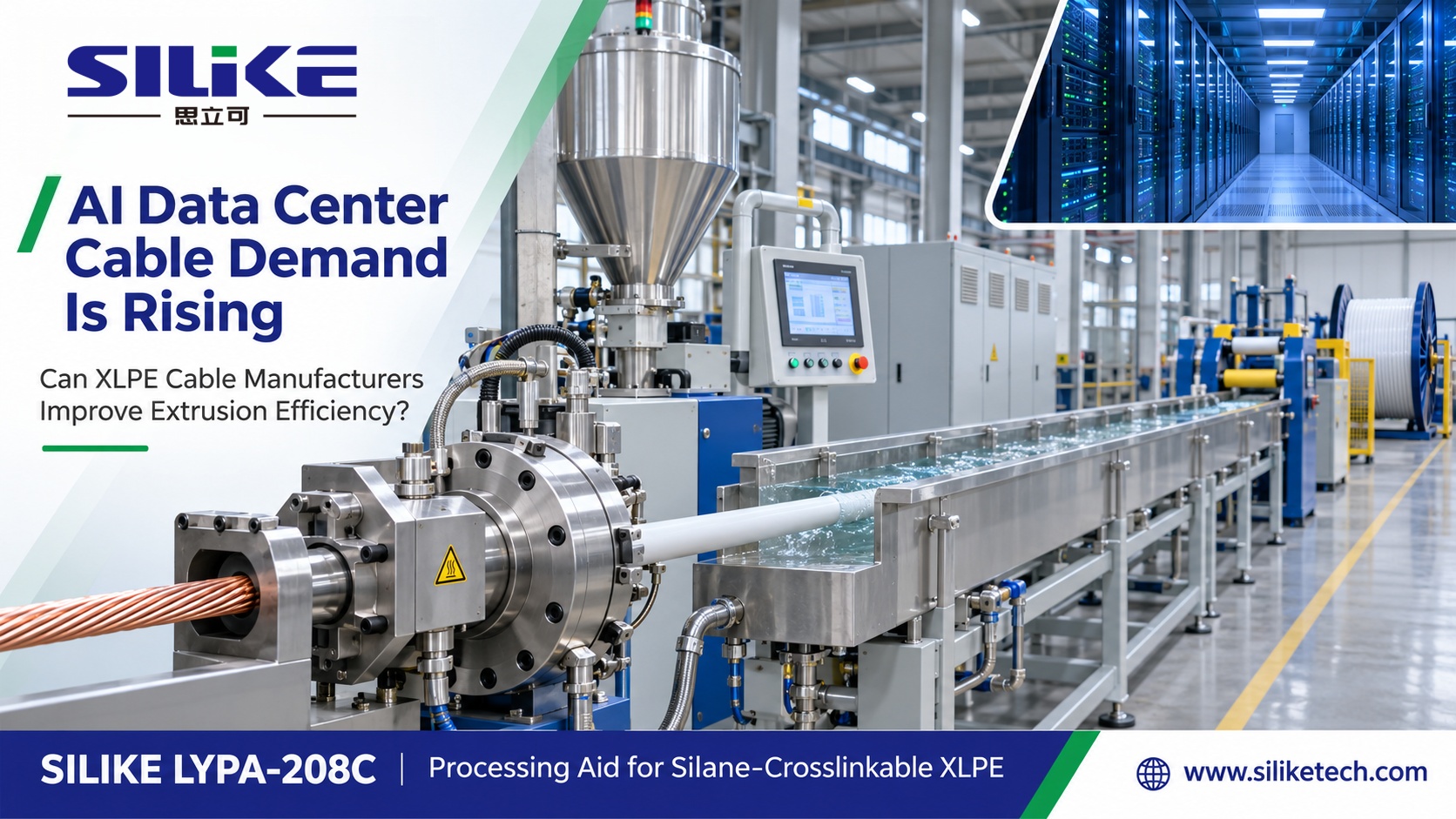
At SILIKE, we have developed Silicone Masterbatch (Siloxane Masterbatch) LYPA-208C, a silicone-based processing additive designed to improve the processability and surface quality of compatible XLPE cable compounds.
LYPA-208C contains 50% ultra-high-molecular-weight siloxane polymer dispersed in a PE carrier. LYPA-208C is designed to help:
• Improve melt processability: Reduce processing resistance and support stable extrusion.
• Reduce material adhesion: Minimize the accumulation of pre-crosslinked material in screw channels and equipment dead zones.
• Reduce die buildup and die drool: Support cleaner extrusion conditions and potentially longer operating intervals.
• Improve insulation surface quality: Help minimize surface roughness and visible extrusion defects.
How Does Silicone Additive LYPA-208C Address Pre-Crosslinking-Related Processing Problems?
LYPA-208C acts primarily as a processing lubricant, helping reduce material adhesion and accumulation during extrusion.
This can help address processing difficulties associated with premature crosslinking, but it does not replace proper moisture control or eliminate the underlying crosslinking reaction.
We recommend a general addition range of 0.2–5.0 wt%.
For selected two-step silane-crosslinkable XLPE formulations, 0.8–1.0 wt% may be considered for initial evaluation. Incorporation during Material A preparation may also be evaluated where formulation compatibility permits.
We recommend determining the optimum dosage through controlled trials and verifying that final crosslinking, mechanical, and electrical performance meet the required specifications.
Application scope: Our published guidance primarily covers silane-crosslinkable XLPE systems. Suitability for peroxide-crosslinked XLPE continuous vulcanization lines requires separate technical validation.
Learn more about our LYPA-208C Silicone Processing Additive for silane-crosslinked XLPE processing solutions.
4. From Processing Improvements to Production Value: What Should Manufacturers Test?
As cable supply chains face tighter delivery requirements, processing improvements should be evaluated against actual manufacturing performance—not just extrusion pressure or line speed.
At SILIKE, we recommend four practical checkpoints:
1. Extrusion Stability: Compare torque, melt pressure, output consistency, and material buildup under controlled conditions.
2. Insulation Surface Quality: Evaluate surface roughness, gel particles, visible defects, and dimensional consistency.
3. Crosslinking and Electrical Performance: Verify final crosslinking characteristics, applicable mechanical properties, and electrical insulation requirements.
4. Manufacturing Productivity: Monitor cleaning intervals, scrap rates, stable line speed, and saleable output during representative production runs.
Lower extrusion pressure alone does not guarantee higher production capacity. The real commercial value lies in more consistent, saleable output without compromising finished-cable quality.
Looking to Improve Your XLPE Cable Extrusion Process?
Are premature crosslinking, die buildup, poor melt flow, or insulation surface defects affecting your production?
At SILIKE, we provide silicone-based processing additives and technical support for application-specific formulation evaluation.
Contact us to discuss LYPA-208C or request samples for testing.
Share your crosslinking technology, polymer formulation, extrusion conditions, and current challenges with our technical team. We can help assess whether the silicone processing additive LYPA-208C is suitable for your application.
Website: https://www.siliketech.com/
Email: amy.wang@silike.cn
Post time: Nov-11-2026


