
High extrusion torque, unstable die pressure, poor wood flour dispersion, and rough profile surfaces are common concerns in wood-plastic composite (WPC) manufacturing, particularly in highly filled polyethylene (PE) and polypropylene (PP) formulations.
For manufacturers of WPC decking, fencing, cladding, railing, and other extruded profiles, these processing challenges can increase motor loading, restrict production output, and make consistent product quality more difficult to maintain.
Increasing the lubricant dosage may seem like a straightforward solution. However, the wrong lubrication balance can introduce new concerns related to filler–matrix adhesion, surface quality, and finished-product properties.
How can WPC manufacturers reduce processing resistance while maintaining the required mechanical performance of their composite profiles?
This guide explains the main causes of high extrusion torque, compares commonly used WPC lubricants, examines recent research on formulation compatibility, and outlines how to evaluate modified polysiloxane processing aids such as SILIKE SILIMER 5322.
Why Is Extrusion Torque High in Wood-Plastic Composites?
Quick Answer: High WPC extrusion torque can result from excessive processing resistance associated with wood flour loading, filler characteristics, moisture variation, inadequate mixing, unsuitable lubrication, or equipment conditions. Effective troubleshooting begins by checking the formulation and production process together. A suitable processing aid may help reduce friction and improve flow, but its effect should be evaluated alongside filler dispersion, coupling-agent compatibility, surface quality, and mechanical properties.
1. High Wood Flour Loading and Processing Resistance
WPC formulations combine a thermoplastic resin with wood flour or other lignocellulosic fillers.
Increasing wood flour content changes the way the compound flows and interacts with processing equipment.
Depending on the polymer matrix, filler characteristics, and processing conditions, high filler loading may contribute to:
• Increased extruder torque and motor loading
• Higher or fluctuating die pressure
• Greater sensitivity to screw speed and temperature settings
• Reduced extrusion output
• Inconsistent profile surfaces
However, filler concentration alone does not determine extrusion performance.
The particle size, aspect ratio, moisture content, and distribution of wood flour can also influence the behavior of the compound.
Practical consideration: If torque rises after increasing wood flour loading, investigate both the filler specification and the lubrication system before assuming that a higher lubricant dosage is the best solution.
2. Poor Wood Flour Dispersion
Uniform filler distribution is important for consistent extrusion and finished-product performance.
When wood flour is unevenly distributed, localized filler concentrations or agglomerates may contribute to inconsistent processing and visible surface defects.
Potential causes include:
• Insufficient mixing or dispersion
• Variations in filler particle size
• Inconsistent feeding
• Inadequate moisture control
• Unsuitable resin–filler compatibility
A processing aid may support better distribution under suitable conditions, but dispersion problems should also be examined through the mixing process and formulation design.
3. Moisture Variation in Wood Flour
Wood-based fillers readily absorb moisture.
Excess moisture can contribute to voids, porosity, surface defects, and changes in processing behavior.
For this reason, wood flour drying and storage are essential aspects of WPC production.
Manufacturers should verify filler moisture levels and feeding conditions before attributing all processing instability to insufficient lubrication.
A lubricant cannot compensate for inadequate wood flour drying.
4. An Unbalanced Lubrication System
WPC formulations often contain lubricants intended to reduce friction and improve processing.
However, the effects of a lubricant depend on its chemistry, dosage, and interaction with the resin, filler, and coupling agent.
Insufficient lubrication may leave processing resistance higher than desired.
Excessive or incompatible lubrication may affect the composite’s interfacial behavior or final properties.
The objective is therefore to achieve an appropriate balance between processing efficiency and material performance.
5. Equipment and Operating Conditions
High torque is not always caused by the compound itself.
Screw configuration, screw wear, feed consistency, extrusion rate, temperature profile, and die resistance may also contribute.
Importantly, extruder torque and die pressure are different processing measurements. They may change together, but an improvement in one does not automatically establish an improvement in the other.
Both should be monitored when evaluating a WPC processing aid.
WPC Extrusion Problems: Causes, Symptoms and Troubleshooting
When a WPC extrusion line becomes unstable, changing multiple formulation ingredients simultaneously can make the problem difficult to diagnose.
The following troubleshooting guide provides a practical starting point.
| Processing Problem | Possible Causes | What to Check First |
|---|---|---|
| High extruder torque | High filler loading, insufficient lubrication, screw loading | Wood content, screw speed, motor load, lubricant system |
| Unstable die pressure | Feeding variation, moisture, inconsistent compound flow | Feed rate, material moisture, die pressure trend |
| Poor wood flour dispersion | Inadequate mixing, filler variation, formulation compatibility | Particle-size distribution, mixing conditions, coupling agent |
| Rough WPC profile surface | Filler agglomeration, moisture, unstable flow, die conditions | Wood flour condition, processing temperature, die surface |
| Low extrusion output | Torque or feeding limitations, excessive resistance | Motor load, throughput, material feeding, extrusion pressure |
| Weak mechanical properties | Insufficient interfacial adhesion, inappropriate formulation balance | Compatibilizer, lubricant dosage, mechanical test results |
| Excessive water absorption | Filler characteristics, voids, poor encapsulation, interfacial defects | Wood loading, porosity, coupling system, water absorption tests |
A Practical Troubleshooting Sequence
Before introducing a new lubricant, WPC manufacturers should answer three questions:
Is the torque problem caused by the formulation?
Review the resin grade, wood flour concentration, particle characteristics, coupling-agent dosage, and existing lubricant package.
Is the process operating under consistent conditions?
Check moisture, feeding stability, screw speed, temperature settings, and output.
Which production result actually needs improvement?
A manufacturer seeking lower motor loading may need a different evaluation strategy from one seeking a smoother profile surface or higher acceptable throughput.
Defining the primary problem helps prevent unnecessary formulation changes.
Why Adding More Lubricant May Not Solve WPC Processing Problems
Lubricants are important formulation components, but more lubrication does not necessarily mean better WPC performance.
The reason lies in the interaction between flow behavior and filler–matrix adhesion.
Internal and External Lubrication
In polymer processing, lubrication is commonly described in terms of internal and external effects.
Internal lubrication generally concerns changes in interactions and flow behavior within the compound.
External lubrication concerns friction and adhesion between the compound and equipment surfaces, including metal surfaces in the extrusion system.
Some lubricant formulations influence both effects.
The balance required for a high-wood-content WPC formulation may differ from that of a lower-filled polymer compound.
Lubrication and Coupling Agents Perform Different Functions
Wood flour is relatively hydrophilic, while PE and PP are comparatively hydrophobic.
This difference can create challenges in achieving good filler–matrix adhesion.
Coupling agents such as maleic anhydride-grafted polyethylene (MAPE) and maleic anhydride-grafted polypropylene (MAPP) are commonly used to improve the interface in appropriate PE- and PP-based systems.
Lubricants, by contrast, are primarily introduced to improve processing behavior.
Although the two additive functions are different, their formulation effects can interact.
A lubricant that reduces processing resistance should therefore be evaluated to ensure that it does not undermine the benefits of the existing coupling system.
Why Lubricant Dosage Must Be Optimized
Research on extruded wood-plastic composites has demonstrated that inappropriate lubricant concentrations can adversely affect mechanical properties and water-related behavior in particular formulations.
For example, a study published in Construction and Building Materials investigated wood flour particle size, coupling-agent dosage, lubricant content, and wood-to-polymer ratio in recycled polypropylene-based WPCs.
The researchers reported that excessive lubricant content increased swelling and reduced mechanical properties under the conditions studied.
This does not mean that every lubricant has the same effect or that one dosage is universally suitable.
Instead, it reinforces a practical principle:
The best WPC lubricant is not necessarily the one that produces the lowest torque. It is the one that provides a suitable balance of extrusion performance and finished-product quality.
What Does Recent 2026 Research Reveal About WPC Lubricants and Coupling Agents?
Recent research continues to highlight the importance of treating wood-plastic composites as interconnected material systems rather than optimizing individual additives in isolation.
A systematic literature review published online in August 2026 in Case Studies in Construction Materials analyzed 38 studies published between 2020 and 2025.
The review identified several important themes relevant to WPC manufacturers.
1. Interfacial Compatibility Remains a Major Performance Factor
The review highlighted the importance of coupling agents, particularly MAPE, in improving adhesion between wood-based fillers and polymer matrices.
This suggests that manufacturers should examine the coupling system when evaluating whether a lubricant change affects composite performance.
2. Conventional Lubricants Remain Important in WPC Processing
The reviewed studies included polyethylene waxes, paraffin waxes, stearates, and specialized commercial lubricant formulations.
These materials are used to modify friction and processing behavior, particularly in systems containing substantial amounts of reinforcing filler.
However, their performance depends on the surrounding formulation.
3. Multifunctional Formulation Approaches Deserve Further Investigation
The review identified opportunities for additives and formulation strategies that address multiple performance requirements.
For manufacturers, this points to a broader question:
Can a processing aid provide useful lubrication while remaining compatible with the polymer, wood filler, and coupling-agent system?
This is a relevant evaluation direction for modified polysiloxane-based WPC additives.
However, the 2026 review did not establish comparative performance results for SILIMER 5322 specifically. Its findings should be interpreted as industry research context, not product test evidence.
Another 2026 study on wood flour and recycled HDPE-based composites also reinforces the importance of selecting filler characteristics and coupling systems according to mechanical performance objectives.
What Does This Mean for WPC Manufacturers?
The key lesson is not to replace every conventional lubricant with a new additive.
It is to evaluate lubrication, dispersion, compatibility, and final profile properties together.
This provides a more reliable basis for improving WPC processing efficiency.
PE Wax vs. EBS vs. Stearates vs. Modified Polysiloxane: How Should WPC Manufacturers Compare Lubricants?
Different lubricant chemistries offer different formulation possibilities.
The following comparison highlights evaluation priorities rather than declaring one chemistry universally superior.
| Lubricant Type | Common Processing Role | What WPC Manufacturers Should Evaluate |
|---|---|---|
| PE wax / oxidized PE wax | Wax-based processing lubrication | Torque, pressure, dosage, resin compatibility, surface effects |
| Paraffin wax | Lubrication and friction modification | Processing stability, migration or surface deposits, formulation balance |
| EBS (ethylene bis-stearamide) | Amide-based lubrication and processing assistance | Processing behavior, dispersion, interaction with coupling agents |
| Metallic stearates | Lubrication and processing modification | Dosage, compatibility, filler–matrix adhesion, mechanical properties |
| Modified polysiloxane-based additives | Modified friction and flow behavior in compatible formulations | Torque, filler dispersion, compatibilizer interaction, output, surface and mechanical properties |
Which Lubricant Is Best for Wood-Plastic Composites?
There is no single lubricant chemistry that is best for every WPC formulation.
The selection depends on the polymer matrix, wood flour characteristics, coupling agent, processing equipment, and final product requirements.
For example, a PE-based decking formulation containing MAPE may respond differently from a PP-based profile containing MAPP.
The effect of a lubricant also depends on the dosage and the existing additive package.
Rather than selecting a material based only on general claims about lubricity, manufacturers should conduct comparisons under equivalent processing and formulation conditions.
What Should Be Measured During a Lubricant Comparison?
The comparison should address both processing and finished-product performance.
Important indicators include:
• Extruder torque and motor loading
• Die pressure and processing stability
• Throughput and specific energy consumption
• Wood flour dispersion
• Surface appearance and dimensional consistency
• Mechanical properties
• Water absorption and thickness swelling
• Additive cost per acceptable finished product
Where relevant, also evaluate surface deposits and downstream finishing compatibility.
How to Choose the Right WPC Processing Aid for PE- and PP-Based Formulations
A suitable WPC processing aid should be selected according to the actual manufacturing objective.
If the Primary Problem Is High Extruder Torque
Evaluate whether the proposed additive reduces processing resistance at comparable throughput, screw speed, and temperature conditions.
Monitor motor load and extrusion pressure separately.
If the Primary Problem Is Poor Wood Flour Dispersion
Investigate the mixing process, filler characteristics, and compatibility package.
Consider whether an additive contributes to more consistent filler distribution without introducing unwanted effects elsewhere in the formulation.
If the Primary Problem Is Rough Surface Quality
Check moisture, filler agglomeration, die condition, and extrusion stability.
Evaluate whether a processing aid helps produce a more consistent surface while maintaining the required dimensional and mechanical properties.
If the Objective Is Higher Production Output
Begin with the current production limitation.
If processing resistance is the main constraint, improved lubrication may create an opportunity to evaluate higher throughput.
However, the equipment, feeding system, cooling capacity, and product specifications must be able to support the change.
Higher output should be assessed at an acceptable finished-product quality level, not simply at the highest achievable screw speed.
SILIKE SILIMER 5322: A Modified Polysiloxane Lubricant for WPC Processing
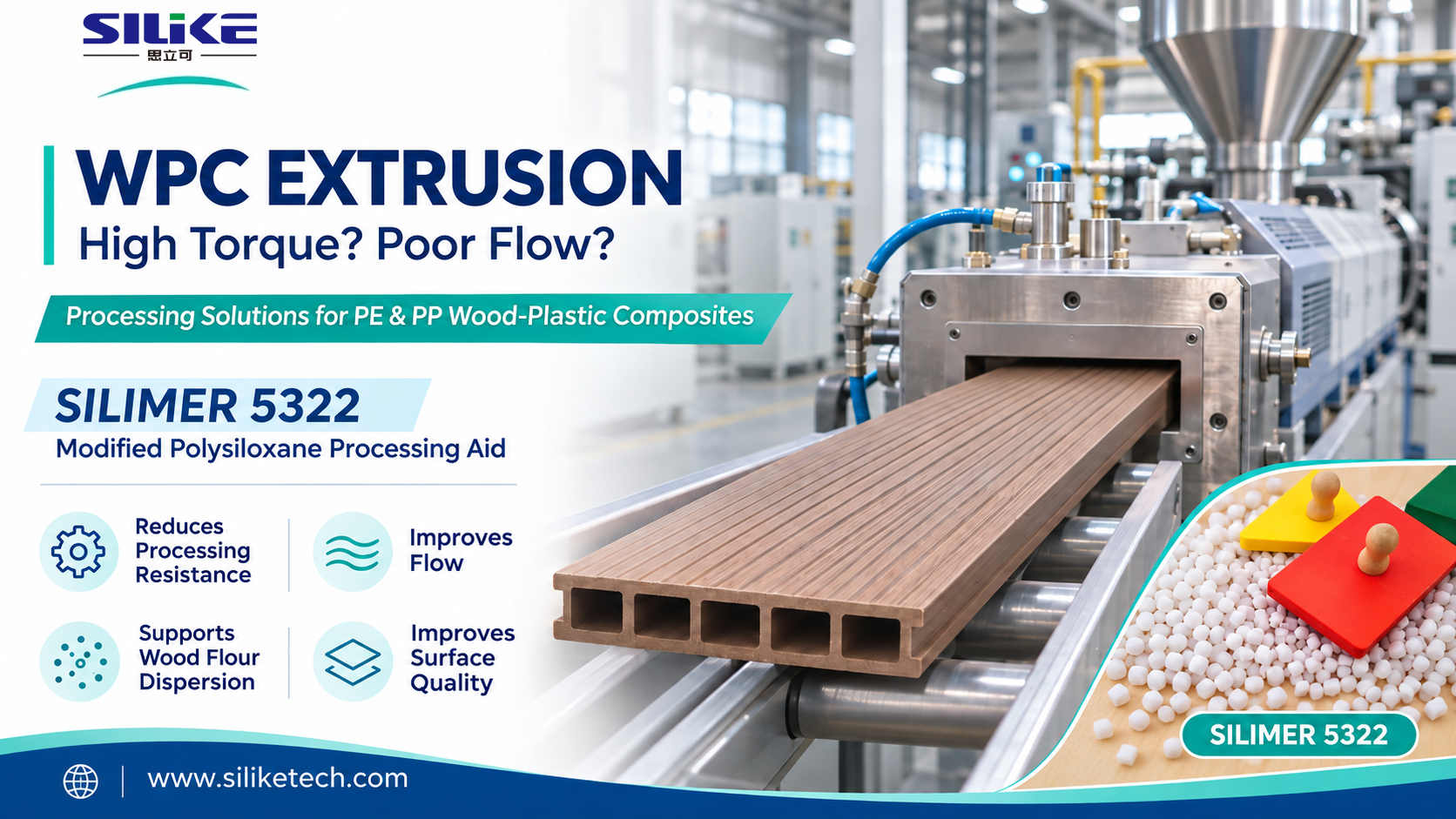
For WPC manufacturers evaluating alternative lubrication systems, SILIKE SILIMER 5322 is a modified polysiloxane-based processing aid developed for wood-plastic composites.
According to SILIKE’s product information, its modified polysiloxane components contain polar functional groups intended to support compatibility with resin and wood flour.
The product is designed primarily for PE- and PP-based WPC formulations.
What Processing Problems Is SILIMER 5322 Designed to Address?
High extrusion torque and processing resistance
SILIMER 5322 is designed to help improve lubrication and reduce extruder torque under suitable processing conditions.
Poor wood flour dispersion
The product is intended to support wood flour dispersion within compatible WPC formulations.
Surface quality concerns
By modifying processing and lubrication behavior, SILIMER 5322 may help manufacturers improve the surface consistency and appearance of finished WPC profiles.
Balancing processing efficiency with formulation compatibility
SILIKE positions SILIMER 5322 for WPC systems in which lubricant performance and compatibility with wood flour and existing additives are important.
Its effects on the coupling system and mechanical properties should nevertheless be verified through application-specific trials.
Production efficiency
Where processing resistance limits the extrusion process, reduced friction may create opportunities to evaluate lower energy consumption or improved throughput.
The actual outcome depends on the formulation, equipment, and production conditions.
SILIMER 5322 Product Information
| Property | SILIKE Product Information |
|---|---|
| Product grade | SILIMER 5322 |
| Additive type | Modified polysiloxane-based WPC lubricant |
| Appearance | White or off-white pellets |
| Main application focus | PE- and PP-based wood-plastic composites |
| General recommended dosage | 1–5 wt% |
| Incorporation method | Conventional melt blending, including single- or twin-screw processing |
The recommended dosage is general guidance provided by SILIKE. The appropriate level should be established through formulation-specific testing.
For detailed product information, visit:
SILIKE SILIMER 5322 — WPC Lubricant and Processing Aid
Is SILIMER 5322 Better Than Conventional WPC Wax or Stearate Lubricants?
SILIMER 5322 offers an alternative chemistry that manufacturers can evaluate against their current lubricant system.
SILIKE describes the product as designed to improve processing, lubrication, and compatibility in suitable WPC formulations.
However, the degree of improvement over PE wax, EBS, zinc stearate, or another commercial additive depends on the specific formulation and test conditions.
Without directly comparable testing data, it would not be appropriate to claim that SILIMER 5322 outperforms every conventional lubricant.
The most useful comparison is a controlled trial using the manufacturer’s actual WPC formulation.
Interested in Evaluating SILIMER 5322?
If your PE- or PP-based WPC production line experiences excessive torque, poor filler dispersion, or unstable extrusion performance, SILIKE can discuss whether SILIMER 5322 is suitable for your formulation.
For a preliminary technical evaluation, share:
• Polymer type and grade
• Wood flour content and particle characteristics
• Existing lubricant and coupling-agent system
• Extruder type and main processing problem
• Required finished-product properties
Contact: amy.wang@silike.cn
How to Evaluate SILIMER 5322 Without Compromising WPC Product Requirements
A well-designed evaluation should compare processing performance and finished-product properties under controlled conditions.
The following procedure provides a practical starting point.
Step 1: Establish the Reference Formulation
Document the existing WPC formulation and processing conditions.
Include the polymer grade, wood flour loading, moisture level, coupling agent, lubricant package, screw speed, temperature profile, and production output.
Record baseline torque, die pressure, surface quality, and relevant mechanical properties.
Step 2: Select an Appropriate Trial Dosage
SILIKE lists a recommended SILIMER 5322 addition range of 1–5 wt%.
A preliminary screening may include selected concentrations within this range, such as 1%, 2%, and 3%, followed by further optimization where appropriate.
These are example screening points, not proven optimum dosages.
When comparing against an existing lubricant, clearly document whether SILIMER 5322 is being added or used to replace all or part of that lubricant.
Maintain a consistent total formulation basis for meaningful comparisons.
Step 3: Compare Processing Conditions
For the first comparison, hold major operating variables as consistent as practical.
Measure:
| Parameter | Purpose |
|---|---|
| Extruder torque | Evaluate processing resistance |
| Motor loading | Assess operating demand |
| Die pressure | Monitor flow behavior |
| Throughput (kg/h) | Measure production output |
| Specific energy consumption (kWh/kg) | Compare energy used per unit of product |
| Actual melt temperature | Check processing conditions |
| Surface appearance | Evaluate visible quality |
| Profile dimensions | Assess dimensional consistency |
When possible, first compare formulations at the same output.
Only after identifying a promising formulation should the manufacturer evaluate whether throughput can be increased while maintaining product quality.
Step 4: Examine Wood Flour Dispersion
Assess whether the modified formulation provides an acceptable and consistent distribution of wood flour.
Suitable methods may include section inspection, microscopy, and other application-specific evaluation techniques.
Do not infer improved filler dispersion solely from a reduction in motor torque.
Step 5: Verify Mechanical and Physical Properties
Finished-product performance should be checked against the actual application specification.
Relevant tests may include:
• Flexural strength and modulus
• Tensile properties
• Impact resistance
• Water absorption
• Thickness swelling
• Surface durability
• Dimensional stability
• Weathering performance where required
These measurements are particularly important for outdoor WPC decking, fencing, and cladding applications.
Step 6: Confirm Continuous Production Performance
A short trial may not reflect the behavior of the compound during extended extrusion.
Once a promising formulation is identified, conduct a representative production trial to confirm:
• Stable motor loading and die pressure
• Consistent throughput
• Acceptable profile surface quality
• Dimensional consistency
• No unacceptable processing deposits or defects
• Continued compliance with finished-product specifications
Step 7: Evaluate the Overall Production Economics
Lubricant selection should consider more than additive price per kilogram.
A useful comparison is the total production cost per acceptable finished profile, including additive consumption, energy demand, production output, scrap, and operating interruptions.
This helps manufacturers determine whether a processing change offers meaningful commercial value.
WPC Lubricant Evaluation Checklist for Manufacturers
Before selecting a WPC lubricant supplier or requesting samples, review the following criteria.
| Selection Question | Why It Matters |
|---|---|
| Is the additive intended for my resin system? | PE, PP, and PVC formulations may require different solutions |
| Is it compatible with my wood flour loading? | Filler characteristics influence processing behavior |
| Has the supplier provided a recommended dosage range? | Helps establish a controlled trial |
| Can it be compared with my current lubricant? | Supports objective formulation decisions |
| Could it interact with my coupling agent? | Important for filler–matrix adhesion |
| Will I test the final mechanical properties? | Ensures processing benefits do not hide product-quality concerns |
| Can the supplier support application trials? | Helps evaluate the additive under real production conditions |
For PE- and PP-based WPC manufacturers, these questions provide a starting point when assessing SILIMER 5322 or other lubricant technologies.
Frequently Asked Questions About WPC Extrusion and Lubricants
1. What causes high torque in wood-plastic composite extrusion?
High torque may result from wood flour loading, filler characteristics, moisture variation, high processing resistance, an unsuitable lubrication system, or equipment conditions. The most effective troubleshooting approach evaluates formulation and processing variables together.
2. What is the best lubricant for WPC extrusion?
There is no universal best lubricant. PE waxes, EBS, metallic stearates, and modified polysiloxane additives may each be suitable for particular systems. Selection should be based on resin type, filler loading, coupling-agent compatibility, processing performance, and finished-product requirements.
3. Can a lubricant reduce WPC extrusion torque?
A suitable lubricant may help reduce friction and processing resistance, resulting in lower extruder torque under appropriate conditions. The improvement should be measured using controlled trials at comparable processing conditions.
4. What is the difference between a WPC lubricant and a coupling agent?
A lubricant primarily modifies processing friction and flow behavior. A coupling agent is used to improve interaction between wood-based fillers and the polymer matrix. They perform different functions, although their effects can interact in a WPC formulation.
5. Can excessive lubricant reduce WPC mechanical properties?
Yes, depending on the lubricant chemistry and formulation. An excessive or unsuitable lubricant dosage can negatively affect properties such as strength or water-related performance in certain systems. This is why both processing and final-product testing are necessary.
6. What is SILIMER 5322 used for?
SILIKE SILIMER 5322 is a modified polysiloxane-based WPC lubricant intended to support processing, reduce extrusion resistance, and improve lubrication and wood flour dispersion in suitable PE- and PP-based wood-plastic composites.
7. What is the recommended dosage of SILIMER 5322?
SILIKE provides a general recommended addition range of 1–5 wt%. The optimum concentration depends on the polymer, filler content, existing lubricant system, coupling agent, processing equipment, and performance requirements.
8. Is SILIMER 5322 suitable for PVC-based WPC?
SILIKE’s SILIMER 5322 product page specifically identifies PE- and PP-based WPC applications. Although SILIKE’s broader WPC solutions portfolio also addresses PVC-based composites, the suitability of SILIMER 5322 for a particular PVC formulation should be confirmed with the technical team before use.
9. Can SILIMER 5322 help increase WPC extrusion output?
By supporting lubrication and reducing processing resistance, SILIMER 5322 may create opportunities to improve extrusion efficiency where processing resistance is a limiting factor.
Higher output is not guaranteed and must be evaluated alongside equipment capacity, cooling performance, dimensional stability, and final product quality.
10. How should I compare SILIMER 5322 with my current WPC lubricant?
Use the same representative WPC formulation and comparable equipment conditions. Compare extrusion torque, die pressure, throughput, dispersion, surface quality, and finished-product properties. A longer production trial may be necessary before confirming the formulation change.
Conclusion: Lower WPC Extrusion Torque Is Only One Part of Better Processing
Improving WPC extrusion efficiency requires more than reducing friction.
High filler loading, wood flour moisture, dispersion quality, polymer compatibility, coupling agents, and processing conditions can all influence extrusion performance.
Conventional lubricants such as PE wax, EBS, and metallic stearates remain useful formulation options. Modified polysiloxane-based additives provide another approach worth evaluating when manufacturers need to improve processing resistance, flow consistency, or filler dispersion.
For PE- and PP-based wood-plastic composites, SILIKE SILIMER 5322 offers a formulation-specific lubrication solution that can be assessed through controlled production trials.
The objective is not simply the lowest possible torque or the highest possible screw speed.
It is stable, efficient WPC production with mechanical, dimensional, and durability performance that meets the finished product’s requirements.
Looking for a WPC Lubricant or Processing Aid Supplier?
Are you manufacturing PE- or PP-based WPC decking, fencing, cladding, railing, or other composite profiles?
If you are experiencing high extrusion torque, inconsistent wood flour dispersion, rough surfaces, or limited production efficiency, SILIKE can help you explore a suitable lubricant evaluation strategy.
Contact SILIKE to discuss SILIMER 5322 samples, technical specifications, and application testing.
To help our team understand your needs, please provide your polymer type, wood flour loading, existing lubricant and coupling-agent system, and main extrusion challenge.
Email: amy.wang@silike.cn
Website: https://www.siliketech.com/
Explore Related Solutions:
- SILIKE Wood-Plastic Composite Lubricants and Processing Aids
- SILIMER 5322 Modified Polysiloxane WPC Lubricant
Technical References
- SILIKE — SILIMER 5322 Lubricant Additive for WPC: Product Information, Specifications and Recommended Dosage.
- Case Studies in Construction Materials (2026) — Physical, Mechanical, and Durability Properties of Wood–Plastic Composites (WPC): A Systematic Literature Review. Published online August 7, 2026.
- Journal of Composites Science (2026) — The Influence of Wood Flour and Recycled High-Density Polyethylene on the Mechanical Performance of Wood–Plastic Composites.
- Construction and Building Materials (2012) — Optimized Material Composition to Improve the Physical and Mechanical Properties of Extruded Wood–Plastic Composites.
Post time: Nov-06-2026


