
Adding more recycled PE is one challenge. Keeping film performance consistent is another.
For manufacturers using post-consumer recycled polyethylene (PCR-PE), a key question is whether the film can maintain its required coefficient of friction (COF), opening performance and appearance when the recycled resin changes.
This matters because lower COF is not always better. Depending on the application, excessive slip can create as many handling problems as insufficient slip.
1. Industry Signal: PCR-PE Films Need Consistent Processing Performance
In November 2026, BENZ Packaging introduced vapour corrosion inhibitor (VCI) films containing at least 30% post-consumer recycled PE.
According to industry reporting, BENZ evaluated the recycled-content film for corrosion protection and introduced additional raw-material checks and mixing adjustments to manage variations in the recycled resin.
The case highlights a broader manufacturing issue: PCR materials may differ in melt-flow behaviour, residual additives and contamination levels.
For film producers, these variations can influence extrusion stability, surface properties and final-product consistency.
Increasing recycled content therefore requires more than choosing an acceptable recycled resin. It requires a formulation and testing strategy suited to the intended application.
2. Why Can PCR-PE Film COF Become Difficult to Control?
Residual slip agents
Recycled PE may contain erucamide, oleamide, or other additives from its previous use.
If these agents migrate to the film surface, the resulting COF may be lower than expected.
For heavy-duty sacks and pallet packaging, excessive slip can affect handling and stack stability.
In other formulations, surface friction may remain too high, contributing to film-opening or converting difficulties.
These situations require different corrective actions.
Resin variability
Differences in polymer grades, processing history, and contamination can affect melt flow and film appearance.
Variation between PCR batches may complicate process optimization and require additional incoming-material checks.
Blocking and aging
A formulation that meets its initial COF target may change after storage.
Film blocking, winding behaviour and surface condition should therefore be assessed at application-relevant intervals.
Downstream performance
Printing, lamination, heat sealing and other converting requirements must be evaluated separately.
A lower COF does not automatically mean better package performance.
3. How Should Manufacturers Select Slip and Anti-Blocking Additives?
Start by identifying the actual problem.
When the COF is too high, evaluate whether the film needs improved surface lubrication, film opening, or anti-blocking performance.
When the COF is too low, investigate residual migrating slip agents before adding more slip-enhancing material.
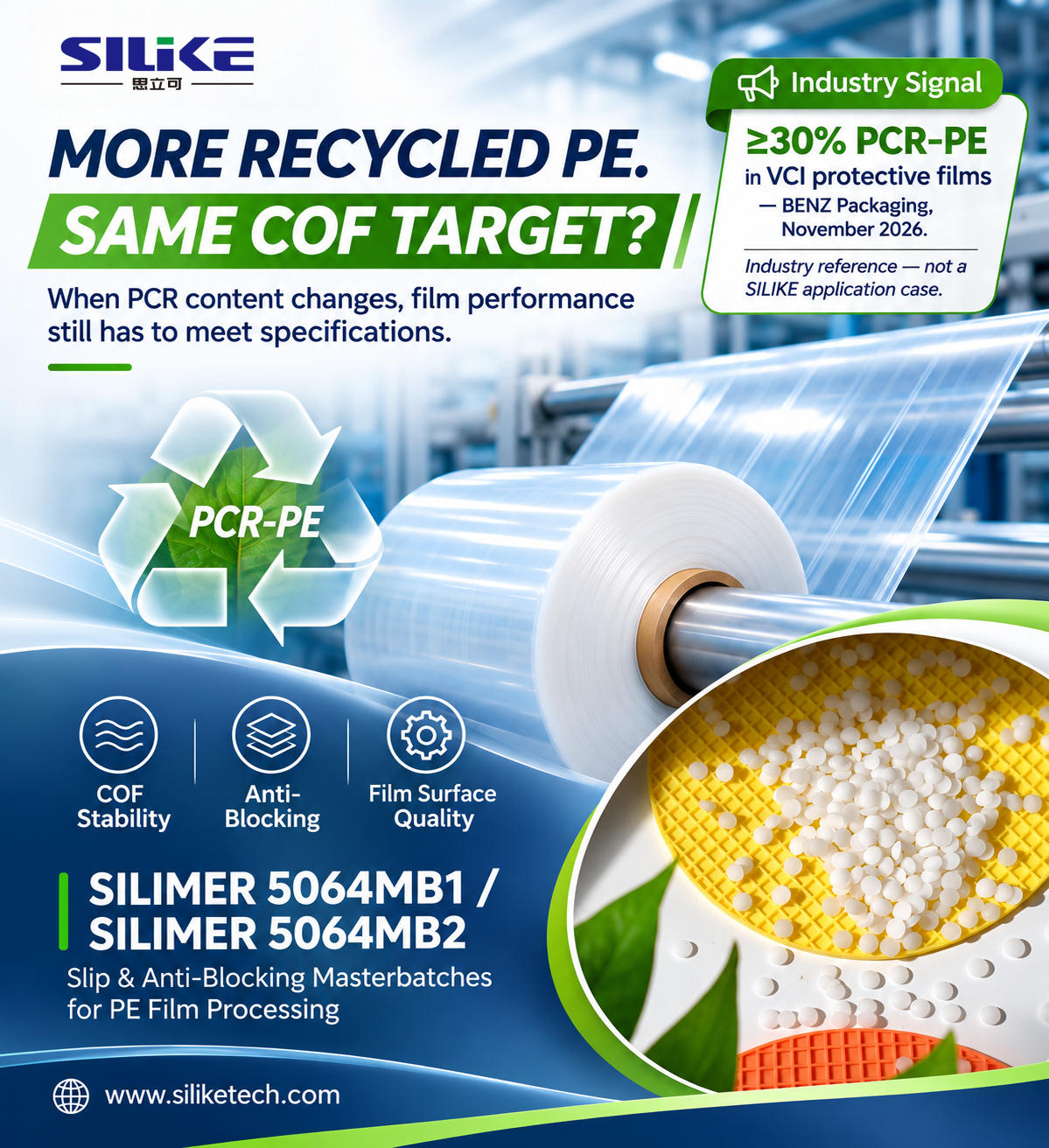
At SILIKE, we develop all kinds of slip and anti-blocking masterbatches for PE film applications. Especially, SILIMER Series is a range of high-performance super-slip and anti-blocking masterbatches. The products contain specially modified silicone polymers as active ingredients to address common issues with conventional slip agents, such as blooming, precipitation, stickiness at high temperatures, and surface powdering.
SILIMER PE film slip and anti-block masterbatches help improve film smoothness, reduce dynamic and static coefficients of friction (COF), and provide stable, long-lasting non-migratory slip and anti-blocking performance. The formulations are highly compatible with the resin matrix, maintain film transparency, and do not adversely affect downstream converting operations such as printing, lamination, or heat sealing.
Two candidate slip and anti-blocking additive grades are:
SILIMER 5064MB1
SILIKE ‘ s SILIMER 5064MB1 is a super slip and anti-blocking masterbatch based on long-chain alkyl-modified siloxane containing polar functional groups. It is mainly used in PE and CPE films as well as blown film applications. It significantly improves film anti-blocking performance and surface smoothness while providing processing lubrication. It also helps reduce both dynamic and static coefficients of friction (COF), resulting in improved film handling and a smoother surface.
The product has a specially designed structure with good compatibility with the polymer matrix, showing no precipitation, no stickiness, and no impact on film transparency. It is suitable for packaging film systems requiring non-migratory slip and anti-blocking performance.
SILIMER 5064MB2
SILIKE ‘ s SILIMER 5064MB2 is a long-chain alkyl-modified siloxane masterbatch containing polar functional groups. It is primarily designed for polyethylene (PE) film systems and is suitable for cast, blown, and co-extrusion film applications.
It helps enhance film anti-blocking performance and surface smoothness while providing processing lubrication. It also reduces both dynamic and static coefficients of friction (COF), resulting in improved slip and smoother film surfaces.
This super-slip and anti-blocking masterbatch features a specially designed structure with excellent compatibility with LDPE, LLDPE, HDPE, MDPE, and mLLDPE resin matrices. It exhibits no precipitation, no stickiness, and minimal impact on film transparency. SILIMER 5064MB2 is ideal for PE film systems where stable slip and anti-blocking performance are required.
Both products: We recommend a general addition range of 1–6 wt%, depending on the specific film formulation and requirements.
SILIKE has evaluated selected PE blown-film formulations for COF development, haze, light transmittance, and visible surface residue.


Figure 1. SILIKE internal PE blown-film evaluation showing dynamic COF development, transmittance, and haze.
Visible Surface Residue: Cloth-Wipe Comparison
In a separate internal evaluation, black cloths were used to wipe films containing conventional amide slip agents and SILIKE slip additives.

Figure 2. Qualitative comparison of visible residue collected from film surfaces during a cloth-wipe evaluation.
Under the evaluated conditions, the SILIKE samples left less visible white residue on the cloths than the amide-based samples.
This is a qualitative observation of visible surface residue, not a quantitative measurement of additive migration.
These existing evaluations also do not establish performance in every PCR-PE formulation.
For recycled PE containing unknown slip-agent residues, the additive choice and dosage should follow baseline film measurements.
4. What Should a PCR-PE Film Trial Measure?
Before changing the additive package, compare representative PCR batches using consistent film-making and conditioning conditions.
Evaluate:
• PCR quality: Resin source, melt-flow behaviour and contamination.
• Static and dynamic COF: Initial values and changes after conditioning or storage.
• Film handling: Blocking, opening, winding and stacking.
• Optical appearance: Haze, transparency, specks and gels.
• Converting: Printing, lamination and sealing where relevant.
• Processing stability: Melt pressure, output consistency and scrap.
• Final functionality: Mechanical, barrier or other application-specific performance.
For COF, use an appropriate standardized procedure and consistent test surfaces, such as film-to-film or film-to-metal, according to the intended specification.
The objective is not to obtain the lowest possible friction coefficient.
It is to maintain the required COF window and production performance across realistic PCR-batch variation.
Discuss Your PCR-PE Film Formulation with SILIKE
Are you experiencing high COF, film blocking, or inconsistent surface performance in recycled PE blends?
Share your base PE resin, PCR percentage, existing slip package, target COF, and main processing issue.
Our technical team can help assess whether SILIMER 5064MB1 or SILIMER 5064MB2 is appropriate for evaluation and discuss a formulation-specific comparison trial.
Explore:
Slip-anti-blocking-solutions-for-plastic-films-packaging
High-Performance Slip & Anti-Blocking Masterbatch SILIMER 5064MB1
Super-slip and anti-blocking masterbatch SILIMER 5064MB2
Request Sample Evaluation
Email: amy.wang@silike.cn
Mobile / WhatsApp: +86 151 0828 0799
Website: www.siliketech.com
Post time: Nov-18-2026


