
Technical Insight | Automotive PP/TPO Compounds, Recycled Plastics & Surface Quality
Europe’s automotive industry is entering a new phase of material circularity.
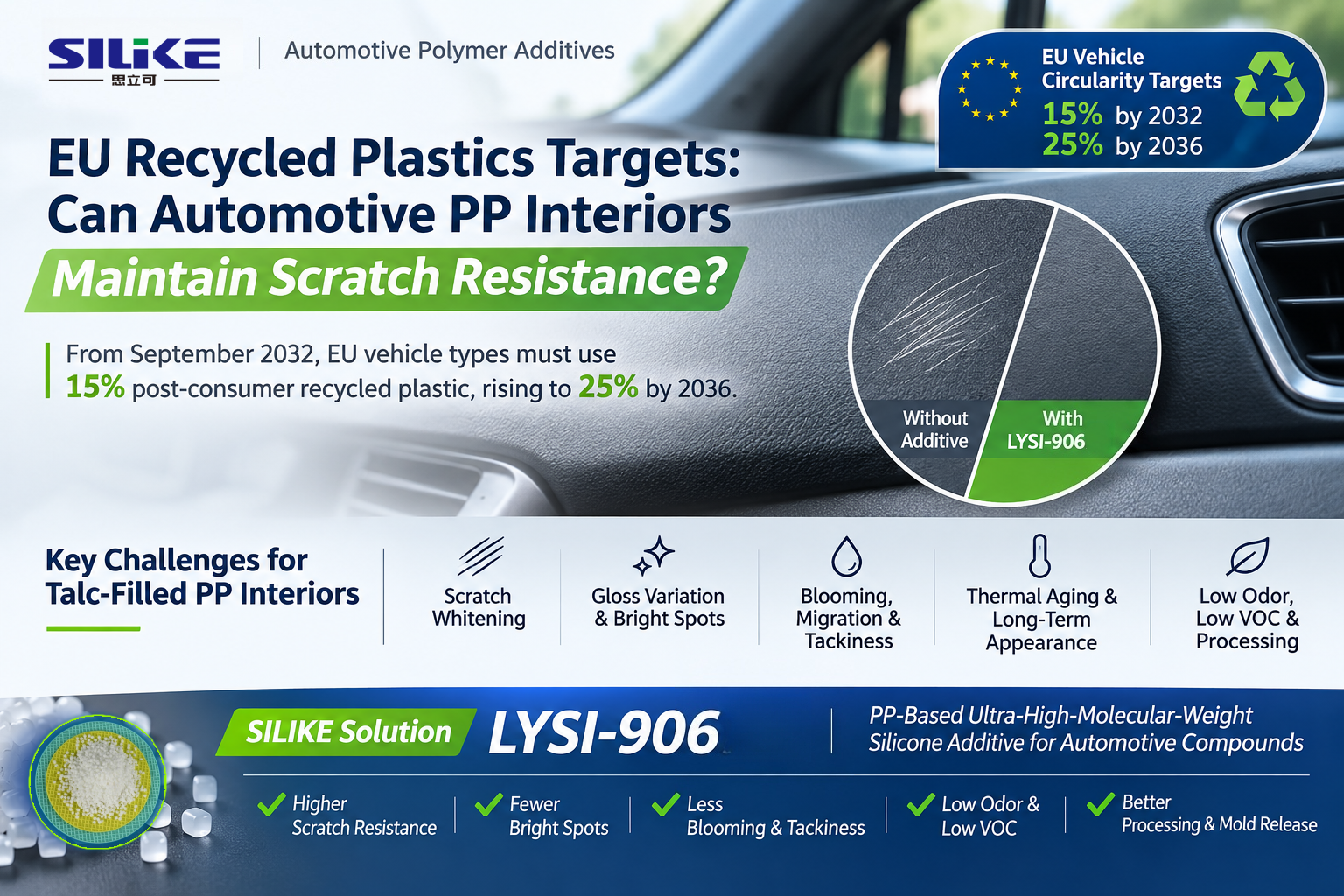
Under Regulation (EU) 2026/1738, new vehicle types approved from September 1, 2032, must contain at least 15% post-consumer recycled plastic by weight in their plastic content. The requirement increases to 25% from September 1, 2036.
These targets apply to the plastic content of applicable vehicle types—not individually to every dashboard, door panel, or other interior component.
For automotive compounders and Tier 1 suppliers, the direction is clear: recycled material development must advance without losing sight of OEM performance requirements.
Can automotive PP/TPO interiors retain scratch resistance, low-gloss appearance, and long-term surface stability as formulations evolve?
1. Why Recycled Plastic Targets Matter for Automotive Interior Materials
Talc-filled polypropylene (PP) and thermoplastic polyolefin (TPO) compounds are widely used in automotive door panels, instrument panels, center consoles, and other interior components.
Introducing post-consumer recycled (PCR) material into these formulations requires attention to feedstock consistency, polymer compatibility, contamination, thermal history, and processing stability.
However, recycled content does not automatically mean poorer scratch resistance. Performance depends on the recycled feedstock, compound design, additive package, processing conditions, and finished-part requirements.
The real challenge is maintaining a qualified balance of mechanical properties, visual appearance, emissions, and durability.
2. Five Surface-Quality Challenges Automotive PP Compounders Should Evaluate
1. Scratch whitening and visible surface damage
On dark-colored or textured talc-filled PP parts, scratches can create visible contrast. Scratch performance should be assessed using the applicable OEM test method and specification.
2. Gloss variation and bright spots
Uneven surface appearance may arise from material distribution, molding conditions, texture replication, or formulation-related effects. Additive selection alone cannot resolve every cause.
3. Surface blooming and tackiness
Surface residue, additive migration, or sticky areas can affect appearance and tactile quality. Long-term surface stability is particularly important for high-touch interior components.
4. Thermal aging and appearance retention
An acceptable initial surface may behave differently after heat exposure or prolonged use. Aging evaluations should include both appearance and scratch performance.
5. Odor, VOC, and processing stability
Automotive compounds must also satisfy project-specific emissions and manufacturing requirements. Surface improvement should not come at the expense of these properties.
3. How Can Silicone Anti-Scratch Additives Improve Automotive PP Interior Surface Performance?
For automotive compounders developing scratch-resistant PP/TPO interior materials, surface durability involves more than reducing visible scratches. Maintaining low-gloss appearance, minimizing scratch whitening, and controlling surface blooming and tackiness after thermal aging are equally important, particularly for talc-filled polypropylene compounds used in dashboards, door panels, and center consoles.
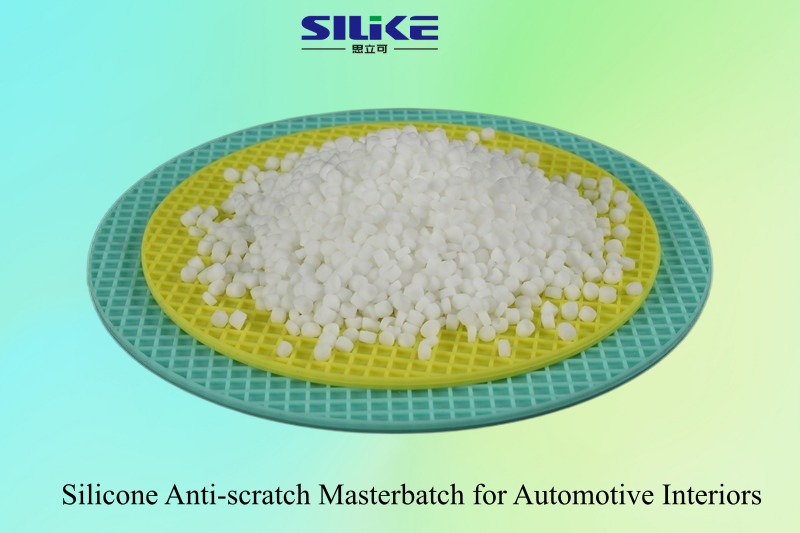
Since 2013, SILIKE has focused on silicone modification technologies for automotive interior applications, developing ultra-high-molecular-weight (UHMW) silicone anti-scratch masterbatches designed to improve surface performance while addressing the processing and durability requirements of automotive plastics.
How Do SILIKE Silicone Anti-Scratch Masterbatches Work?
Unlike conventional low-molecular-weight lubricants that may be more susceptible to migration or blooming, SILIKE’s high-molecular-weight silicone masterbatch technology is designed to provide effective surface lubrication with improved long-term surface stability.
When properly incorporated into compatible PP-based formulations, these additives can help reduce the coefficient of friction (COF), limit visible scratch damage, and improve surface slip properties. Their performance depends on the polymer matrix, additive dispersion, filler content, and processing conditions.
In addition to its best-selling LYSI-306 anti-scratch masterbatch series, SILIKE has introduced a new generation of silicone anti-scratch additives, including LYSI-906, LYSI-906A, LYSI-906NB, and LYSI-906NC. These PP-based ultra-high-molecular-weight silicone additives are designed for polypropylene modification and automotive interior compounding applications, particularly talc-filled PP compounds.
Depending on the selected grade and formulation, SILIKE silicone anti-scratch additives are designed to help:
• Improve long-term scratch and mar resistance, helping reduce visible scratch whitening on automotive PP/TPO interior surfaces.
• Enhance surface appearance and gloss consistency, helping reduce bright-spot defects in suitable talc-filled PP compounds.
• Minimize surface blooming and tackiness, supporting long-term surface stability and appearance retention after thermal aging.
• Reduce surface friction and improve lubricity through surface-energy modification. The resulting hydrophobic effect may also help reduce stain adhesion.
• Support low-odor, low-VOC, and aging-performance requirements through appropriate additive selection and formulation-specific validation.
• Improve processing lubrication and mold release, helping reduce screw torque, enhance mold filling, and support more stable processing of modified PP compounds.
Can These Scratch Resistance Additives Also Be Used in Recycled PP Automotive Compounds?
As automotive manufacturers evaluate higher levels of post-consumer recycled (PCR) plastics, silicone-based anti-scratch masterbatches are also candidates for improving the surface performance of recycled polypropylene (PP) and PCR-containing automotive interior compounds.
However, recycled feedstocks can introduce variations in polymer composition, contamination, thermal history, and additive compatibility. These factors may influence scratch resistance, surface appearance, and long-term stability.
For this reason, we recommend evaluating the appropriate anti-scratch masterbatch LYSI-906 series grade in the actual formulation, considering PCR content, talc loading, pigment system, processing conditions, and applicable OEM specifications.
The objective is not simply to improve initial scratch resistance, but to achieve a balance of surface durability, low emissions, appearance retention, mechanical performance, and processing stability throughout the component’s intended service life.
4. How Should Automotive Compounders Evaluate Scratch-Resistant PP Formulations?
A meaningful material evaluation should distinguish changes caused by recycled feedstock from those associated with the additive.
Where practical, compare the following formulations:
| Trial | Formulation | Purpose |
|---|---|---|
| A | Qualified virgin PP/TPO reference | Establish the existing performance benchmark |
| B | Candidate PCR-containing PP/TPO without the new additive | Evaluate the effect of the proposed material change |
| C | Same PCR-containing formulation with LYSI-906 | Assess the additive’s contribution |
| D | Virgin reference with LYSI-906, where relevant | Help distinguish additive effects from PCR-related effects |
Use a consistent talc level, pigment system, surface texture, processing procedure, and conditioning method wherever the comparison permits.
Performance evaluation should cover:
Scratch resistance: Initial and aged scratch performance, including visible whitening or ΔL where required by the OEM specification.
Surface appearance: Gloss uniformity, bright spots, texture reproduction, and visible defects.
Surface stability: Blooming, tackiness, residue, and appearance after specified aging conditions.
Interior emissions: Odor, VOC, and fogging measurements according to the customer’s applicable requirements.
Processing and mechanical properties: Extrusion or molding stability, mold release, impact performance, and other relevant properties.
Methods such as PV3952 and GMW14688 may be relevant depending on the automotive customer’s specification. They should not be treated as interchangeable tests or automatic evidence of compliance.
The most useful result is not simply the lowest initial scratch value. It is a compound that meets the complete application specification, including performance after aging.
5. What Should Manufacturers Confirm Before Selecting an Anti-Scratch Additive?
Before beginning a formulation trial, define the PP/TPO matrix, PCR source and content, talc loading, pigment system, and final component application.
Then identify the main surface-quality problem.
Is the priority scratch whitening on a dark door panel, bright spots on a molded dashboard, or long-term surface stability after thermal exposure?
These details help determine whether a silicone anti-scratch additive is appropriate and how its performance should be validated.
Frequently Asked Questions
Q: Does the EU require every automotive interior component to contain 15% recycled plastic by 2032?
A: No. The regulation establishes recycled plastic content requirements for the plastic content of applicable newly type-approved vehicle types, rather than a separate minimum for each individual interior component.
Q: Can silicone anti-scratch masterbatch improve scratch resistance in recycled PP compounds?
A: Yes, potentially. SILIKE silicone anti-scratch masterbatches are designed to improve scratch and mar resistance, reduce visible scratch whitening, and support long-term surface stability in PP-based formulations. They may also be evaluated for recycled polypropylene (PP) and PCR-containing automotive interior compounds.
Performance depends on recycled feedstock quality, polymer compatibility, filler loading, additive dosage, and processing conditions. SILIKE recommends comparative testing to assess scratch resistance, surface appearance, and aging stability against the applicable OEM requirements.
6. Developing Automotive PP Compounds for Circularity and Surface Performance
More recycled content should not mean overlooking surface quality.
At SILIKE, we work with polymer compounders and automotive material developers to evaluate silicone-based anti-scratch solutions for PP/TPO interior applications.
If you are developing talc-filled PP compounds using recycled materials, share your PP/TPO grade, PCR content, talc loading, target scratch specification, aging requirements, and current surface defects.
We can discuss suitable material options, technical evaluation, and sample trials based on your formulation needs.
Please feel free to contact Ms. Amy Wang via email at amy.wang@silike.cn or via WhatsApp/mobile at +86 151 0828 0799.
Explore SILIKE Automotive Anti-Scratch Solutions:
https://www.siliketech.com/anti-scratch-masterbatch-for-automotive-interiors/
Regulatory reference: Regulation (EU) 2026/1738, European Union.
https://eur-lex.europa.eu/legal-content/EN/TXT/?uri=CELEX:32026R1738
Post time: Nov-27-2026


