
Can reducing the coefficient of friction (COF) in HDPE microducts help improve fiber cable blowing performance?
For manufacturers of HDPE telecom ducts, optical fiber ducts, and permanently lubricated HDPE (PLB) pipes, low inner-wall friction is an important consideration in supporting efficient cable installation.
Incorporating a suitable silicone masterbatch into the HDPE inner-layer formulation is one material-based approach to reducing COF. But how much can friction be reduced, and what does that mean for actual cable blowing distance?
1. Industry Trend: As Fiber Technology Advances, Installation Performance Still Matters
On November 12, 2026, the Fiber Broadband Association (FBA) announced its report, The Future of Fiber Technology: What’s Next?
The report explores emerging technologies, including hollow-core and multicore fiber, that could support AI, data centers, and next-generation communication networks.
While these technologies do not necessarily require different duct formulations, continued fiber infrastructure development highlights the importance of reliable cable installation.
For manufacturers supplying HDPE telecom ducts and microducts, this brings attention to a practical engineering challenge:
How can duct materials be optimized to reduce installation resistance without compromising extrusion stability or mechanical performance?
2. How Does Inner-Wall Friction Affect Fiber Cable Blowing Distance?
During compressed-air-assisted cable installation, airflow helps propel the optical cable through the duct, while contact between the cable jacket and inner wall creates frictional resistance.
As installation distance increases, this resistance can become an important factor affecting cable movement.
Lowering the inner-wall COF can help reduce frictional resistance under comparable conditions. However, actual blowing performance also depends on:
• Duct geometry: Inner diameter, ovality, bends, and dimensional consistency.
• Cable construction: Jacket material, diameter, stiffness, and weight.
• Installation conditions: Air pressure, airflow, route configuration, and blowing equipment.
Therefore, improving cable installation performance requires more than simply achieving a lower laboratory COF value.
For HDPE duct manufacturers, reducing inner-wall friction through material modification is one practical area to evaluate.
3. Which Polymer Additives Can Help Reduce Friction in HDPE Optical Fiber Ducts?
One approach is to incorporate an HDPE-compatible silicone masterbatch into the duct’s inner-layer formulation during extrusion.
Silicone masterbatches containing ultra-high-molecular-weight siloxane polymers can help improve surface lubrication and reduce COF in compatible polyolefin formulations.
Unlike lubricants applied separately during installation, this approach integrates the friction-reducing additive directly into the polymer material.
For suitable HDPE telecom duct and microduct formulations, this may help manufacturers:
• Reduce static and dynamic COF.
• Improve inner-wall lubricity and surface quality.
• Support smoother cable movement during installation.
• Improve extrusion processability under suitable conditions.
At SILIKE, we develop silicone masterbatch technologies for polymer processing and surface modification.
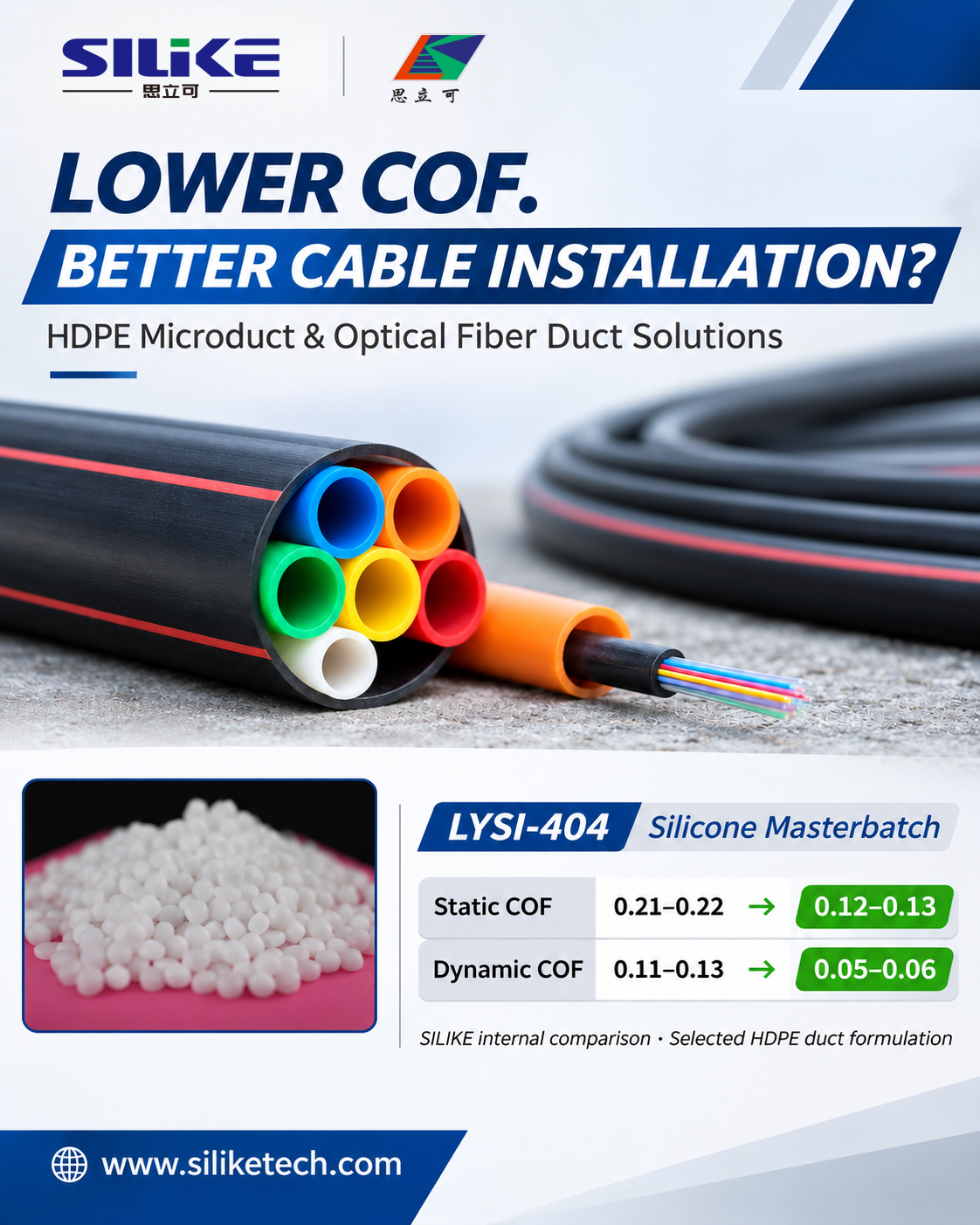
Our LYSI-404 Silicone Masterbatch contains 50% ultra-high-molecular-weight siloxane polymer dispersed in an HDPE carrier.
It can be incorporated into compatible HDPE inner-layer formulations for optical fiber ducts, telecom microducts, and PLB pipes.
But how does this material approach perform in an actual HDPE duct formulation?
4. HDPE Duct Inner-Layer Test Results: COF Reduction with 1–1.5% Silicone Masterbatch
In a selected HDPE telecom duct inner-layer evaluation, incorporating 1–1.5 wt% SILIKE LYSI-404 Silicone Masterbatch helped reduce both static and dynamic COF.
Our reference comparison showed:
| Test Parameter | Reference HDPE | HDPE Inner Layer with LYSI-404 |
|---|---|---|
| LYSI-404 addition | 0% | 1–1.5 wt% |
| Static COF | 0.21–0.22 | 0.12–0.13 |
| Dynamic COF | 0.12–0.13 | 0.05–0.06 |
These results demonstrate how silicone masterbatch modification can help improve the friction characteristics of selected HDPE duct inner-layer formulations.
What Does This Mean for Long-Distance Fiber Cable Blowing?
Lower friction between the cable jacket and duct inner wall can help reduce resistance during compressed-air-assisted installation.
In optimized duct and installation systems, fiber cable blowing distances exceeding 2,000 meters in a single run are achievable.
This highlights the practical importance of developing low-friction HDPE duct materials for long-distance cable installation.
However, the reported COF comparison does not independently establish a specific blowing distance. Actual performance depends on the complete duct, cable, route, and installation equipment configuration.
Technical Note: The COF values are based on a selected SILIKE application comparison. They are not guaranteed specifications. Results may vary depending on HDPE grade, formulation, additive dosage, extrusion conditions, and test methods.
5. Beyond COF: What Should HDPE Microduct Manufacturers Test Before Changing Formulations?
A low-friction additive should be evaluated against both material performance and end-use requirements.
We recommend four key checkpoints:
1. Static and Dynamic COF
Compare modified and unmodified HDPE formulations under consistent test conditions.
2. Extrusion and Inner-Wall Quality
Check extrusion stability, die buildup, inner-wall uniformity, duct dimensions, and ovality.
3. Mechanical Performance
Verify that the modified formulation meets applicable tensile, impact, environmental stress-crack resistance, and other duct requirements.
4. Cable Blowing Performance
Conduct representative blowing trials using defined cable construction, duct geometry, route conditions, and installation equipment.
For applicable microduct cabling systems, IEC 60794-1-124:2025 Method E24 provides standardized procedures for evaluating cable blowing installation behavior.
The objective is to achieve lower friction while maintaining the overall performance required for the finished duct.
6. Frequently Asked Questions About Low-Friction HDPE Microducts
What type of additive can reduce COF in HDPE optical fiber ducts?
HDPE-compatible silicone masterbatches can be evaluated as inner-layer additives to improve lubrication and reduce COF. SILIKE silicone additive LYSI-404 is one material option for compatible HDPE duct formulations.
Is 1–1.5% silicone masterbatch sufficient for HDPE microduct applications?
In our selected HDPE inner-layer evaluation, 1–1.5 wt% silicone-based additive LYSI-404 helped reduce static and dynamic COF. However, the optimum dosage depends on the polymer formulation, duct structure, and target performance and should be confirmed through application-specific trials.
Does lower COF guarantee longer fiber cable blowing distances?
No. Lower COF can help reduce cable installation resistance, but blowing distance also depends on duct geometry, cable construction, route conditions, airflow, and installation equipment.
Discuss Your HDPE Microduct Friction Challenges with SILIKE
Are you looking for a low-friction additive for HDPE optical fiber ducts, telecom microducts, or PLB pipes?
Whether your goal is to reduce inner-wall COF, improve surface lubrication, or evaluate an alternative additive for your current HDPE formulation, our technical team can help you discuss a suitable polymer additive evaluation approach.
Share your HDPE resin grade, duct structure, inner-layer formulation, current COF, target COF, and cable installation requirements.
We can help evaluate whether LYSI-404 Silicone Masterbatch is suitable for your application and discuss starting dosage, formulation considerations, and comparative trial methods.
Explore SILIKE Solutions:
- LYSI-404 Silicone Masterbatch for HDPE
- Silicone Masterbatch Solutions for Telecom Pipes and Optical Fiber Ducts
Industry References:
- Fiber Broadband Association — The Future of Fiber Technology: What’s Next?
- IEC 60794-1-124:2025 — Installation Test for Microduct Cabling, Method E24
SILIKE | www.siliketech.com
Email: amy.wang@silike.cn
TEL: +86-28-83625089
Post time: Nov-25-2026


