
Optical Fiber Ducts and Pipes Industry Challenge: Friction-Limited Performance in Modern Fiber Networks
The rapid expansion of FTTH (Fiber-to-the-Home), data centers, and long-distance optical fiber networks demands optimized duct systems for reliable fiber deployment.
Optical Fiber Ducts and Pipes, including HDPE telecom ducts, microducts, and PLB conduit systems, form the backbone of modern telecommunication infrastructure. A critical engineering limitation is:
High inner-wall coefficient of friction (COF), which restricts fiber blowing distance and increases installation force.
This leads to:
• Reduced air-blown fiber installation efficiency
• Increased mechanical stress on optical fiber jackets
• Higher energy consumption during installation
• Limited continuous deployment distance per duct segment
Addressing this requires more than temporary lubrication—it necessitates permanent tribological modification of the polymer inner wall
Technical Solution Overview: Silicone Masterbatch for Optical Fiber Ducts and Pipes
SILIKE’s silicone masterbatch LYSI-404 is an efficient lubricant based on ultra-high molecular weight polydimethylsiloxane (PDMS), engineered for integration into micro-ducts, ducts, or pipe structures via co-extrusion. It provides an easy installation solution for telecom ducts and optical fiber pipes.
Key engineering functions:
• Reduces COF across all Optical Fiber Duct and Pipe types
• Improves fiber blowing and pulling performance in microducts and PLB ducts
• Stabilizes long-term tribological behavior
• Integrates seamlessly into standard HDPE extrusion processes
Unlike external coatings, the silicone masterbatch is embedded within the polymer matrix, providing permanent internal lubrication.
Performance Validation: COF and Processing Improvement
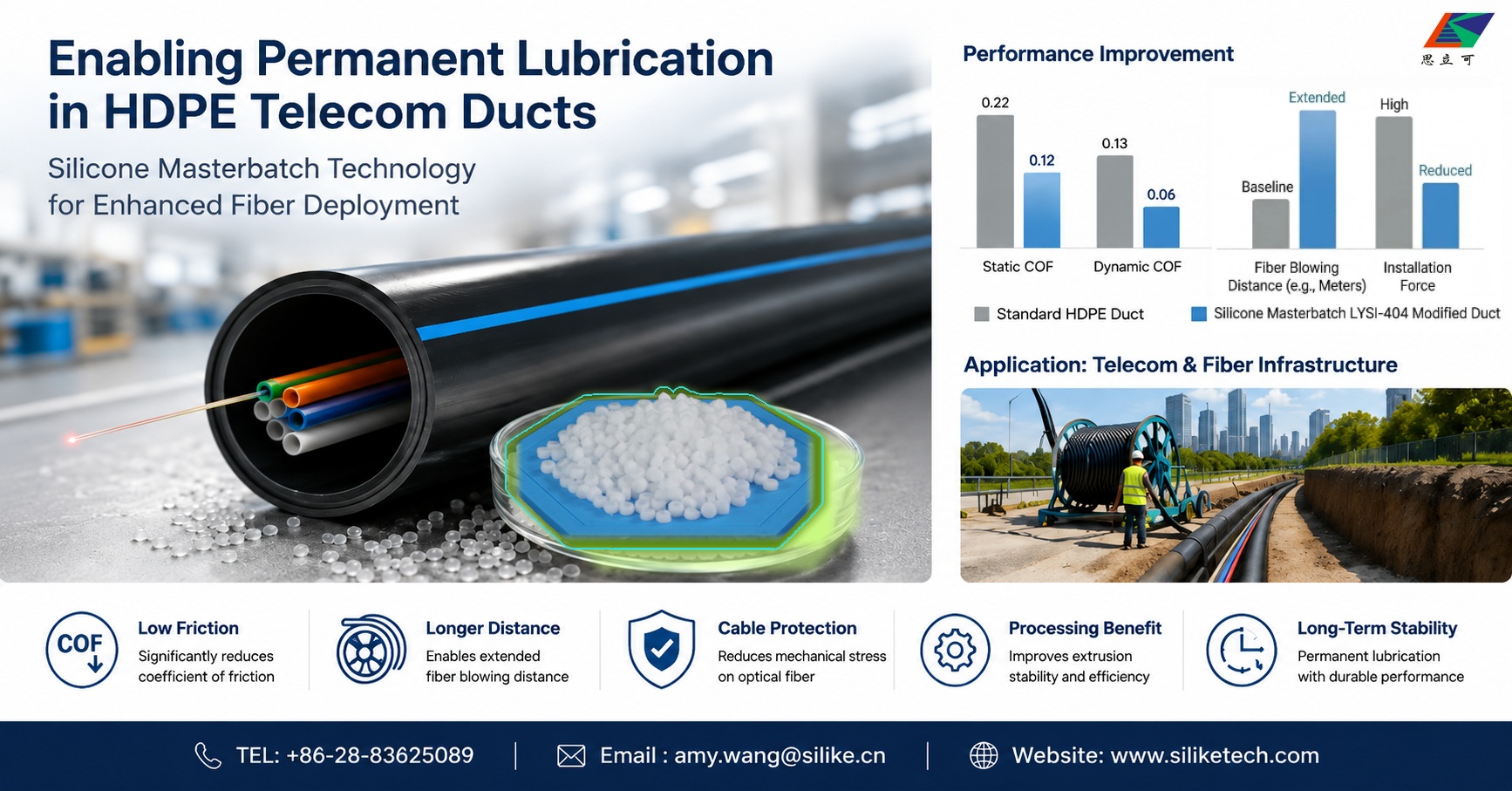
| Property | Standard HDPE Duct | Silicone Masterbatch Modified Optical Fiber Duct |
|---|---|---|
| Static COF | 0.21–0.22 | 0.12–0.13 |
| Dynamic COF | 0.11–0.13 | 0.05–0.06 |
| Fiber Blowing Distance | Limited | Significantly Extended |
| Installation Force | High | Reduced |
| Extrusion Torque | Higher | Lower |
| Inner Surface Smoothness | Standard | Improved |
Engineering interpretation: COF reduction of ~40–55% extends installation runs and reduces mechanical stress across all duct types.
Application Scope: Unified Optical Fiber Ducts and Pipes System
The PDMS masterbatch technology is classified as a thermoplastic additive. It is suitable for global optical fiber infrastructure applications to reduce friction, improve cable blowing distance, and enable permanent inner-wall lubrication, including:
♦ PLB HDPE telecom ducts (permanently lubricated)
♦ FTTH microduct networks
♦ Long-distance optical fiber backbone pipelines
♦ Underground telecommunication conduit systems
♦ Smart city fiber distribution networks
♦ Electrical and communication cable protection ducts
Engineering Guidance for Implementation
1. Processing Method: Standard HDPE pipe extrusion or co-extrusion
2. Temperature Range: 175–220°C
3. Dosage Recommendations:
¤ 0.5–2.0% → processing improvement + moderate lubrication
¤ 1.0–5.0% → maximum COF reduction + surface performance
4. Structural Design Recommendation:
• Outer layer: HDPE + color masterbatch
• Inner layer: HDPE + silicone masterbatch (LYSI-404)
Technology Comparison: Lubrication Approaches in Optical Fiber Ducts and Pipes
| Technology | Lubrication Type | Durability | COF Stability | Field Performance |
|---|---|---|---|---|
| Silicone Masterbatch (Internal) | Permanent internal | High | Stable long-term | High |
| Surface coating | External layer | Medium | Degrades over time | Moderate |
| Lubricant spray | Temporary | Low | Unstable | Limited |
| Untreated HDPE | None | N/A | High COF | Poor |
Key Insight: Only internal silicone masterbatch systems provide structural, permanent lubrication across all sub-types of optical fiber ducts and pipes.
Industry Impact
This silicone additive against coatings or lubricating agents, solution directly addresses your Ducts and Pipes processing and surface issues, such as:
♦ Why is the fiber blowing distance limited in microducts
♦ Best additive for optical fiber duct lubrication
♦ Permanent lubrication solution for FTTH duct systems
♦ Improve fiber installation efficiency in HDPE pipes
Engineering Summary
SILIKE silicone masterbatch technology enables permanent lubrication throughout optical fiber ducts and pipes by forming a stable PDMS-rich interfacial layer that significantly reduces COF, improves fiber blowing efficiency, and enhances long-term installation performance without migration over time.
Engineering Action & Validation
Industry stakeholders are encouraged to perform pilot-scale extrusion validation to assess:
• COF reduction under real processing conditions
• Fiber blowing distance improvements in microducts and PLB ducts
• Long-term tribological stability of inner duct surfaces
Final material selection should be based on system-level installation performance validation rather than laboratory COF data alone.
Contact SILIKE, a leading Chinese manufacturer specializing in silicone-based plastic additives. Get solutions for optical fiber ducts and high-performance additives for telecom duct lubrication.
Tel: +86-28-83625089 or via email: amy.wang@silike.cn. website:www.siliketech.com.
Post time: May-29-2026


