
How to Achieve Stable Matte Appearance in TPU Extrusion for Cable Applications
Abstract:
TPU cable surface quality has become an increasingly important factor in EV charging cables, consumer electronics cables, and automotive wiring systems. While TPU materials provide excellent flexibility and mechanical performance, achieving stable matte surface appearance during continuous extrusion remains a persistent manufacturing challenge.
This article analyzes common TPU matte surface failure modes, explains their root causes from a material and process perspective, and outlines industrial solution pathways for achieving stable production performance.
1. Introduction: Why TPU Cable Surface Quality Matters?
In conventional cable manufacturing, mechanical properties such as tensile strength, flexibility, and abrasion resistance were the primary focus, while surface appearance was secondary.
In modern high-value applications such as EV charging systems and premium electronics, surface quality has evolved into a process stability indicator.
Key industrial requirements include:
• stable matte or controlled semi-matte appearance
• resistance to fingerprint visibility
• reduced perceived scratch visibility
• consistent surface quality across batches
• stable performance under high-speed extrusion
→ Therefore, TPU surface quality reflects extrusion process stability rather than only formulation design.
2. Why TPU Naturally Tends Toward Glossy Surfaces
From a material behavior perspective, TPU exhibits characteristics that favor glossy surface formation during extrusion.
These include:
• strong melt flow behavior
• high surface leveling capability
• limited micro-scale surface disruption during cooling
During extrusion, these properties promote smooth surface formation and reduce surface roughness, which leads to inherently higher gloss levels.
Therefore, achieving a matte surface requires intentional modification of surface formation behavior rather than relying on base polymer properties.
3. TPU Cable Matte Surface Failure Modes in Production
3.1 Gloss variation during continuous extrusion
A common issue in industrial production is the gradual change in surface gloss during long production runs.
Typical behavior includes:
• stable matte appearance at startup
• gradual increase or fluctuation in gloss over time
Root causes are generally associated with:
• thermal history accumulation in TPU melt
• changes in flow stability during long-run extrusion
• dominance of surface leveling over controlled micro-roughness formation
This type of failure is especially evident in high-speed EV cable production lines.
3.2 Batch-to-batch inconsistency in surface appearance
Another frequent issue is variation in surface gloss between production batches using the same formulation.
Key influencing factors include:
• variation in TPU rheological properties between batches
• inconsistent dispersion of functional additives
• sensitivity of surface formation to raw material variability
This problem is particularly relevant in OEM supply chains where multiple TPU sources or compounders are used.
3.3 Over-rough or low-quality surface texture
In some cases, achieving a strong matte appearance leads to undesirable surface quality.
Typical issues include:
• dry or chalk-like visual appearance
• excessive surface roughness
• reduced perceived premium quality
This is often associated with high loading of inorganic matting fillers or uncontrolled phase separation.
3.4 Sensitivity to processing conditions
TPU matte surfaces may vary significantly under small changes in processing conditions, such as:
• extrusion temperature
• line speed
• cooling rate
• die design
This indicates that surface formation is highly dependent on processing stability rather than formulation alone.
4. Root Cause Analysis: Why TPU Matte Systems Fail
Across different failure modes, the underlying cause is consistent.
TPU matte instability is primarily driven by unstable surface formation dynamics during extrusion.
This can be summarized as follows:
• TPU has strong intrinsic surface leveling behavior
• Matte effects rely on controlled disruption of this behavior
• Most systems fail to maintain this balance under industrial variability
Therefore, the problem is not simply insufficient matting additives, but insufficient stability of the surface formation system under real production conditions.
5. Industrial Solution Pathways for TPU Matte Surfaces
5.1 Inorganic filler-based systems
This is the most traditional approach, using materials such as silica, titanium dioxide, or mineral fillers to increase surface roughness.
Advantages:
• low cost
• easy implementation
Limitations:
• reduced flexibility
• surface quality instability during long runs
• sensitivity to process fluctuations
This approach is mainly used in cost-sensitive applications.
5.2 Polymer blending systems
Polymer blending modifies surface behavior through phase structure design using materials such as SEBS, EPDM, or NBR.
Advantages:
• adjustable surface texture
• improved tactile properties
Limitations:
• batch-to-batch variability
• sensitivity to processing conditions
• scale-up instability
This approach requires strict process control to maintain consistency.
5.3 Matte effect masterbatch / dedicated matte-modified compound (engineering-optimized solution)
The matting components are pre-dispersed into a masterbatch and then melt-compounded with TPU during extrusion. This approach generally enables more uniform dispersion and makes it easier to balance a fine matte appearance with mechanical performance.
Functional advantages:
• Stable additive dispersion
• Improved surface morphology control
• Balanced mechanical and aesthetic performance
• Long-run extrusion stability
Compared with direct filler addition, Matt masterbatch systems provide better control over surface formation dynamics under industrial conditions.
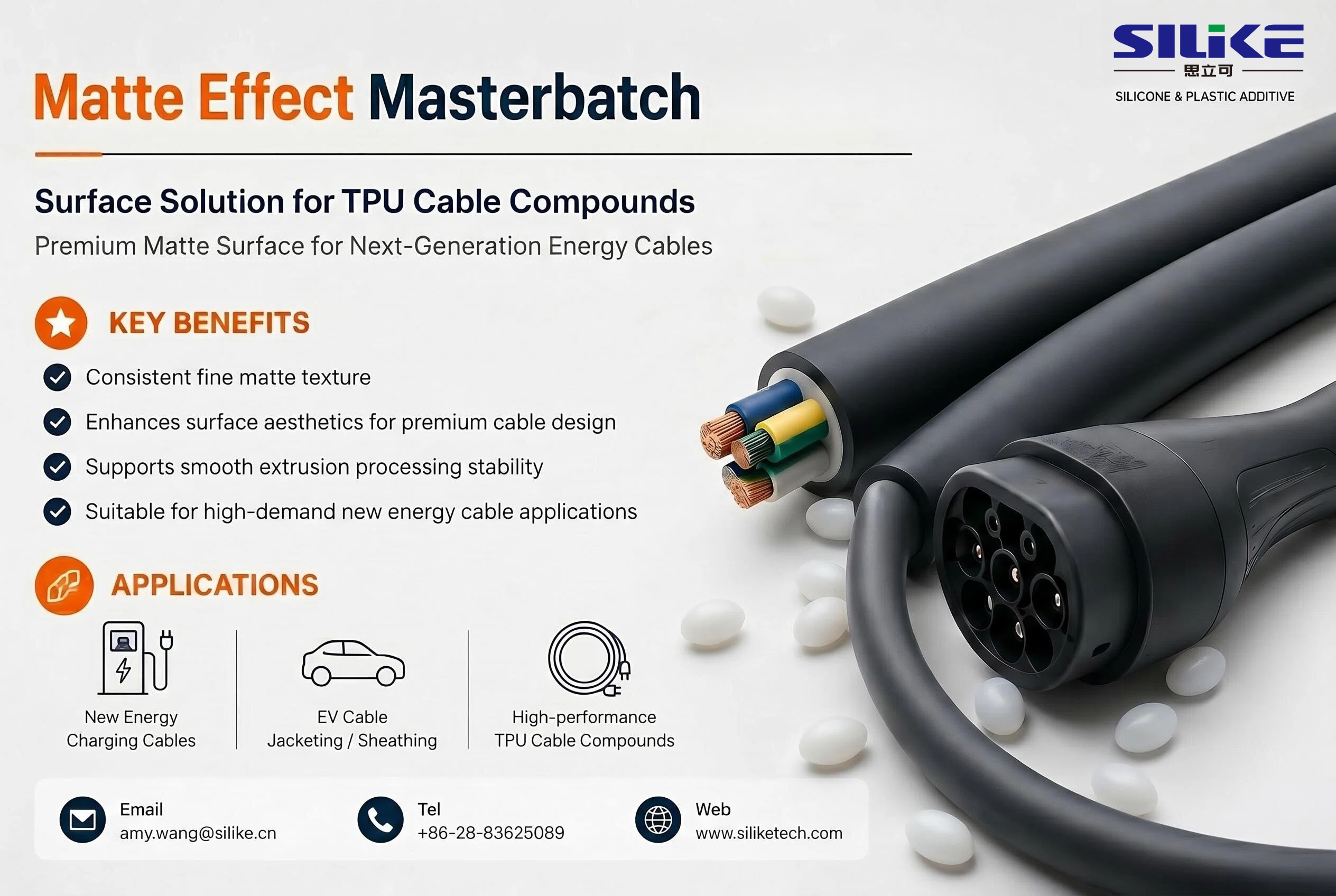
Industrial application example
SILIKE Technology’s Matte Effect Masterbatch is widely used in:
♦ TPU film systems
♦ Wire & cable jacketing compounds
♦ Automotive/ EV EV charging cable applications
♦ Consumer electronics cables
Functional benefits:
• Stable matte appearance
• Improved surface feel
• Enhanced anti-blocking performance
• No migration or precipitation
This matting surface modifier can be directly added during compounding or extrusion, eliminating pre-granulation steps.
5.4 Process control (supporting but critical factor)
Even with optimized formulations, process stability remains essential:
Key parameters:
• Temperature control
• Die design
• Cooling efficiency
• Pressure stability
Common defects caused by poor control:
• Surface whitening
• Gloss increase
• Uneven texture
→ Final surface quality is always a material + process co-controlled system
Struggling with TPU cable jacket gloss fluctuation, surface inconsistency, or matte instability during extrusion?
SILIKE Matte Effect Masterbatch is engineered to deliver stable matte surfaces, improved process consistency, and reliable long-run extrusion performance in TPU cable applications.
Replace unstable surface appearance with a process-insensitive matte solution designed for industrial TPU extrusion systems.
Request a free sample or technical consultation to evaluate performance in your own TPU formulation.
Speak directly with Amy Wang
Email:amy.wang@silike.cn
Website:www.siliketech.com
→ Discover how to optimize TPU cable compounds with durable matte surface performance and long-term production stability.
Post time: May-27-2026


