
Exhibition Reviews: What International Buyers Focused on at CHINAPLAS and K Show
At recent editions of CHINAPLAS and the German K Show, the atmosphere inside the international polymer processing halls clearly reflected a growing shift in regulatory and sustainability expectations across the global plastics industry. Walking through the crowded aisles, technical teams and procurement managers—from international brand owners and converters in the flexible/rigid packaging, wire & cable, pipe, automotive components, and industrial polymer sectors—were no longer focused solely on conventional material solutions.
Instead, many were actively and urgently evaluating sustainable, future-ready polymer technologies aligned with evolving compliance requirements.
The Focal Point: The PFAS Regulatory Storm
One of the most frequently discussed topics at technical meeting tables was the accelerating tightening of regulations on per- and polyfluoroalkyl substances (PFAS), often referred to as "forever chemicals". With regulatory frameworks in Europe, North America, and Asia continuing to evolve, global brands across multiple industries are under increasing pressure to reduce or phase out PFAS in selected applications and accelerate the transition toward compliant, sustainable alternatives.

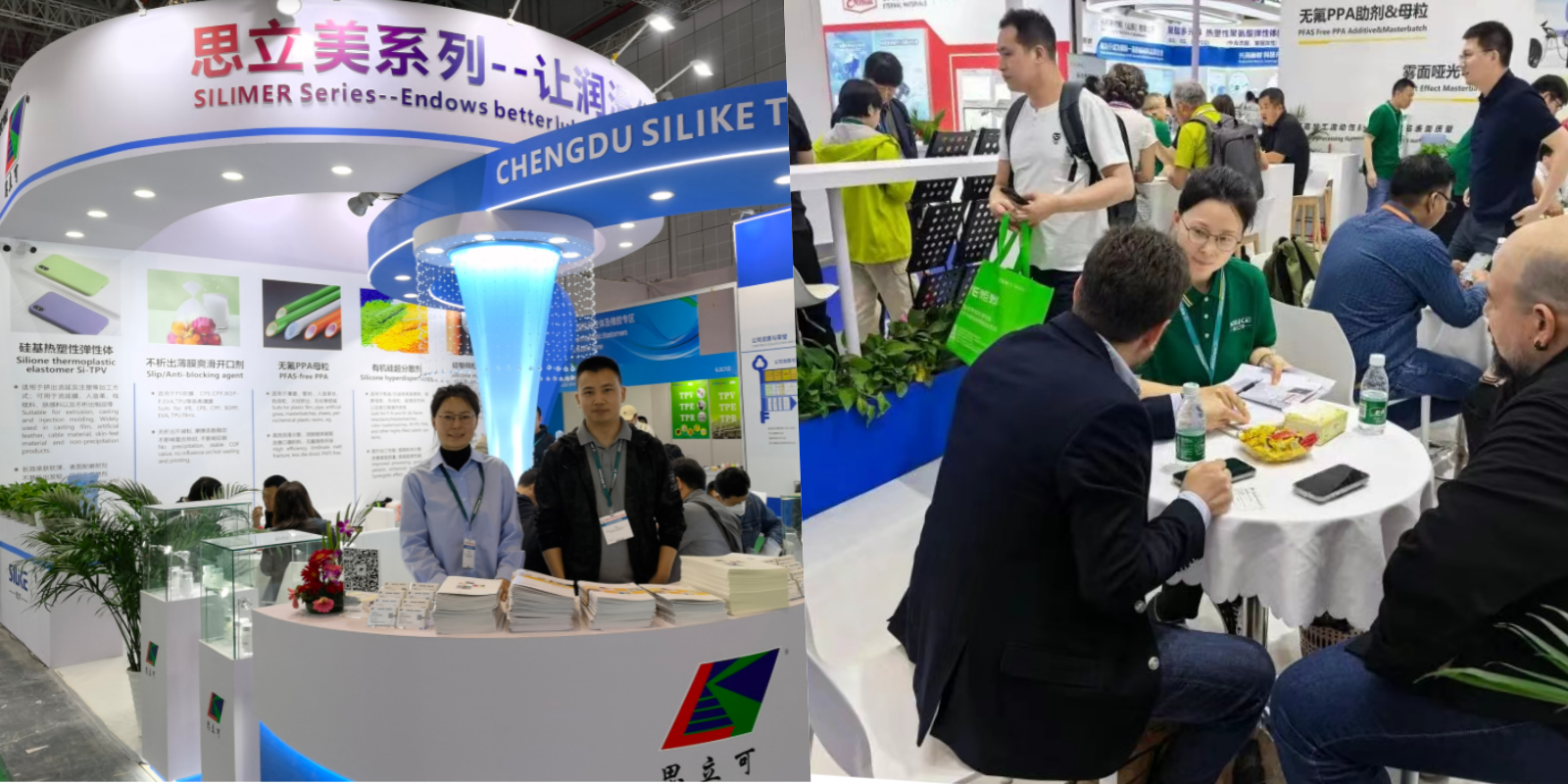
For decades, traditional fluoropolymer-based processing aids (legacy PPAs) have been the industry standard to eliminate melt fracture and surface defects during extrusion. Today, they are being aggressively reassessed. At the exhibition, international buyers focused on one central question: How can we eliminate fluorinated additives without compromising extrusion efficiency, increasing scrap rates, or raising overall production costs?
It was within this solution-driven environment that Chengdu SILIKE Technology Co., Ltd., a leading pioneer in PFAS-free polymer processing aids, attracted strong interest. With over 20 years of expertise in silicone-polymer materials, SILIKE presented a comprehensive portfolio of PFAS-free PPA solutions, drawing attention from international brand owners and Tier-1 suppliers seeking validated, scalable alternatives to conventional fluoropolymer-based PPAs.

Why Global Brands Are Reassessing Fluoropolymer-Based PPAs
The shift toward PFAS reduction is driven by a combination of evolving regulatory frameworks and growing sustainability expectations across global value chains. Regulatory initiatives such as the EU Packaging and Packaging Waste Regulation (PPWR), along with broader chemical management policies in key markets, are gradually redefining requirements for material safety, recyclability, and environmental impact.
While these regulations do not yet constitute an immediate global ban on all fluoropolymer-based processing aids, they signal a clear long-term trend toward stricter control of persistent fluorinated substances. Consequently, global brand owners are proactively reviewing formulations to mitigate potential PFAS-related compliance risks.
Processing Challenges During the Transition Away from Fluoropolymers
Replacing fluoropolymer-based processing aids introduces significant technical challenges in high-performance extrusion systems. In processes involving high-molecular-weight resins or linear low-density polyethylene (LLDPE), removing conventional PPAs increases melt viscosity and internal friction within the polymer melt. This results in several well-known processing instabilities:
• Melt fracture ("shark skin") on extruded surfaces.
• Fluctuations in die pressure and reduced extrusion stability.
• Enhanced die build-up ("die drool"), requiring frequent maintenance and cleaning.
• Elevated scrap rates due to inconsistent surface quality.
These challenges are particularly severe in high-speed film extrusion and multi-layer packaging structures, where process stability directly impacts bottom-line productivity.

Industry Voice: Feedback from the Exhibition Floors
During technical exchanges at major international exhibitions like CHINAPLAS and the K Show, the operational tension between regulatory mandates and manufacturing realities was a dominant theme among materials procurement and technical engineering teams.
As one European packaging industry representative candidly noted during a technical meeting:
"The primary challenge is not only compliance with emerging PFAS-related regulations, but also maintaining stable production efficiency and acceptable scrap levels when transitioning away from established processing systems."
This direct feedback from the field reflects a broader global industry reality: material substitution decisions cannot be made in a vacuum. To be commercially viable, alternative solutions must masterfully balance regulatory alignment with processability, cost efficiency, and long-term production reliability.
The SILIKE Approach: Engineered Path to PFAS-Free Extrusion
Within this challenging context, Chengdu SILIKE Technology Co., Ltd., a China-based manufacturer specializing in silicone-polymer additive and modifier, presented its PFAS-free polymer processing aid (PPA) portfolio as a potential pathway for fluoropolymer reduction in extrusion applications.
The SILIMER series is designed to support polymer processing systems by improving melt flow behavior and reducing surface defects during extrusion. These solutions are developed to help processors address common challenges such as melt fracture(shark skin) and die build-up in polyolefin processing environments.
Rather than positioning as a direct replacement with identical performance, SILIKE PFAS-free PPAs are engineered as potential alternatives to traditional fluoropolymer-based processing aids, aiming to support:
• Improved extrusion stability in selected formulations
• Reduced surface defects under optimized processing conditions
• Lower frequency of die cleaning in certain applications
• Support for PFAS reduction strategies in relevant polymer systems
Best Alternatives to Traditional Fluoropolymer Processing Aids
When evaluating alternatives to traditional fluoropolymer processing aids (PPAs), polymer engineers increasingly find that conventional wax- or fatty-acid-based systems fail to provide the required balance of thermal stability, interfacial activity, and long-term processing consistency under modern high-throughput extrusion conditions.
To bridge this performance gap, SILIKE developed a tri-segment organo-modified polysiloxane molecular architecture. This single engineered system integrates polar functional segments, a polysiloxane backbone, and non-polar compatibility segments to drive a highly controlled, multi-stage mechanism during melt extrusion:
• Uniform Matrix Dispersion: During melt processing, the non-polar compatibility segments ensure that the additive disperses flawlessly within polyolefin matrices like PE and PP, preventing localized agglomeration.
• Dynamic Interfacial Lubrication: The polysiloxane backbone leverages its intrinsic low surface energy and high thermal stability to provide efficient internal lubrication within the moving polymer melt.
• Stable Metal Anchoring: Concurrently, the polar functional segments progressively migrate outward and anchor tightly onto the metal surfaces of the screw, barrel, and die.
This creates a stable, dynamically renewing, low-friction interfacial layer that effectively minimizes polymer-to-metal adhesion and reduces internal shear resistance. By preventing flow instabilities at the die exit, this advanced molecular mechanism reliably mitigates melt fracture (shark skin), controls die drool, stabilizes pressure fluctuations, and extends maintenance cycles—delivering a scalable, fluoropolymer-free alternative for film, pipe, fiber, monofilament, and compounding applications.

SILIKE SILIMER PFAS-Free PPA Product Forms for Polyolefins and Selected Engineering Thermoplastics (PET, PBT, PA, PC)
To support global masterbatch producers, compounders, and downstream converters, SILIKE offers sustainable PFAS-free processing additives in two main product forms, providing flexible formulation and processing options.
• 100% Pure PFAS -free polymer processing additives(PPAs)
(For Resin Production / Compounding Stage)
For high-precision compounding applications requiring full formulation control, SILIMER 9400, SILIMER 9300, SILIMER 9200, and SILIMER 9100 series are supplied as 100% active, fluorine-free polymer processing additives designed to enhance the processing performance of various polyolefins.
These grades are primarily used in the formulation of functional masterbatches. They can be incorporated into polymer systems via compounding and then further processed into customized masterbatches for downstream film, cable, pipe, fiber, and other extrusion applications.
Based on organically modified polysiloxane chemistry, these additives combine the lubricating characteristics of polysiloxanes with functional polar groups, enabling effective dispersion and controlled activity within the polymer melt during processing. This provides processing performance comparable to fluorinated PPA systems across a wide range of applications.
At low addition levels, they help mitigate melt fracture, improve surface quality, and reduce surface defects and gel formation. They also support reduced die build-up, improved processing stability, lower operating pressure, and enhanced production efficiency under demanding extrusion conditions.
Overall, they represent a fluorine-free alternative to conventional fluoropolymer-based PPAs.
• Carrier-Based fluorine-free Masterbatch Systems
(For Direct Industrial Use)
The SILIMER PFAS-free PPA masterbatch series is based on modified polysiloxane functional systems carried in PE, PP, and other resin matrices. Grades such as SILIMER 9406, SILIMER 9301, SILIMER 9201, and SILIMER 5090 are designed to provide effective processing aid functionality during extrusion.
During processing, the active components provide interfacial lubrication at the die, improving melt flow stability and surface quality while reducing die drool, melt fracture, and processing instability.
These Non-PFAS Process Aids Masterbatch products are widely used in film, pipe, sheet, fiber, artificial grass, and wire & cable applications.
SILIMER PFAS-Free PPA Incorporation Procedure
SILIMER PFAS-free PPAs are designed for flexible integration into polyolefin and engineering polymer systems. They can be introduced at different stages depending on production configuration and processing requirements.
• Resin Production / Compounding Stage
– Direct addition during resin manufacturing or compounding for uniform distribution within the polymer matrix
– Alternatively supplied as a masterbatch or concentrate for controlled dosing in downstream processing
• Downstream Processing Stage
– Addition via masterbatch let-down during extrusion or conversion processes, adjusted according to processing conditions and performance targets
SILIMER products are compatible with conventional extrusion and compounding systems and are designed to support stable processing without requiring equipment modification.
PFAS-Free Processing Aid Solutions for Extrusion Applications
The value of a PFAS-free processing aid is ultimately validated under real-world, high-speed extrusion conditions. At recent industry exhibitions, SILIKE demonstrated successful commercial applications of its SILIMER PFAS-free processing aid series across a broad range of polyolefin and recycled polyolefin resin processing systems, including blown film, cast film, and multilayer film extrusion, as well as fiber and monofilament production, cable and pipe extrusion, masterbatch manufacturing, and compounding applications. These application cases demonstrate that fluorine-free processing solutions can effectively replace conventional fluoropolymer-based PPAs while maintaining stable processing performance, consistent surface quality, and high production efficiency under demanding industrial conditions.
Proven Performance Across Key Polyolefin Extrusion Applications
|
Application Sector |
Common Processing Issues & Quality Defects |
SILIKE SILIMER Series Fluorine-free/ PFAS-free polymer processing aids (PPAs) Key Performance Improvements |
|
Blown Film Systems (HDPE, LDPE, LLDPE / mLLDPE) |
shark skin, localized gel formation, die build-up. |
Helps mitigate melt fracture (sharkskin) at appropriate usage levels, supporting more stable extrusion performance across a broad range of polyolefins. It assists in reducing die build-up and the tendency for gel formation, contributing to cleaner processing conditions. In film applications, it may help stabilize bubble inflation and broaden the workable processing window, improving overall operational consistency. |
|
Cast Film Systems |
High shear stress, rapid die lip contamination, high downtime for cleaning. |
Supports more stable melt flow and die lip stability, enabling improved film formation and surface quality. It can help lower gel and crystal point formation while maintaining cleaner dies during extended production runs. At appropriate addition levels, it is generally designed to have minimal impact on optical properties such as clarity and gloss, while supporting more efficient and continuous operation. |
|
Multilayer Co-Extrusion |
Viscosity mismatches between layers, interfacial flow disturbances, haziness. |
Enhances layer-to-layer melt flow balance and die stability in multilayer co-extrusion, helping reduce die build-up and enabling more uniform layer distribution. This contributes to stable processing, consistent surface quality, and reduced downtime, with minimal impact on downstream converting operations such as printing, lamination, and heat sealing at appropriate usage levels. |
|
Pipe Extrusion (HDPE, MDPE, LLDPE, LDPE, PP, PP-R& PE-RT and PVC) |
High backpressure, processing defects caused by carbon black/pigment loading. |
Helps optimize melt flow and interfacial lubrication during extrusion, supporting smoother material transport and more stable processing. This contributes to lower extrusion back pressure and reduced die build-up, enabling more consistent operation and improved overall throughput. |
|
Wire & Cable Extrusion |
Surface defects, die drool, frequent line stops. |
Improves melt flow stability and helps minimize die build-up and equipment fouling, supporting more uniform insulation surfaces and improved processing stability. |
|
Fiber & Monofilament (such as artificial grass and synthetic turf) |
Screen pack fouling, strand breakage, equipment buildup. |
Reduces die and equipment build-up, helping maintain more stable extrusion conditions and smoother processing. It improves melt flow behavior, enabling more uniform fiber and monofilament formation and reducing the risk of strand breakage. This helps reduce cleaning frequency and unplanned downtime, contributing to improved overall production efficiency. |
|
... |
... |
... |
Conclusion: Driving Global Sustainability with Industrial Precision
As the global polymer market continues to move away from hazardous chemical additives, waiting to adapt is no longer an option for forward-thinking brands. Traditional loose fluoropolymer powders and legacy PPAs have reached the end of their lifecycle in premium manufacturing.
By partnering with Chengdu SILIKE Technology Co., Ltd. and integrating the industrially validated SILIMER series, a fluorine-free polymer processing aid solution, global polymer processors can achieve a dual advantage: supporting compliance with stringent international environmental regulations such as REACH, RoHS, and the EU PPWR framework, while simultaneously optimizing their manufacturing throughput and surface quality.
To explore detailed technical documentation of Non-PFAS polymer processing aids for extrusion applications, including application case studies in films, pipes, wire & cable, and fiber & monofilament (such as artificial grass and synthetic turf), or to schedule a custom formulation consultation with our materials engineering team, please visit the official SILIKE corporate portal at https://www.siliketech.com/.
SILIKE’s global application specialists are ready to support your technical team in achieving a smooth and efficient transition toward sustainable, fluorine-free extrusion processes.
Post time: Jun-27-2026


