
Silicone Masterbatch vs Silicone Oil vs Wax vs Slip Agents: Selecting the Right Polymer Additive Solution for Thermoplastic Processing and Surface Performance
Introduction: Advanced Polymer Processing Requires More Than Conventional Lubrication
Modern thermoplastic manufacturing is entering a new stage where processing efficiency, surface quality, durability, and sustainability requirements must be achieved simultaneously.
Polymer processors are continuously improving production efficiency while facing increasingly complex challenges, including higher extrusion speeds, demanding formulations, increased filler content, recycled polymer utilization, and stricter requirements for final product appearance and performance.
During extrusion, compounding, and molding processes, excessive melt friction, unstable flow behavior, die build-up, surface defects, and insufficient wear resistance can significantly affect productivity and product quality.
To overcome these challenges, manufacturers commonly use different additive technologies, including silicone masterbatch, silicone oil, wax additives, and slip agents.
Although these additives may all provide lubrication or surface improvement effects, their molecular structures and working mechanisms are fundamentally different.
Silicone oil provides excellent initial lubrication but may experience migration-related limitations. Wax additives provide conventional processing lubrication but limited surface modification capability. Slip agents effectively reduce coefficient of friction (COF) in film applications but rely on controlled migration behavior.
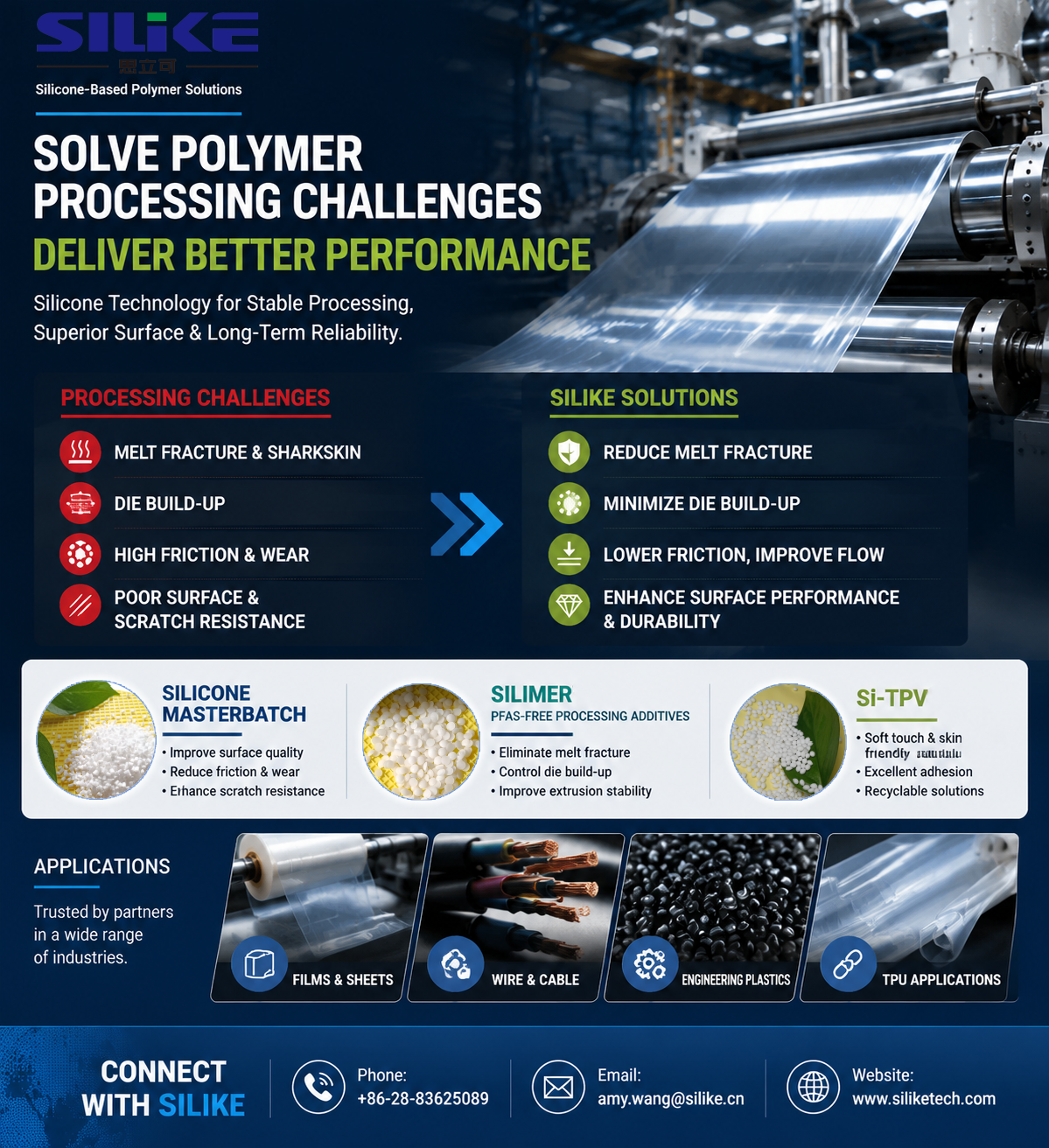
Silicone masterbatch provides a more advanced approach by combining high molecular weight silicone polymers with thermoplastic carrier systems, enabling controlled silicone dispersion, improved processing performance, and long-term surface enhancement.
As a technology-driven silicone additive manufacturer, SILIKE specializes in silicone-based polymer modification solutions designed to help global thermoplastic manufacturers improve processing efficiency, enhance surface performance, and develop higher-value polymer products.
Understanding Silicone Masterbatch Technology
What Is Silicone Masterbatch?
Silicone masterbatch is a polymer additive technology based on high molecular weight silicone polymers dispersed in various thermoplastic carrier resins. It is widely used in thermoplastic processing to improve processing efficiency and enhance surface performance.
Unlike low molecular weight silicone oil, silicone masterbatch is designed to achieve controlled silicone distribution within the polymer matrix. During processing and product service life, silicone components gradually migrate toward the surface, creating a stable low-friction interface.
This controlled release mechanism provides a balance between immediate processing improvement and long-term surface durability.
Compared with traditional lubricants, silicone masterbatch offers multifunctional performance, including:
♦ Improved melt flow behavior
♦ Reduced processing resistance
♦ Enhanced surface smoothness
♦ Lower friction characteristics
♦ Improved scratch and abrasion resistance
♦ Long-term performance stability
Silicone Masterbatch Processing Mechanism and Performance Advantages
During polymer processing, friction occurs between polymer chains, fillers, additives, and metal processing surfaces.
Excessive friction increases melt viscosity, extrusion pressure, torque, and energy consumption.
The silicone polymer component in silicone masterbatch reduces friction interactions within the polymer system and improves melt processing behavior.
Depending on polymer type, formulation design, and processing conditions, silicone masterbatch can contribute to:
♦ Improved extrusion stability
♦ Reduced extrusion torque
♦ More stable melt pressure
♦ Reduced die build-up
♦ Improved surface appearance
♦ More consistent production performance
These advantages make silicone masterbatch particularly valuable for high-speed extrusion, filled compounds, and applications requiring stable manufacturing conditions.
Silicone Masterbatch for Surface Modification and Long-Term Performance
Beyond processing improvement, silicone masterbatch provides durable surface modification.
Silicone polymers naturally possess low surface energy, excellent thermal stability, and outstanding lubrication characteristics.
When properly dispersed within thermoplastic systems, silicone components can improve surface properties without relying on excessive surface migration.
This makes silicone masterbatch suitable for applications requiring:
♦ Low friction surfaces
♦ Improved scratch resistance
♦ Enhanced abrasion resistance
♦ Better tactile performance
♦ Improved release behavior
Compared with low molecular weight lubricants, silicone masterbatch provides more stable long-term performance, especially in demanding applications where surface durability is critical.
Silicone Oil vs Silicone Masterbatch: Lubrication Performance and Durability
Silicone oil is one of the most widely used silicone-based lubricants in polymer processing.
Its low viscosity and high molecular mobility allow rapid distribution throughout polymer systems, providing excellent initial lubrication and release performance.
However, the same mobility can also result in uncontrolled migration.
Potential challenges include:
♦ Surface contamination
♦ Reduced printing adhesion
♦ Coating compatibility issues
♦ Bonding problems
♦ Changing friction behavior over time
Therefore, silicone oil is typically suitable for applications where immediate lubrication is required.
For applications requiring controlled silicone performance, reduced migration risk, and long-term surface modification, silicone masterbatch provides a more durable solution.
Wax Additives vs Silicone Masterbatch: Traditional Lubrication Compared with Advanced Surface Modification
Wax additives have been widely used as conventional processing lubricants in polymer manufacturing.
They improve processing behavior by reducing friction between polymer chains and between polymer melt and equipment surfaces.
However, wax additives primarily function as lubricants and generally provide limited improvement in advanced surface properties.
Compared with silicone masterbatch, wax technology typically provides less contribution to:
♦ Scratch resistance
♦ Abrasion resistance
♦ Long-term low-friction performance
♦ Premium surface feel
For modern applications requiring both processing optimization and enhanced surface functionality, silicone masterbatch offers broader performance advantages.
Slip Agents vs Silicone Masterbatch: Different Approaches to Friction Control
Slip agents are commonly used in PE and PP film applications to reduce the coefficient of friction.
Traditional slip agents function through migration. After processing, molecules move toward the polymer surface and create a lubricating layer.
This mechanism provides effective film handling performance.
However, migration behavior can be influenced by:
♦ Polymer structure
♦ Additive concentration
♦ Storage conditions
♦ Processing history
♦ Environmental exposure
For applications requiring consistent surface properties, printing compatibility, and long-term performance, silicone masterbatch provides an alternative technology approach.
Technical Comparison of Silicone Masterbatch, Silicone Oil, Wax, and Slip Agents
| Performance Requirement | Silicone Masterbatch | Silicone Oil | Wax Additives | Slip Agents |
|---|---|---|---|---|
| Processing improvement | Excellent | Excellent | Good | Moderate |
| Friction reduction | Excellent | Excellent | Moderate | Excellent |
| Migration control | High | Low | Medium | Medium |
| Surface durability | Excellent | Limited | Limited | Medium |
| Scratch resistance | Excellent | Limited | Limited | Limited |
| Long-term stability | Excellent | Limited | Medium | Application dependent |
| Engineering plastics suitability | Excellent | Limited | Limited | Limited |
| Film application suitability | Excellent | Application dependent | Application dependent | Excellent |
SILIKE Silicone Masterbatch Solutions: Enabling Better Polymer Performance
A Technology Partner for Thermoplastic Manufacturers
Selecting a silicone masterbatch supplier is not only about choosing an additive. Successful polymer modification requires a deep understanding of material chemistry, polymer compatibility, processing behavior, and final application requirements.
SILIKE combines silicone technology expertise with polymer application experience to develop silicone-based process aids and surface modifier solutions that help manufacturers improve processing efficiency, surface performance, and product reliability.
Key capabilities include:
♦ Silicone polymer technology expertise
♦ Polymer compatibility evaluation
♦ Application-specific formulation development
♦ Processing optimization support
♦ Technical troubleshooting and evaluation
SILIKE LYSI series Silicone Masterbatch ( Siloxane Masterbatch ) solutions are pelletized formulations with 20~65% ultra-high-molecular-weight siloxane polymer dispersed in various resin carriers. It is widely used as an efficient processing additive in its compatible resin system to improve the processing properties and modify surface quality.
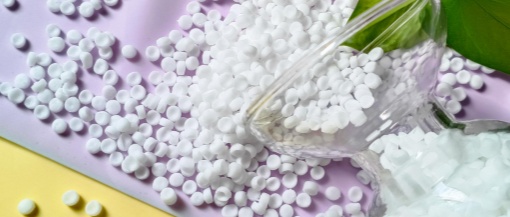
Compared to conventional lower molecular weight Silicone / Siloxane additives, like Silicone oil, silicone fluids, or other types of processing aids, SILIKE Silicone Masterbatch LYSI series are expected to give improved benefits, eg,. Less screw slippage, improved mold release, reduced die drool, a lower coefficient of friction, fewer paint and printing problems, and a broader range of performance capabilities.
Typical benefits include:
♦ Improved scratch and abrasion resistance
♦ Enhanced surface smoothness
♦ Reduced friction and improved release performance
♦ Better processing stability
♦ Improved tactile properties
SILIKE Polymer Processing Additive Technology
Beyond silicone masterbatch, SILIKE develops polymer processing solutions designed to improve extrusion performance.
SILIMER PFAS-Free Polymer Processing Additives
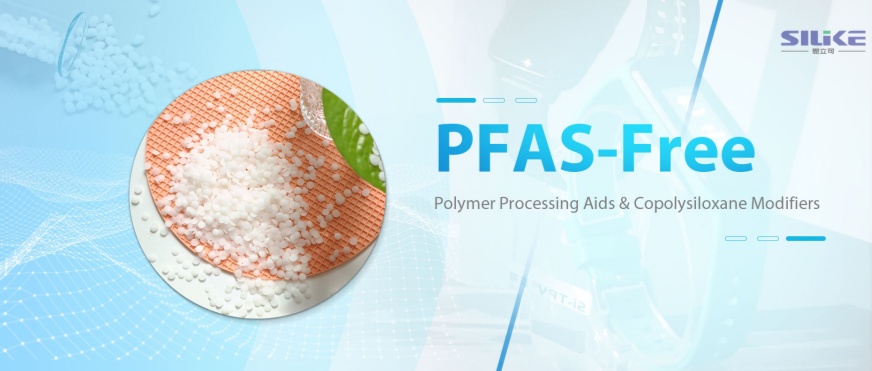
SILIMER PFAS-free PPA solutions provide fluorine-free alternatives for polymer extrusion applications requiring:
♦ Reduced melt fracture(Sharkskin)
♦ Lower die build-up
♦ Improved processing stability
♦ Enhanced surface quality
♦ Meet eco-friendly standards and regulatory compliance
These technologies support manufacturers seeking efficient and sustainable processing solutions.
Why Choose SILIKE as Your Silicone Additive Partner?
With more than 20 years of expertise in silicone–polymer integration, Chengdu SILIKE Technology Co., Ltd. specializes in silicone-based polymer additives and thermoplastic silicone elastomer technologies.
SILIKE provides:
♦ Silicone masterbatch solutions
♦ Siloxane Additives & Modifiers
♦ Silicone processing additives
♦ Anti-scratch and anti-abrasion additives
♦ PFAS-free polymer processing solutions
♦ Slip Masterbatch & Anti-Blocking Masterbatch
♦ Hyperdispersants
♦ Functional Additives for Biodegradable Materials
♦ Processing Lubricants for Wood-Plastic Composites (WPCs)
♦ Matte Effect Masterbatch
♦ Si-TPV thermoplastic silicone elastomer solutions
♦ Slip- & Wear-Resistant Additive
♦ And more…
By combining material science expertise with application development capabilities, SILIKE supports manufacturers across industries including:
♦ Automotive
♦ Wire and cable
♦ Films and packaging
♦ Electronics
♦ Footwear
♦ Consumer products
♦ Sustainable polymer applications
Application-Focused Technical Support
Every polymer system has unique requirements. SILIKE works with customers to optimize solutions based on:
♦ Polymer type and formulation design
♦ Processing conditions and equipment
♦ Performance targets and application requirements
Technical support includes:
♦ Additive selection
♦ Formulation optimization
♦ Application testing
♦ Processing improvement recommendations
Partner with SILIKE for Next-Generation Polymer Solutions
As a professional silicone masterbatch manufacturer and silicone additive supplier, SILIKE is committed to helping polymer manufacturers achieve higher processing efficiency, improved product quality, and enhanced application performance.
Whether your challenge is extrusion instability, high friction, surface defects, scratch resistance, poor processing efficiency, or the need for advanced polymer surface modification, SILIKE provides customized silicone-based polymer processing additives and surface modifier solutions engineered for your specific application requirements.
Contact SILIKE to discuss your polymer processing challenges and explore an optimized silicone additive solution for your materials.
Phone: +86-28-83625089
Email:amy.wang@silike.cn
Website:www.siliketech.com
Post time: Jul-24-2026


