
1. Industry Challenges in Nylon (PA6 / PA66 Glass Fiber Reinforced Systems) Applications
Nylon (PA6, PA66, and PA66 glass fiber reinforced grades) is widely used in engineering plastics due to its high strength, chemical resistance, and durability. However, in long-term high-load or dry-friction applications, nylon components often face critical wear and friction challenges:
• Surface degradation and high friction: Dry sliding and intermittent contact generate heat, increasing the coefficient of friction (COF) and surface wear.
• Glass fiber protrusion: In reinforced systems, uneven fiber dispersion exposes micro-asperities, causing abrasive wear.
• Noise generation during sliding contact
• Poor mold release during injection molding
• Reduced durability under long-term dry sliding conditions
2. Conventional Lubricant Additives for Nylon
Common additives include PTFE, MoS₂, graphite, and waxes. Challenges include:
• High loading requirements with cost-performance trade-offs
• Reduced mechanical strength of the nylon matrix
• Dispersion instability in reinforced systems
• Regulatory pressure on PFAS-based materials
Market trend: The industry is shifting toward PFAS-free, low-dosage, high-efficiency lubrication systems. Manufacturers are exploring alternative PTFE-free modification technologies for engineering plastics.
3. Innovative Silicone-Based Solution: A New Approach for Nylon
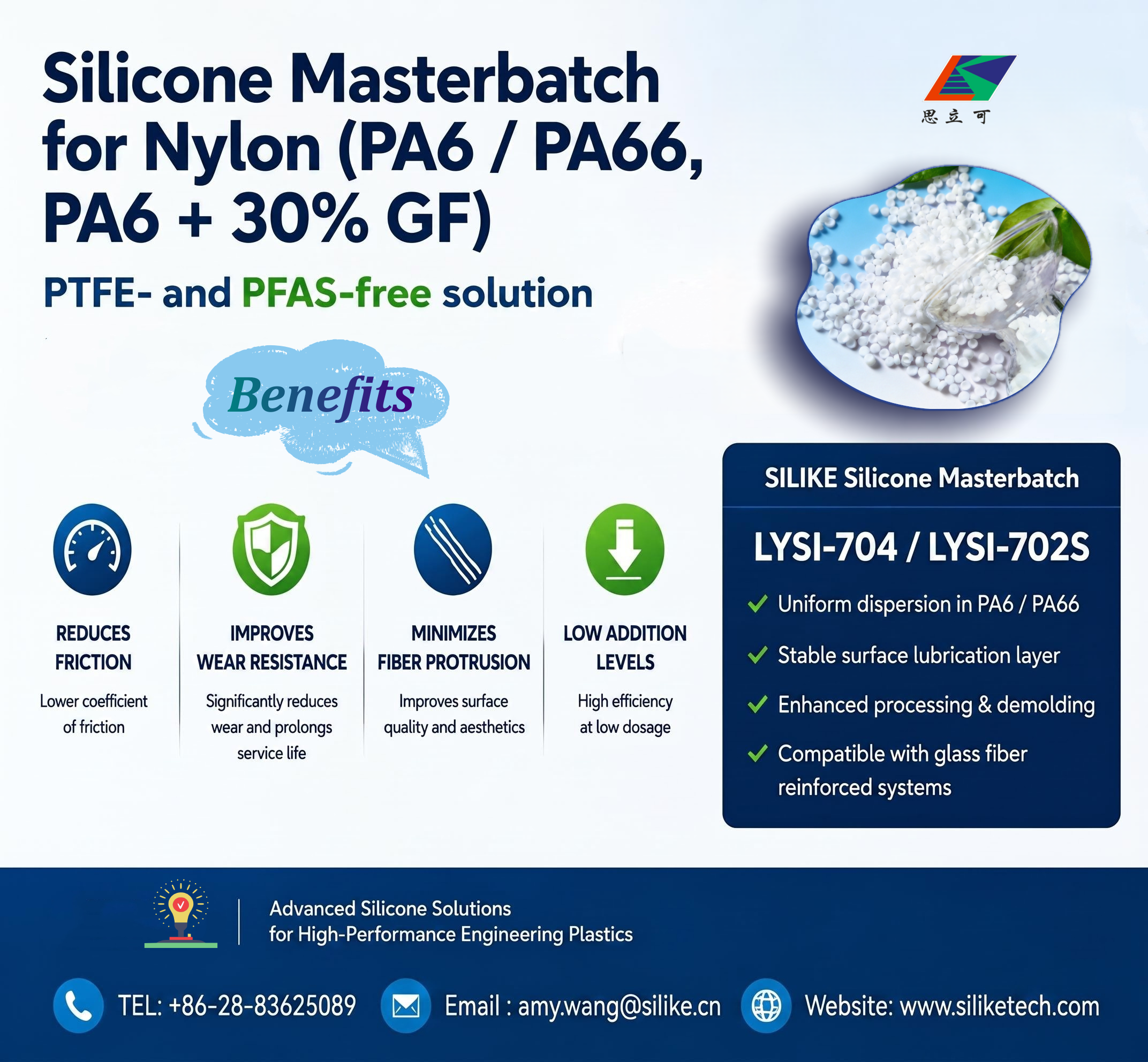
Unlike solid lubricants, SILIKE has developed an innovative silicone-based solution—specifically, Silicone Masterbatch LYSI-704 and LYSI-702S. This solution is designed to enhance the wear resistance of engineering plastics. Its core component is a polysiloxane with a special structure, synthesized through a proprietary process to endow the polysiloxane with specific functionalities. It is a PTFE- and PFAS-free solution for friction and wear reduction, offering manufacturers an alternative modification technology.
Core Mechanism
① Surface Migration (Self-Lubrication Formation)
Polysiloxane chains migrate to the surface during processing and service.
② Lubricating Film Formation
A continuous silicone-rich layer reduces direct polymer–fiber contact.
③ Wear Protection Mechanism
Minimizes fiber exposure and surface abrasion in reinforced nylon.
④ Processing Lubrication Effect
Improves melt flow, mold release, and surface finish.
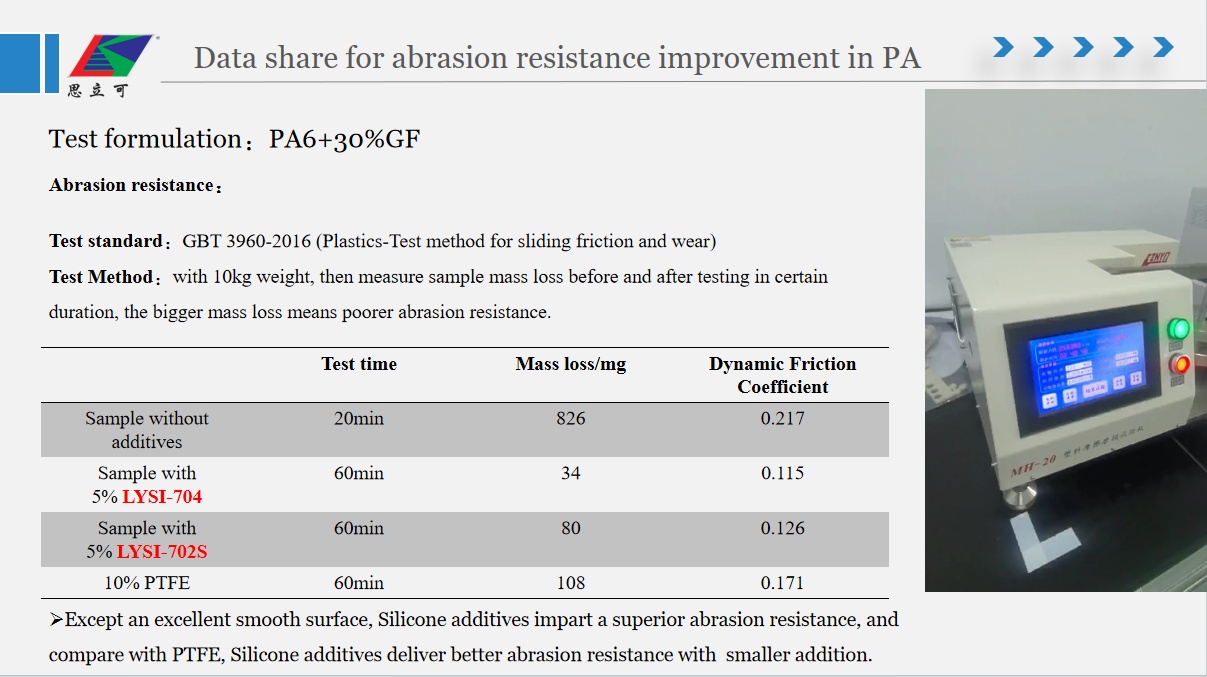
4. Performance Comparison (PA6 + 30% Glass Fiber): Silicone Masterbatch vs PTFE
5. Why Silicone Masterbatch as an Alternative to PTFE in Nylon
Key functional benefits of silicone masterbatch as a PFAS-free alternative to PTFE in nylon:
• Uniform dispersion in PA6 / PA66 systems
• Requires lower dosage for equivalent or superior performance
• Reduces friction, wear, and forms a stable surface lubrication layer
• Improves surface quality by reducing fiber protrusion in reinforced nylon
• Maintains mechanical strength and compatibility with PA6 / PA66 matrix
• Provides more stable processing behavior and improved demolding performance
• Enables PFAS-free compliance in regulated markets
6. Recommended Grades for PA6 / PA66 Systems
SILIKE Silicone Masterbatch: LYSI-704 / LYSI-702S, designed specifically for engineering nylon systems requiring high wear resistance, low friction performance, and stable processing behavior in glass fiber reinforced systems.
By using SILIKE Silicone Masterbatch LYSI-704 and LYSI-702S in PA6, PA66, and glass fiber reinforced nylon systems, it directly extends product lifetime, improves efficiency, and enhances safety in demanding applications such as automotive, UAV, photovoltaics, and electronics.
7. Frequently Asked Questions (FAQ )About Silicone Masterbatch for Nylon
Q1: What is Silicone Masterbatch for Nylon?
SILIKE Silicone Masterbatch LYSI-704 and LYSI-702S are PTFE- and PFAS-free engineering polymer additives based on ultra-high molecular weight polysiloxane, designed to improve the tribological and processing performance of nylon materials such as PA6, PA66, and PA66 glass fiber reinforced systems.
Silicone masterbatch enhances nylon by forming a self-migrating polysiloxane surface layer that significantly reduces friction and wear while maintaining mechanical strength at low dosage levels.
Compared with conventional lubricants such as PTFE, MoS₂, and waxes, silicone masterbatch provides a more stable and polymer-compatible lubrication system that does not rely on high filler loading.
Q2: What is silicone masterbatch used for in nylon?
It is used to reduce friction, improve wear resistance, enhance surface quality, and optimize processing performance in PA6 and PA66 systems.
Q3: Can silicone masterbatch replace PTFE in nylon?
Yes. In many engineering applications, silicone masterbatch serves as a PFAS-free alternative to PTFE, especially where low dosage efficiency and processing stability are required.
Q4: Does silicone masterbatch affect mechanical properties?
When properly formulated, it maintains mechanical strength while significantly improving tribological performance.
Q5: Why is silicone effective in glass fiber reinforced nylon?
It reduces fiber exposure and friction at the polymer–fiber interface, improving wear resistance and surface durability.
Conclusion: Silicone masterbatch provides a PFAS-free lubrication solution for nylon (PA6, PA66) by forming a self-migrating polysiloxane surface layer that significantly reduces friction and wear at low dosage levels, making it a high-performance alternative to PTFE in engineering plastic applications.
For more information on how silicone-based lubricant LYSI-704 and LYSI-702S can improve your PA66 components, contact SILIKE. We provide personalized advice, free samples, and technical support to help you select the most suitable modification solution for your application.
Tel: +86-28-83625089 or via Email: amy.wang@silike.cn. Website:www.siliketech.com
Post time: Jun-04-2026


