
Technical Solution Guide | Silicone Masterbatch for Polyester Fibers
For PET fiber manufacturers, improving surface quality is not simply a matter of adding a lubricant. The right additive must also be compatible with polymer processing, fiber formation, and downstream manufacturing requirements.
Polyester filament producers may need to balance surface slip, coefficient of friction, processing stability, and consistent fiber quality. An additive that performs well in another PET application may not necessarily deliver the same results under fiber-spinning conditions.
So, how should manufacturers select suitable silicone additives for PET fibers?
SILIKE offers PET-compatible silicone masterbatch technology and modified copolysiloxane additives for polymer processing and surface-property modification. These silicone additives provide formulation options for manufacturers seeking to evaluate improvements in PET fiber processing and surface performance.
1. What Surface and Processing Challenges Do PET Fiber Manufacturers Face?
Polyethylene terephthalate (PET) is widely used in polyester filament yarns, staple fibers, nonwoven materials, and technical textiles.
In fiber manufacturing, material properties and processing conditions influence not only production efficiency but also the performance of the resulting fibers and yarns.
Depending on the equipment, formulation, and intended application, manufacturers may encounter:
• Unstable processing behavior: Variations in melt flow, extrusion pressure, or production consistency.
• Surface friction concerns: Fiber-to-fiber and fiber-to-metal friction that may affect handling or downstream operations.
• Filament quality requirements: The need to maintain consistent fiber dimensions, appearance, and mechanical properties.
• Downstream processing challenges: Compatibility with drawing, winding, textile formation, and subsequent finishing.
• Functional surface requirements: Applications requiring specific slip, wear, wetting, or tactile characteristics.
These challenges cannot always be addressed through a single processing adjustment.
For manufacturers evaluating PET fiber processing additives, the objective is to identify a formulation that delivers the required surface properties while remaining compatible with the production process.
2. How Can Silicone Additives Support PET Fiber Processing and Surface Modification?
Silicone-based additives are used in compatible polymer systems to modify processing and surface characteristics.
Their potential functions include processing lubrication, surface friction modification, and improvements in selected aspects of surface quality.
In PET applications, silicone masterbatch can offer a convenient way to incorporate silicone functionality into a polymer formulation.
However, its effectiveness depends on the additive chemistry, carrier compatibility, dosage, incorporation method, and processing conditions.
Surface Slip and Coefficient of Friction
Surface friction is an important consideration in fiber and yarn processing.
Silicone additives may be evaluated when manufacturers need to modify the coefficient of friction (COF) or surface slip characteristics of PET materials.
For a fiber application, the relevant question is not simply whether an additive lowers friction in a general polymer test.
Manufacturers should determine whether it delivers the required frictional behavior during actual filament handling and downstream processing.
Processing Lubrication and Stability
In suitable thermoplastic formulations, silicone-based processing additives can reduce frictional resistance during melt processing.
Potential benefits may include changes in flow behavior, extrusion torque, or material surface quality.
For PET fiber production, these effects should be assessed through relevant line parameters rather than assumed from injection-molding or general extrusion data.
Surface Performance Beyond Processing
Some PET fiber applications require surface-property modification beyond basic processing lubrication.
Examples may include surface smoothness, wear-related behavior, or specific wettability requirements.
The suitability of a silicone additive for these functions must be evaluated against the target fiber and finished-product specifications.
3. LYSI-408: PET-Based Silicone Masterbatch for Polyester Fiber Applications
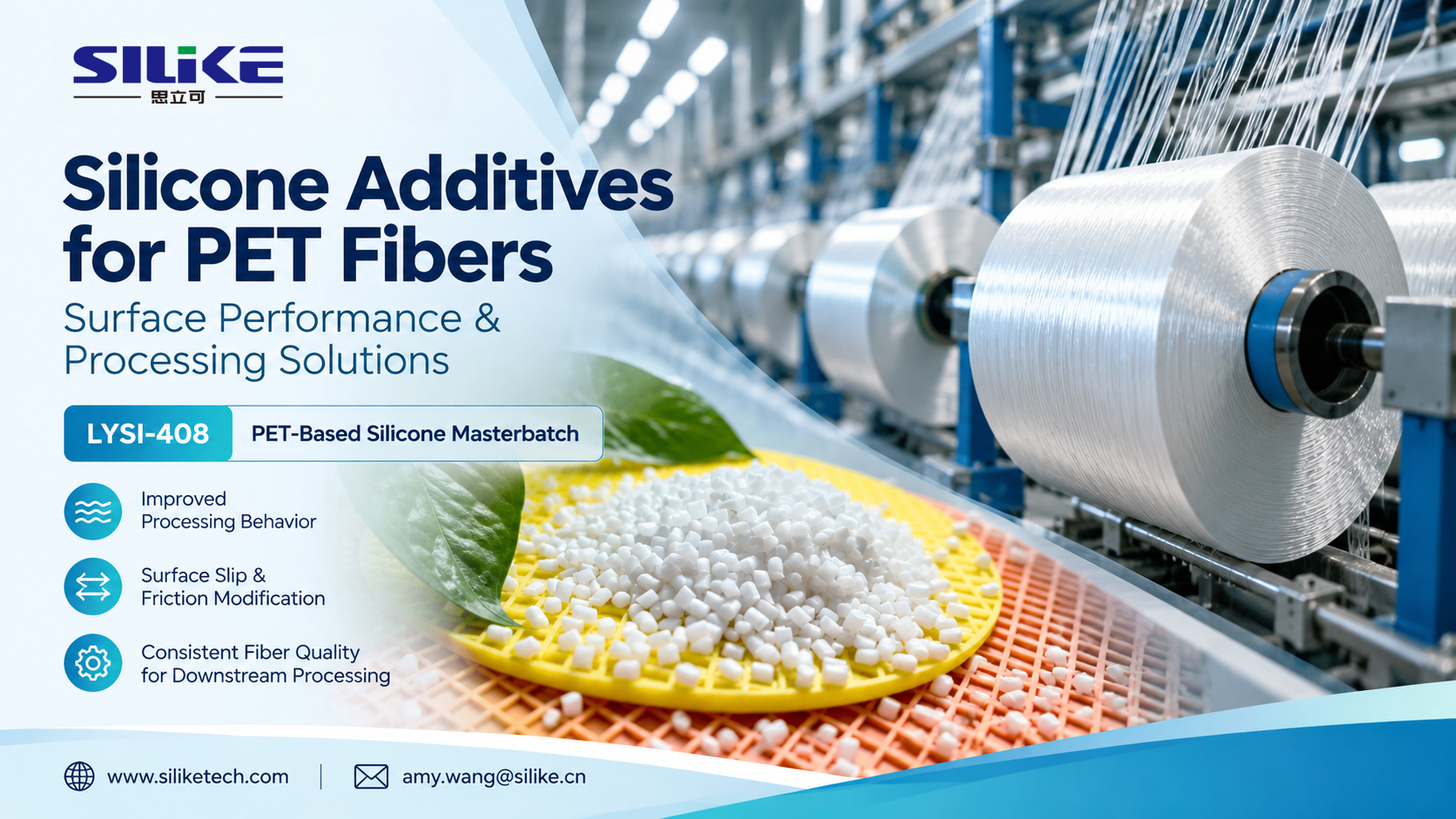
SILIKE LYSI-408 Silicone Masterbatch is a pelletized additive containing 30% ultra-high-molecular-weight siloxane polymer dispersed in a PET carrier.
Its PET-based carrier makes it a relevant candidate for compatible polyester formulations, including PET fibers. Silicone masterbatch LYSI-408 is designed to improve processing and surface characteristics in suitable PET systems.
Key benefits include:
• Improved polymer flow and processing behavior
• Surface slip and coefficient of friction modification
• Improved surface quality
• Abrasion- and scratch-related performance improvement in applicable formulations
Why Does the PET Carrier Matter?
Carrier compatibility is an important consideration when selecting silicone masterbatch for polyester fibers.
A PET-based carrier allows the silicone masterbatch to be evaluated within a compatible polyester formulation without introducing an unrelated carrier resin.
However, matching the polymer carrier does not guarantee successful fiber production.
The masterbatch must still be evaluated for dispersion, thermal processing behavior, filtration, filament formation, and final fiber properties.
How to Evaluate LYSI-408 Silicone Masterbatch in PET Fiber Production
PET fiber manufacturers should evaluate Silicone masterbatch LYSI-408 through controlled trials against their existing formulations, considering both processing performance and final fiber quality.
Key evaluation parameters may include:
• Melt pressure and processing stability
• Filter or spin-pack pressure trends
• Filament breakage frequency
• Filament uniformity and mechanical properties
• Surface friction and yarn handling
• Downstream drawing, winding, and processing performance
According to SILIKE’s published product guidelines, LYSI-408 is generally recommended at addition levels of 0.2–1% for processing improvement and 2–5% for surface-property modification in compatible thermoplastic applications.
Depending on the formulation and processing conditions, potential benefits include improved processability, enhanced surface lubricity and slip, a lower coefficient of friction (COF), and improved scratch and abrasion resistance.
For PET fiber spinning, these general dosage ranges should be treated as starting references rather than validated recommendations. The appropriate addition level should be determined through application-specific trials to ensure a suitable balance between processing stability, filament quality, and the required surface performance.
4. When Should Manufacturers Consider a Liquid Copolysiloxane Additive?
Pelletized silicone masterbatch is not the only formulation option available to polymer processors.
For manufacturers with suitable mixing, metering, or compounding equipment, liquid copolysiloxane additives may also be considered.
SILIKE SILIMER 6600 is a liquid modified copolysiloxane processing additive.
SILIKE copolysiloxane processing additive SILIMER 6600. Its established functions include processing lubrication, improved dispersion of selected formulation components, and surface-property modification in compatible thermoplastic systems.
Beyond these established functions, customer application feedback also highlights its potential in PET fiber surface-performance and processing applications.
In a reported PET fiber evaluation, SILIMER 6600 was used in combination with LYSI-408 silicone masterbatch, achieving a water contact angle of 118° under the evaluated conditions. This result provides a promising basis for further investigation of silicone-based additives in PET fiber hydrophobic modification.
Silicone Masterbatch vs. Liquid Silicone Additive
| Evaluation Factor | PET-Based Silicone Masterbatch | Liquid Copolysiloxane Additive |
|---|---|---|
| Product form | Pellets | Liquid |
| Incorporation | Compatible pellet feeding or compounding | Appropriate liquid metering, mixing, or compounding |
| Key consideration | Carrier compatibility and dispersion | Metering accuracy and uniform distribution |
| Production assessment | Spinning stability and fiber properties | Addition method, processing compatibility, and fiber properties |
| Selection basis | Existing equipment and target performance | Existing equipment and target performance |
A pelletized product may simplify additive handling for some manufacturers, while a liquid product may be more appropriate where suitable incorporation equipment is available.
Neither approach should be selected solely on product form.
Manufacturers must confirm that the additive can be distributed consistently without negatively affecting fiber formation or the required properties.
5. Are Silicone Additives Different from Conventional Fiber Finishes?
PET fiber manufacturers may already use spin finishes or other surface treatments to control friction, static behavior, and downstream processing performance.
A silicone additive incorporated into the polymer melt is not necessarily a direct substitute for a topical fiber finish.
These approaches involve different application stages and may serve different functions.
When evaluating an internally incorporated silicone additive, manufacturers should determine whether the objective is to modify the polymer’s processing behavior, the fiber surface characteristics, or both.
Compatibility with any existing spin-finish system should also be checked.
This distinction is particularly relevant when designing a trial intended to improve surface slip without disrupting subsequent processing.
6. How to Select Silicone Masterbatch for PET Fiber Manufacturing
An effective additive trial should connect the customer’s technical problem with measurable performance requirements.
| Evaluation Stage | Information to Confirm | What to Measure |
|---|---|---|
| Polymer selection | PET grade, intrinsic viscosity, existing formulation | Baseline resin and melt characteristics |
| Additive incorporation | Pellet feeding, mixing, or compounding method | Feeding consistency and dispersion |
| Fiber production | Extrusion and spinning conditions | Melt pressure, continuity, and filament quality |
| Surface evaluation | Target slip or friction requirements | Relevant COF or fiber-friction measurements |
| Downstream validation | Drawing, winding, or textile processing | Processing consistency and finished-product properties |
Where possible, compare the current production formulation with one or more candidate additive formulations under controlled conditions.
Changes in melt processing should be considered alongside filament tensile properties, elongation, quality consistency, and downstream requirements.
An effective PET fiber additive is one that meets the required balance of processability, surface performance, and final product quality—not simply the formulation with the highest silicone content.
7. Can Silicone Additives Also Be Evaluated for Hydrophobic PET Fibers?
Yes. Silicone-based additives may also be investigated as part of PET fiber surface-wettability modification.
In a separate SILIKE application evaluation, a combination of LYSI-408 and SILIMER 6600 produced a reported water contact angle of up to 118° under the evaluated conditions.
This indicates hydrophobic wetting behavior for the tested sample.
However, it does not establish the final fabric’s water-repellency rating, durability, or one-sided repellency performance.
Those requirements need additional application-specific testing.
The evaluation illustrates why surface-property development should be connected with measurable end-use performance rather than assessed using a single laboratory parameter.
8. Frequently Asked Questions
Which silicone masterbatch can be evaluated for PET fibers?
SILIKE LYSI-408 is a PET-carried silicone masterbatch containing 30% ultra-high-molecular-weight siloxane polymer. PET fibers are among its listed applications. The appropriate addition level and suitability for a particular spinning process should be confirmed through production trials.
Can silicone additives reduce friction in polyester fibers?
Silicone additives can modify surface friction in compatible polymer systems. For polyester fibers, the effect should be assessed using relevant fiber or yarn friction measurements and downstream process evaluations. A reduction observed in another polymer application should not automatically be assumed to apply to PET yarns.
How do I choose between liquid silicone additives and silicone masterbatch?
Selection depends on the resin formulation, available feeding or compounding equipment, dispersion requirements, and the intended performance target. PET-based silicone masterbatch provides a pelletized option, while liquid additives require an appropriate incorporation method. Both require application-specific validation.
What should I provide when requesting PET fiber additive samples?
Useful information includes the PET grade, fiber or yarn type, spinning conditions, current processing problems, target surface properties, and expected trial scale. These details help identify suitable additives and develop a meaningful evaluation plan.
9. Discuss Your PET Fiber Processing Challenges with SILIKE
Looking for a silicone masterbatch supplier for PET fibers or evaluating additives to improve polyester fiber surface performance?
SILIKE provides silicone-based additive technologies for compatible thermoplastic formulations, including PET applications.
Whether your priority is surface slip, processing stability, friction modification, or a specific functional surface requirement, additive selection should begin with the actual production conditions.
Share your PET resin grade, fiber process, target properties, and current challenges with SILIKE.
Our technical team can discuss suitable additive candidates and sample evaluation options for your application.
Chengdu SILIKE Technology Co., Ltd.
Website: https://www.siliketech.com/
Email: amy.wang@silike.cn
Product suitability and performance depend on formulation, processing equipment, dosage, and the intended end use.
Post time: Oct-21-2026


