
PFAS-Free PPA for Pipe Extrusion: Meeting 2026 Global Regulatory Compliance & EU Standards
1. Industry Shift: PFAS Regulations Are Reshaping Pipe Extrusion
Across Europe and global markets, PFAS regulations are accelerating:
• EU PFAS restriction proposal covering 10,000+ substances
• OEMs and infrastructure projects requiring PFAS-free declarations
• Increasing audits on food-contact and potable water systems
For pipe extrusion manufacturers, the real risk is not regulation itself —but losing projects due to non-compliance.
2. What is PFAS-Free PPA in Pipe Extrusion?
PFAS-Free PPA (Non-Fluorinated Processing Aid) is an additive used in polymer extrusion that:
• Eliminates melt fracture (sharkskin)
• Improves pipe surface smoothness
• Reduces die build-up
• Enhances processing stability
• Meets global PFAS regulatory requirements
Widely used in: HDPE, PP-R, and PE-RT pipe extrusion
3. Why Fluoropolymer PPA Is Becoming a Risk
Traditional fluoropolymer-based PPAs have long been used to:
• Reduce melt fracture
• Lower friction
• Improve surface finish
However, they now face growing challenges:
• Increasing regulatory restrictions (EU and global)
• Environmental persistence concerns
• Customer demand for PFAS-free materials
As a result, fluorinated PPA is shifting from a “performance solution” to a “compliance liability.”
4. Key Challenges in Pipe Extrusion
Based on industrial production feedback, common issues include:
4.1 Melt Fracture (Sharkskin)
• Causes rough pipe surfaces
• Impacts pressure and potable pipe quality
4.2 Die Build-Up
• Cleaning required every 4–8 hours
• Leads to downtime and productivity loss
4.3 High Energy Consumption & Torque
• Reduced extrusion efficiency
5. Can PFAS-Free PPA Replace Fluoropolymer PPA?
Yes. PFAS-free PPAs provide comparable performance in:
• Melt fracture elimination
• Surface quality improvement
• Throughput enhancement
6. Replacing Fluorinated PPAs in Pipe Production: The PFAS-Free Strategic Alternative
Seamless Replacement for Fluorinated PPAs: SILIKE PFAS-free SILIMER Series, Ushering in a New Era of Green Extrusion
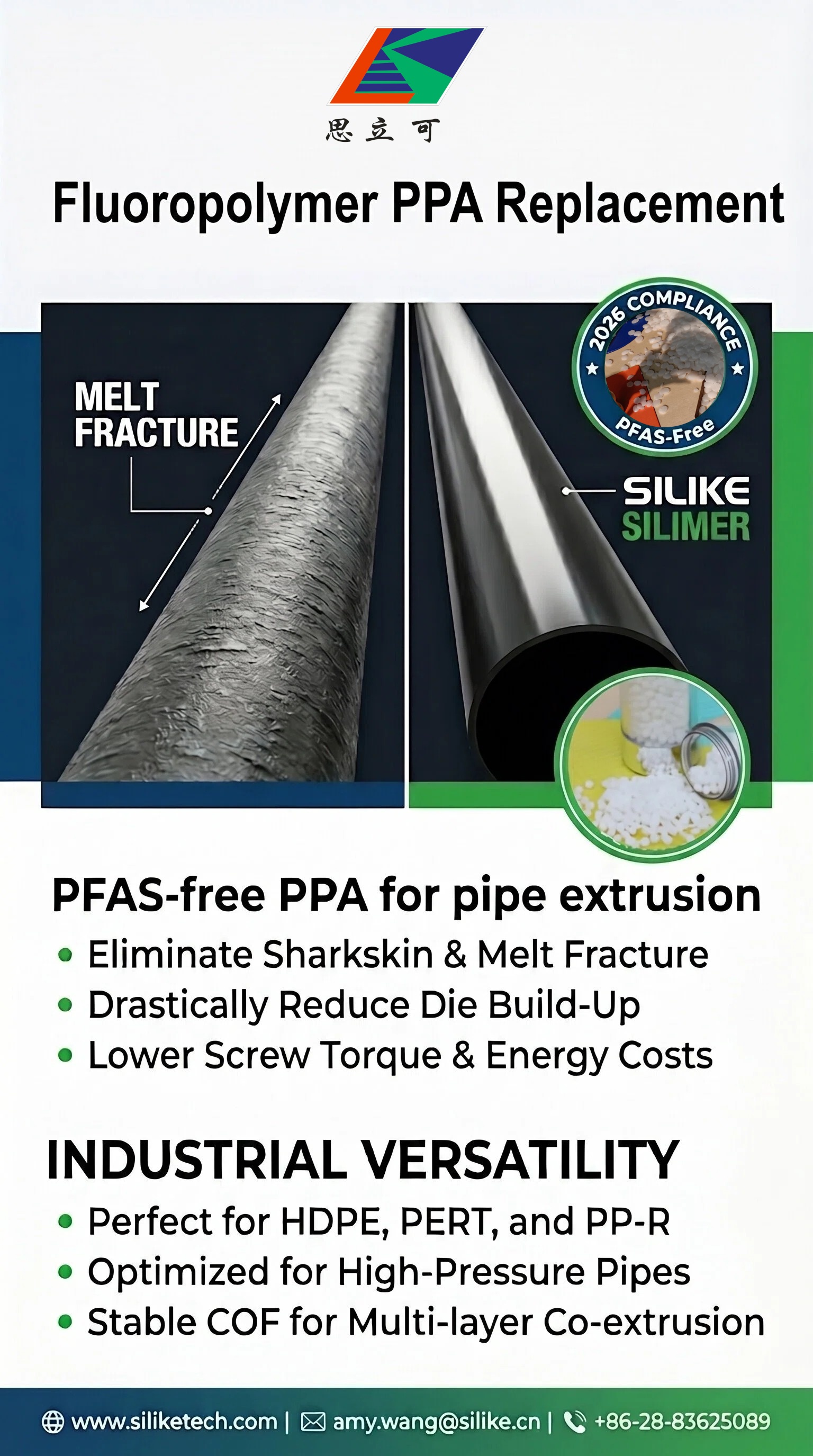
As global PFAS regulations tighten, SILIKE—leveraging over 20 years of expertise in polymer modification—presents the SILIMER Series, a cutting-edge range of PFAS-free polymer processing aids. More than just an eco-friendly alternative- fluoropolymer PPA replacement, it provides a strategic solution for pipe manufacturers to navigate regulatory landscapes while offering a high-performance technical transition.
6.1 Performance Match: Specifically engineered for HDPE water/gas pipes, PP-R systems, and PERT heating tubes. Optimized for high-pressure extrusion and multi-layer co-extrusion, SILIMER effectively eliminates melt fracture (sharkskin), significantly reduces die build-up, and enhances surface gloss and consistency.
6.2 Regulatory Alignment: Developed as a PFAS-free alternative to support compliance with global environmental mandates (such as REACH and PPWR). Our SILIMER series is designed to eliminate the need for fluorinated processing aids without compromising performance.
6.3 High-Efficiency Throughput: Designed for seamless “drop-in” integration. It requires no process modifications and delivers output efficiency comparable—or superior—to traditional fluorinated PPAs.
6.4 Full-Matrix Portfolio: We offer 100% pure powders, fluorine-free masterbatches, and PTFE-free additives, precisely tailored to meet the demands of diverse industrial applications while ensuring global market access.
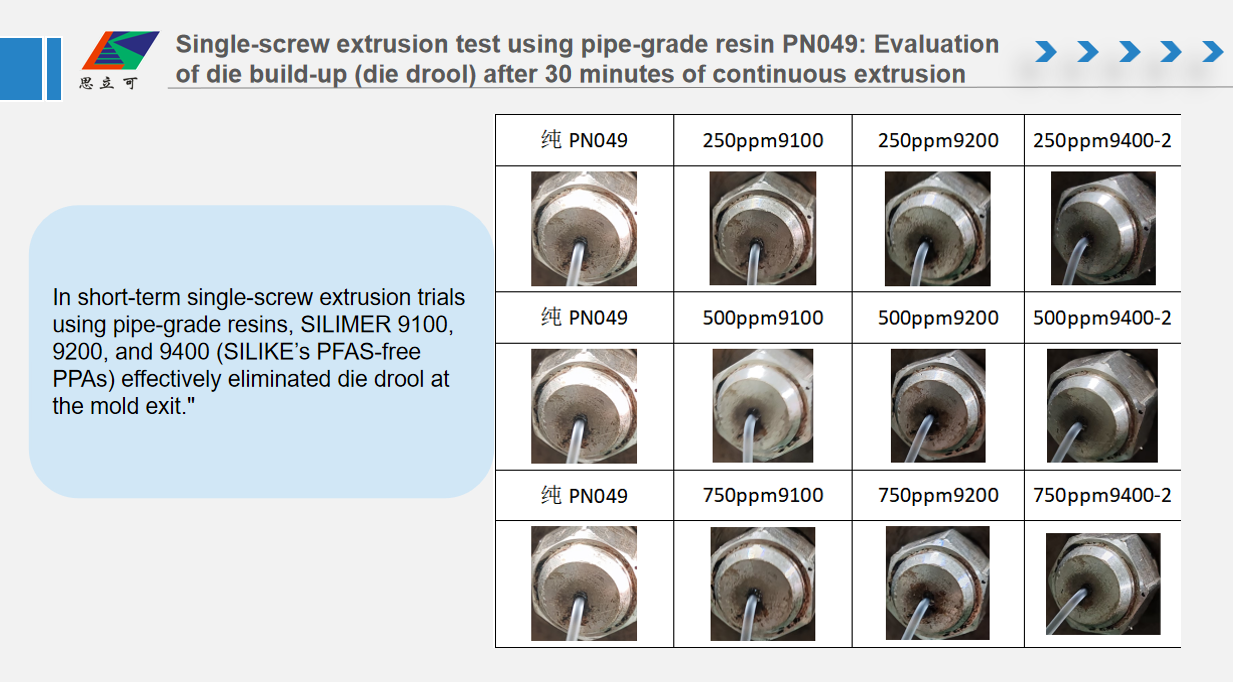
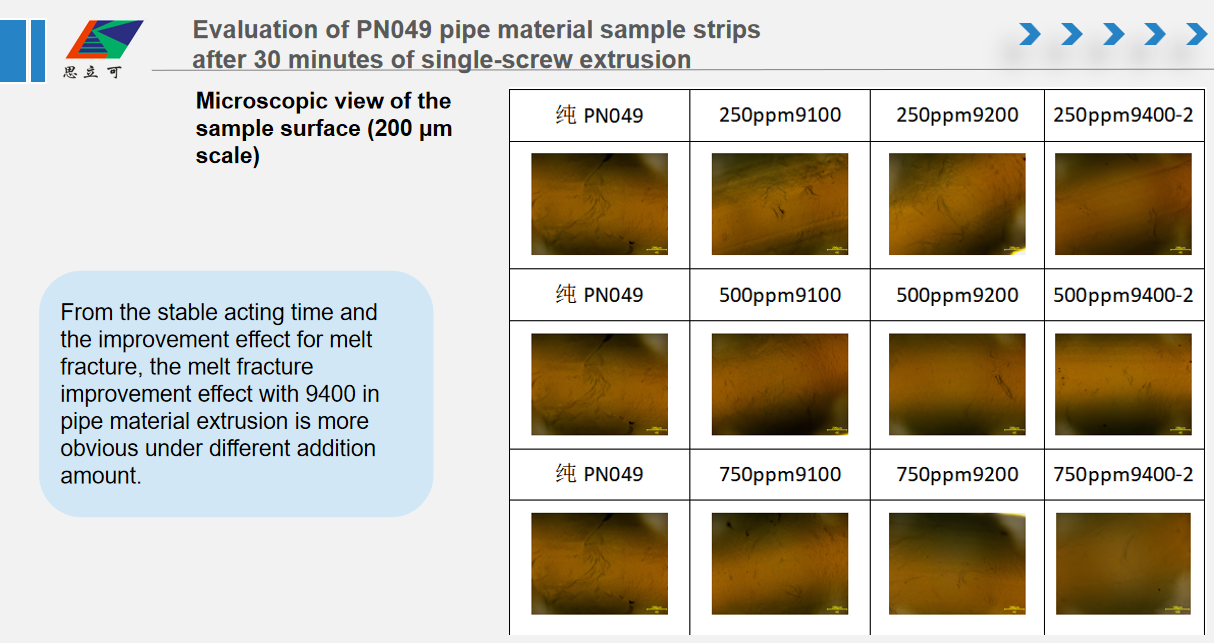
7. Real Industrial Case: SILIKE SILIMER Fuorine-free PPAs for PN049 pipe material
Insight:
SILIKE SILIMER series PFAS-free PPAs not only reduce die build-up (die drool) and address melt fracture (sharkskin) performance but also enhance overall processing efficiency.
8. How SILIKE SILIMER PFAS-Free PPA Works?
Structure and Working Principle of SILIKE SILIMER series PFAS-Free Polymer Processing Aids
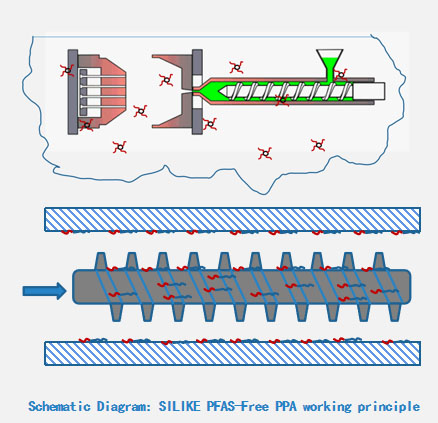
The SILIMER series features a unique molecular architecture consisting of Polysiloxane segments, Polar segments, and Non-polar segments. This multi-functional structure combines the superior slip properties of silicone with the targeted reactivity of functional groups.
8.1. Polar Segment (Anchor Group):
The polar atoms anchor to the metal surfaces of the screw, barrel, and die. By enriching at these interfaces, they form a stable, microscopic lubrication layer.
Effect: This provides efficient isolation between the polyolefin resin and the metal equipment, significantly reducing resin adhesion, minimizing die build-up, and eliminating melt fracture (sharkskin) and film gel (fish eyes).
8.2. Polysiloxane Segment (Lubrication Core):
This segment provides an ultra-low coefficient of friction and exceptional thermal stability.
Effect: It enhances overall melt fluidity and ensures the material moves smoothly through the extruder without adhering to the barrel walls, acting as a high-performance internal and external lubricant.
8.3. Non-polar Segment (Compatibility Link):
Consisting of long-chain hydrocarbons, this segment ensures the additive is compatible with polyolefin resins (like PE and PP).
Effect: It allows the polysiloxane to be uniformly dispersed within the polymer matrix, preventing phase separation while ensuring the active segments can effectively migrate to the surface during processing.
Summary:
SILIKE’s PFAS-free technology utilizes a tri-segmented molecular structure. By balancing metal-affinity (Polar), fluid lubrication (Siloxane), and resin compatibility (Non-polar), it creates a seamless slip layer that replaces traditional fluorinated PPAs without compromising pipe quality or production speed.
9. PFAS-Free vs Fluoropolymer PPA
10. When Should You Switch to PFAS-Free PPA?
Switch if: You export to the EU or regulated markets
• Customers require PFAS-free compliance
• You face frequent die build-up issues
• You aim to reduce downtime and scrap
11. How to Replace Fluoropolymer PPA (Step-by-Step)
11.1 Start with partial replacement (30–50%)
11.2 Monitor pressure and torque
11.3 Optimize dosage (typically 300–1000 ppm)
11.4 Adjust processing conditions if needed
11.5 Gradually phase out fluorinated PPA
This ensures a stable and low-risk transition.
12. FAQ
12.1 Are PFAS-free PPAs suitable for HDPE pipe extrusion?
Yes. SILIKE SILIMER series PFAS-Free PPAs are widely used in HDPE pipe systems where surface quality and compliance are critical.
12.2 Are Non-PFAS process Aids suitable for PE-RT pipe extrusion?
Yes. SILIKE SILIMER series Non-PFAS process Aids improve processing stability and surface durability without relying on fluoropolymers.
12.3 Will switching to fluorine-free polymer processing additives affect mechanical properties?
No. Properly formulated SILIKE SILIMER series fluorine-free PPAs do not negatively affect mechanical performance.
12.4 Does PFAS-Free PPA increase cost?
Not necessarily. Total production cost is often reduced due to: Less downtime, Lower scrap rates, and Higher throughput.
12.5 What is the typical dosage of PFAS-Free PPA?
Typically 300–1000 ppm, depending on formulation and processing conditions.
13. Ready to Replace Fluoropolymer PPA Without Risk?
Every extrusion line is different.
The key is selecting the right PFAS-free PPA for your specific process.
Please visit the websites of manufacturers offering PFAS-free polymer processing aids (PPAs), such as www.siliketech.com.
Request a Technical Evaluation to match the solution to your formulation and process.
Please provide:
• Resin type (HDPE / PP / PE-RT)
• Current processing challenges
• Extrusion conditions
You will receive:
• Tailored product recommendations
• Dosage and trial guidance
• Performance comparison support
Start with a Non-Fluorinated Processing Aids Sample for Pipe Extrusion
Validate performance directly on your production line.
No assumptions—only proven results.
For further information, please contact Amy via email: amy.wang@silike.cn
to learn more about how SILIKE’s fluorine-free solutions can help transform your pipe extrusion and support industry-leading sustainability.
Post time: Apr-17-2026


