
How Can Geomembrane Manufacturers Control Melt Fracture Without Fluoropolymer PPAs?
HDPE and LLDPE geomembranes are widely used in containment systems for landfills, mining, water management, wastewater treatment, reservoirs, ponds, and other civil and environmental engineering applications.
For geomembrane manufacturers, however, processing these polyolefin materials at stable and commercially competitive extrusion rates can be challenging.
High molecular weight polyethylene grades used in geomembrane production may generate high melt pressure and shear stress during extrusion. As production rates increase, manufacturers may encounter issues such as:
• Melt fracture or rough extrudate surfaces
• Die build-up and deposits
• High extrusion pressure
• Increased torque
• Unstable extrusion
• Surface defects
• Limited output at a given processing temperature
• More frequent die cleaning
Polymer processing aids, or PPAs, have therefore been used in polyethylene extrusion to help manage the interaction between the polymer melt and processing equipment.
As the plastics industry evaluates alternatives to fluorinated processing technologies, PFAS-free polymer processing aids are becoming an increasingly relevant option for geomembrane extrusion.
Why Is HDPE Geomembrane Extrusion Particularly Demanding?
Geomembrane production differs from many conventional thin-film extrusion processes.
HDPE geomembranes are designed for demanding containment applications where long-term mechanical and durability performance is critical. The polyethylene grades selected for these applications are therefore not chosen simply for easy processing.
During extrusion, processors must balance several factors simultaneously:
High polymer melt strength
The resin must provide the mechanical characteristics required for the finished geomembrane, but higher molecular weight polyethylene can also increase extrusion resistance.
High production output
Commercial geomembrane lines need consistent output and stable processing over long production runs.
Surface quality
Uncontrolled melt fracture may produce roughness or visible surface defects that manufacturers want to minimize.
Formulation consistency
Carbon black, antioxidants, stabilizers, processing additives, and other formulation components must be properly dispersed while maintaining the required performance of the final membrane.
This creates a familiar processing challenge: How can the extrusion process be made easier without unnecessarily changing the fundamental properties of the geomembrane formulation?
This is where an appropriately selected polymer processing aid can be useful.
What Does a Polymer Processing Aid Do in HDPE Extrusion?
A polymer processing aid is designed to modify processing behavior during extrusion rather than act as the primary structural component of the polymer.
Depending on chemistry, formulation, dosage, equipment, resin, and processing conditions, an effective PPA may help:
1. Control Melt Fracture
At sufficiently high shear rates, polyethylene extrusion can develop surface instability commonly described as melt fracture or sharkskin.
A processing aid can modify conditions at the polymer-metal interface and help the melt pass through the die more smoothly.
The potential result is a more uniform extrudate surface and a wider processing window before visible melt fracture becomes problematic.
2. Reduce Die Build-Up
Accumulation around the die lip may interfere with continuous production and eventually require cleaning or process interruption.
An effective processing aid may help reduce polymer adhesion and deposit formation at the die interface, supporting cleaner extrusion over longer production periods.
3. Reduce Extrusion Pressure and Torque
High-viscosity polyethylene can place substantial load on extrusion equipment.
By improving processing behavior at the interface between the melt and the equipment surface, PPAs may contribute to lower die pressure or torque under appropriate processing conditions.
This can be particularly valuable when manufacturers are trying to increase output without simply increasing extrusion temperature.
4. Support Higher and More Stable Throughput
Once melt fracture, die deposits, and extrusion pressure are better controlled, manufacturers may have more flexibility to optimize line speed and throughput.
The objective is not simply “faster extrusion.”
The real goal is: higher productivity while maintaining stable processing and acceptable geomembrane quality.
Why Are Manufacturers Evaluating PFAS-Free PPA Technologies?
Fluoropolymer-based processing aids have historically been used in polyolefin extrusion because of their effectiveness in controlling melt fracture and improving extrusion behavior.
However, increasing attention to PFAS throughout the global plastics supply chain is changing material-selection discussions.
Converters, resin suppliers, compounders, and end users are increasingly evaluating:
• PFAS content in formulations
• Fluoropolymer processing aid alternatives
• Supply-chain requirements
• Customer specifications
• Future regulatory exposure
• Reformulation feasibility
As a result, the question facing many extrusion companies is changing from: “Do we need a PPA?” to: “Can we achieve the required processing performance with a PFAS-free PPA?”
For geomembrane manufacturers, the transition needs to be approached from an engineering perspective rather than simply replacing one additive at the same dosage.
PFAS-Free PPA Is Not Just a Drop-In Chemistry Change
Replacing a conventional fluorinated PPA should involve process evaluation.
Performance can depend on:
• HDPE or LLDPE resin grade
• Melt index
• Molecular weight distribution
• Carbon black masterbatch
• Other additives in the formulation
• Extrusion temperature profile
• Die geometry
• Shear rate
• Output rate
• Existing fluoropolymer deposits on the equipment
• PPA dosage and feeding method
This is especially important when changing from an established fluoropolymer PPA system.
The new processing aid may require time to reach effective conditions at the die surface.
Therefore, trial evaluation should monitor the process over time rather than judging performance from the first few minutes after addition.
What Should Geomembrane Producers Measure During a PFAS-Free PPA Trial?
Instead of evaluating only whether the surface “looks smoother,” manufacturers should establish a structured trial protocol.
Important process indicators include:
Melt Fracture
Compare the extrudate surface before and after the processing aid reaches stable operating conditions.
Die Pressure
Monitor pressure under comparable output and temperature conditions.
Extruder Torque or Motor Load
Record changes rather than relying only on operator observations.
Output Rate
Determine whether stable throughput can be increased without introducing additional surface defects.
Die Build-Up
Observe deposit formation over a meaningful production period.
Processing Stability
Evaluate pressure fluctuation, surface consistency and general line stability.
Final Geomembrane Properties
Processing improvements must not replace normal product qualification.
The finished geomembrane should still be evaluated according to the manufacturer’s applicable specifications, customer requirements and relevant industry standards.
Why Final Geomembrane Performance Still Matters
For geomembranes, processing efficiency is only one part of the equation.
The final material may need to satisfy requirements related to:
• Density
• Thickness
• Tensile behavior
• Tear resistance
• Puncture resistance
• Carbon black content and dispersion
• Oxidative induction time
• Stress crack resistance
• Aging performance
• UV resistance
Therefore, a PPA trial should answer two separate questions: Did the additive improve extrusion? and did the resulting geomembrane continue to meet the required product specification?
A technically sound additive program should consider both.
SILIKE PFAS-Free PPA Solutions for Polyethylene Extrusion
SILIKE develops the SILIMER series of PFAS-free polymer processing aid solutions for polyolefin extrusion applications.
The technology is designed to provide manufacturers evaluating alternatives to conventional fluoropolymer PPAs with another approach to managing extrusion challenges such as:
• Melt fracture
• Die build-up
• High die pressure
• Processing instability
• Surface defects
• Throughput limitations
Depending on the resin system and manufacturing requirements, SILIKE can support evaluation of different PFAS-free PPA formats and addition approaches.
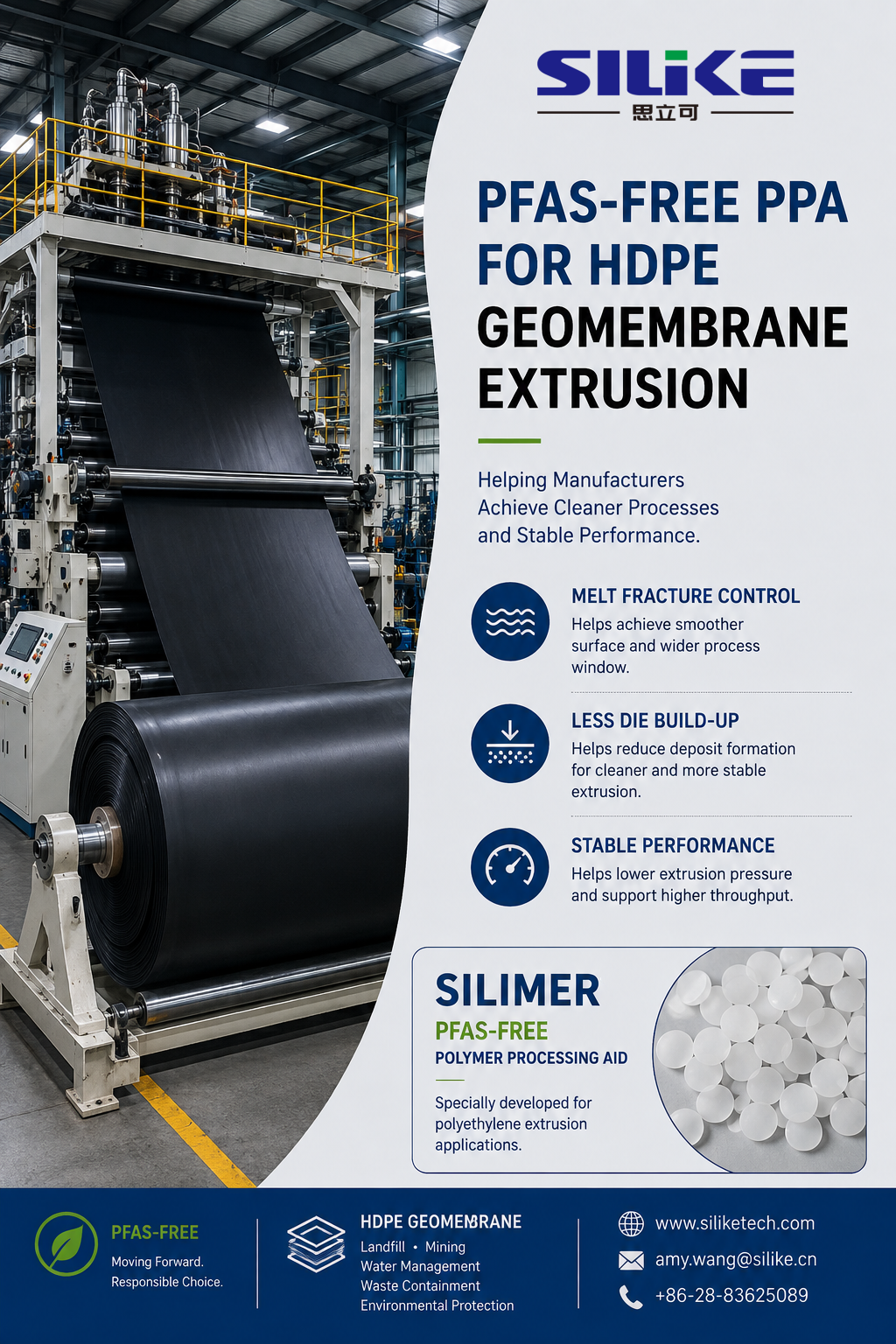
For geomembrane applications, product selection and dosage should be verified through extrusion trials using the customer’s actual HDPE or LLDPE formulation and processing conditions.
Where Could PFAS-Free PPA Technology Be Evaluated in Geosynthetics?
The opportunity is not necessarily limited to smooth HDPE geomembranes.
Depending on formulation and manufacturing process, PFAS-free processing technology may also be considered for extrusion applications involving:
• Smooth HDPE geomembranes
• Textured HDPE geomembranes
• LLDPE geomembranes
• Polyethylene containment liners
• Pond and reservoir liners
• Mining liners
• Waste containment membranes
• Environmental barrier systems
• Other high-output polyethylene sheet and membrane extrusion processes
Each application should be validated independently because processing conditions and final-property requirements can differ.
A Practical Trial Approach for Geomembrane Manufacturers
When evaluating a PFAS-free polymer processing aid, consider recording a baseline before changing the formulation.
Step 1 — Establish Baseline Conditions
Record:
• Resin grade
• PPA type and dosage currently used
• Extrusion temperatures
• Die pressure
• Torque
• Line speed
• Output
• Surface condition
• Frequency of die build-up
Step 2 — Define the Objective
For example:
• Eliminate visible melt fracture
• Reduce die deposits
• Lower pressure
• Increase output
• Replace a fluoropolymer PPA
• Meet a customer’s PFAS-related material requirement
A clear objective makes trial results easier to interpret.
Step 3 — Run the PFAS-Free PPA Trial
Allow sufficient processing time for the new additive system to reach stable conditions.
Step 4 — Compare Processing Data
Compare pressure, torque, extrusion speed, surface quality, and die cleanliness against the baseline.
Step 5 — Confirm Finished-Membrane Performance
Complete the relevant physical, mechanical, and durability testing required for the target geomembrane specification.
From PFAS Transition to Better Extrusion Control
The transition away from fluoropolymer processing aids should not be viewed only as a regulatory exercise.
For geomembrane manufacturers, it is also an opportunity to reassess how extrusion performance is being controlled.
The most useful question is not simply: “Is this PPA PFAS-free?”
It is: “Can this PFAS-free processing aid deliver the extrusion stability and finished-product performance required by our geomembrane process?”
That requires a combination of appropriate chemistry, formulation compatibility, and process validation.
Looking for a PFAS-Free PPA for HDPE or LLDPE Geomembrane Extrusion?
SILIKE provides PFAS-free polymer processing aid solutions for polyethylene extrusion applications.
If you are evaluating a fluoropolymer PPA alternative for geomembrane production, share your:
♦ HDPE / LLDPE resin grade
♦ Current PPA chemistry and dosage
♦ Geomembrane structure
♦ Extrusion temperature
♦ Current die pressure
♦ Line output
♦ Main processing issue
SILIKE can recommend an appropriate PFAS-free PPA solution for laboratory or production-scale evaluation.
Website: www.siliketech.com
Email: amy.wang@silike.cn
TEL: +86-28-83625089
Post time: Sep-02-2026


