
PPWR PFAS Restrictions in Food Packaging: Why Film Manufacturers Need PFAS-Free Polymer Processing Aids
How SILIKE SILIMER Series Enables Sustainable and High-Efficiency Film Extrusion Without Fluorinated PPAs
Introduction: PPWR Accelerates the Transition Toward PFAS-Free Food Packaging Materials
The European packaging industry is entering a new era of regulatory transformation.
With the implementation of Regulation (EU) 2025/40, commonly known as the Packaging and Packaging Waste Regulation (PPWR), the European Union has established stricter requirements for packaging safety, sustainability, and circularity.
A key focus of PPWR is Article 5 – Restriction of Substances of Concern, which aims to minimize the environmental impact and potential health risks associated with hazardous substances in packaging materials.
Among these substances, PFAS (Per- and Polyfluoroalkyl Substances) have become a major concern, particularly in food contact packaging applications.
Starting from 12 August 2026, food contact packaging containing PFAS above specified threshold limits will no longer be allowed to enter the EU market.
For packaging manufacturers, converters, and material suppliers, this regulatory change creates an urgent need to: Review existing raw materials and additives; improve supply chain transparency
Establish reliable compliance documentation; transition toward PFAS-free material solutions.
PPWR PFAS Limits: New Compliance Requirements for Food Packaging
Under PPWR Article 5(5), food contact packaging materials must meet specific PFAS threshold requirements.
The regulation introduces three important testing criteria:
| Test Parameter | Limit Value | Scope |
|---|---|---|
| Individual PFAS | 25 ppb | Targeted analysis; polymeric PFAS excluded |
| Sum of PFAS | 250 ppb | Includes relevant PFAS compounds and degradation products |
| Total Fluorine | 50 ppm | Includes polymeric fluorine-containing substances |
Among these requirements, the Total Fluorine limit of 50 ppm is particularly important for the plastics industry because it may impact materials containing fluorinated polymer components.
This creates new challenges for manufacturers producing flexible food packaging films, barrier packaging films, multilayer co-extrusion films, PE and PP film structures.
How PFAS Restrictions Impact Food Packaging Film Extrusion
Food packaging films require excellent processing performance to achieve high production efficiency, stable extrusion, smooth surface appearance, and consistent mechanical properties.
For decades, fluorinated polymer processing aids (PPAs) have been widely used in film extrusion because they provide excellent processing benefits.
Traditional fluorinated PPAs help manufacturers reduce melt fracture(Sharkskin), improve surface smoothness, minimize die build-up, increase extrusion stability, and expand processing windows.
However, under increasing PFAS regulatory pressure, manufacturers are now facing a critical question: How can food packaging film producers maintain extrusion performance while eliminating fluorinated processing aids?
The Challenge of Replacing Fluorinated PPAs in Film Production
Replacing traditional fluorinated PPAs is not simply a material substitution issue.
Film manufacturers must maintain production efficiency while avoiding common extrusion problems.
1. Melt Fracture and Sharkskin Defects
During high-speed extrusion, polymer melt can experience excessive shear stress at the die exit.
This may cause: Rough film surfaces, loss of gloss, poor appearance, reduced product quality
These problems are particularly common in: LLDPE blown films, mPE films, high-speed flexible packaging production.
2. Die Build-Up and Production Downtime
Die build-up is another major challenge in polymer extrusion.
Accumulated deposits inside extrusion dies can result in frequent cleaning requirements, production interruptions, increased waste, and lower productivity.
For continuous film production, reducing die contamination is critical.
3. Narrow Processing Window
Modern packaging films often involve high-speed extrusion, multiple polymer layers, recycled material incorporation, and complex barrier structures.
Without proper processing assistance, manufacturers may experience increased extrusion pressure, melt instability, and poor film quality consistency.
Therefore, the industry needs a new generation of processing additives that provide:
PFAS-free compliance + excellent extrusion performance.
The Growing Demand for PFAS-Free Polymer Processing Aids
As global regulations evolve, polymer processors are moving toward: Fluorine-free additives, PFAS-free processing solutions, Sustainable polymer technologies.
The ideal alternative must deliver: Regulatory Confidence Free from intentionally added PFAS; support compliance with evolving packaging regulations.
Processing Performance: Reduce melt fracture & sharkskin; improve surface quality; minimize die build-up; maintain production efficiency.
Application Flexibility: Suitable for PE films, PP films and multilayer packaging structures…
SILIKE SILIMER Series: PFAS-Free Polymer Processing Aid Solution for Food Packaging Films
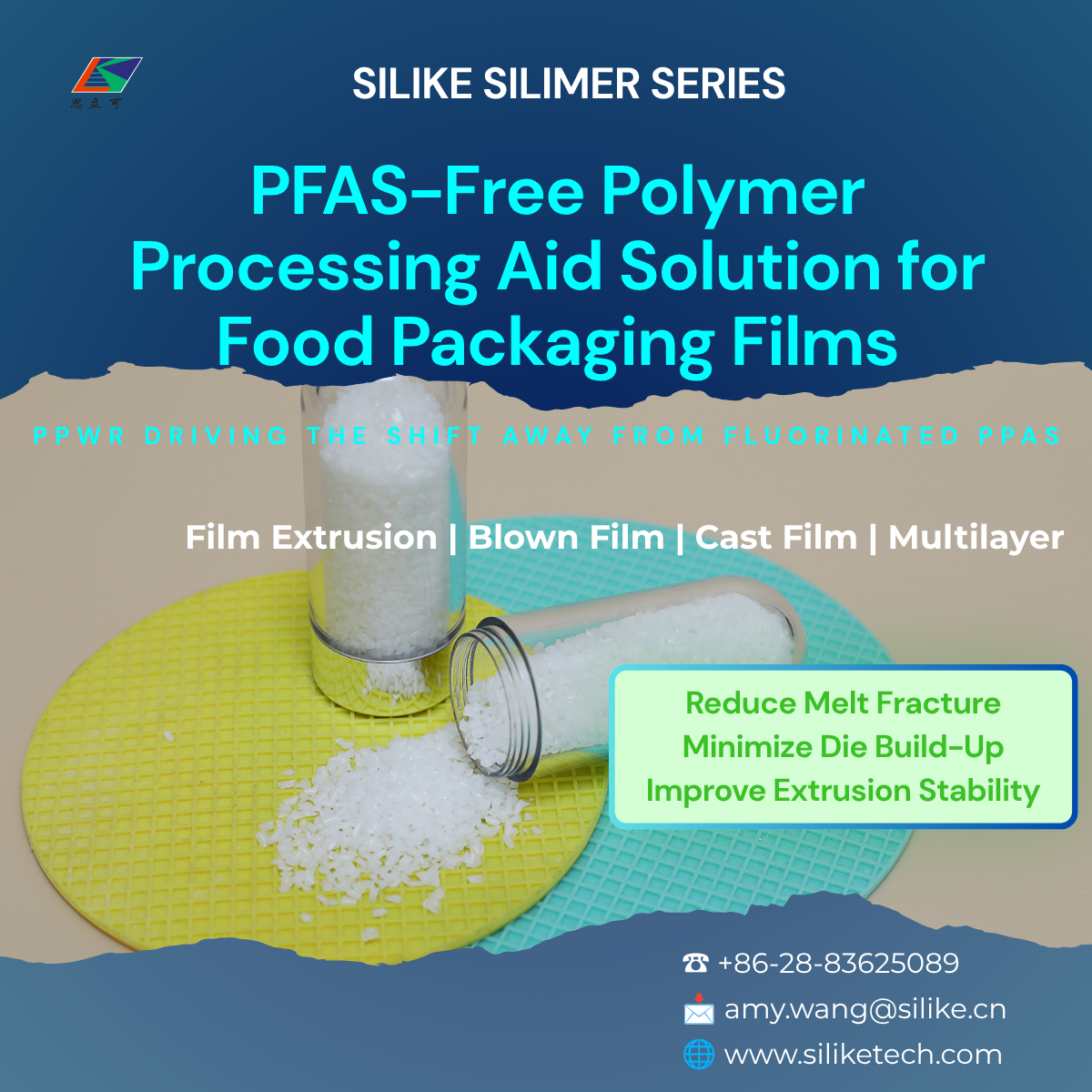
To help polymer processors transition away from fluorinated PPAs, Chengdu SILIKE Technology Co., Ltd. developed the SILIMER Series, a new generation of fluorine-free polymer processing additives designed for modern extrusion applications.
The SILIMER Series provides:
• 100% PFAS-free polymer processing additives
• Fluorine-free masterbatch solutions
• Pure fluorine-free PPA alternatives
• Solutions for PE, PP, and multilayer film extrusion
Unlike traditional fluorinated PPAs, SILIMER technology enables manufacturers to improve extrusion performance without relying on fluorochemicals.
How SILIKE SILIMER Improves Food Packaging Film Extrusion Performance
1. Reduce Melt Fracture and Improve Film Surface Quality
During extrusion, SILIMER helps reduce friction between polymer melt and processing equipment surfaces.
This improves melt flow behavior, surface smoothness, and film appearance, as well as processing stability.
For blown film and cast film applications, SILIKE SILIMER Fluorine-free polymer processing additive solutions help manufacturers achieve higher-quality surfaces while maintaining efficient production.
2. Minimize Die Build-Up and Increase Production Efficiency
SILIMER fluorine-free PPA alternatives technology helps reduce polymer adhesion and accumulation inside extrusion dies.
Benefits include: Reduced die cleaning frequency, longer continuous production runs, lower production interruption, improved manufacturing efficiency
This is especially valuable for: High-output blown film lines, Long-term continuous production, Flexible packaging manufacturing.
3. Improve Multilayer Film Extrusion Stability
Modern food packaging increasingly relies on multilayer structures to provide: Barrier properties, Mechanical strength, Functional performance.
Typical structures include PE/EVOH/PEPP-based multilayer films and flexible barrier packaging films.
SILIMER supports: Stable melt processing, improved layer consistency, reduced surface defects.
Application Solutions for PFAS-Free Food Packaging Film Production
→ Blown Film Extrusion
Applications: LLDPE food packaging films, HDPE films, flexible packaging films…
Processing advantages: Reduced sharkskin defects, improved bubble stability, enhanced film surface quality, stable high-speed production.
→ Cast Film Extrusion
Applications: CPP films, stretch films, lamination films.
Processing advantages: Lower extrusion pressure, improved transparency, better surface appearance, stable processing performance.
→ Multilayer Co-Extrusion
Applications: Barrier food packaging, High-performance flexible packaging.
Processing advantages: PFAS-free processing pathway, improved melt stability, reduced extrusion defects, enhanced production reliability.
Supporting the Future of Sustainable Food Packaging Manufacturing
The implementation of PPWR represents a major shift in how packaging materials are designed, processed, and evaluated.
For food packaging film manufacturers, moving away from fluorinated PPAs is becoming an important step toward regulatory compliance, sustainable production, supply chain transparency, and long-term market competitiveness.
By adopting SILIKE SILIMER Series PFAS-free polymer processing aids, polymer processors can replace traditional fluorinated PPAs while maintaining excellent extrusion efficiency and film quality.
The future of food packaging extrusion is moving toward PFAS-free materials, sustainable processing, and high-performance manufacturing.
About SILIKE
Chengdu SILIKE Technology Co., Ltd. specializes in silicone-based polymer additives, PFAS-free polymer processing aids, and advanced material solutions for global polymer processing industries.
The SILIMER Series provides innovative fluorine-free solutions for:
• Polyolefins and recycled polyolefin resins
• Blown, cast, and multilayer films
• Fiber and monofilament extrusion
• Cable and pipe extrusion
• Masterbatch
• Compounding
• Other high-performance polymer extrusion applications
In light of global PFAS restrictions, contact SILIKE to discuss your packaging film processing challenges and discover our high-performance, fluorine-free polymer processing aids (PPA) for plastic film production.
Phone: +86-28-83625089
Mobile / Whatsapp : + 86-15108280799
Email:amy.wang@silike.cn
Website:www.siliketech.com
External Resources
https://environment.ec.europa.eu/topics/waste-and-recycling/packaging-waste_en
Post time: Jul-29-2026


