
Technical Application Insight | Silicone Additives for Water-Repellent PET Fiber Development and Performance Evaluation
Developing water-repellent PET fibers or functional polyester textiles?
You may be facing a critical question:
How can you improve PET fiber surface hydrophobicity through additive modification while maintaining spinning stability, fiber quality, and the required performance of the finished textile?
In a reported PET fiber application evaluation, SILIKE investigated a combination of LYSI-408 silicone masterbatch and SILIMER 6600 modified copolysiloxane additive, achieving a water contact angle of 118° under the evaluated conditions.
This result provides a useful technical reference for PET fiber hydrophobic modification.
However, for fiber and textile manufacturers, a 118° contact angle is not the final answer.
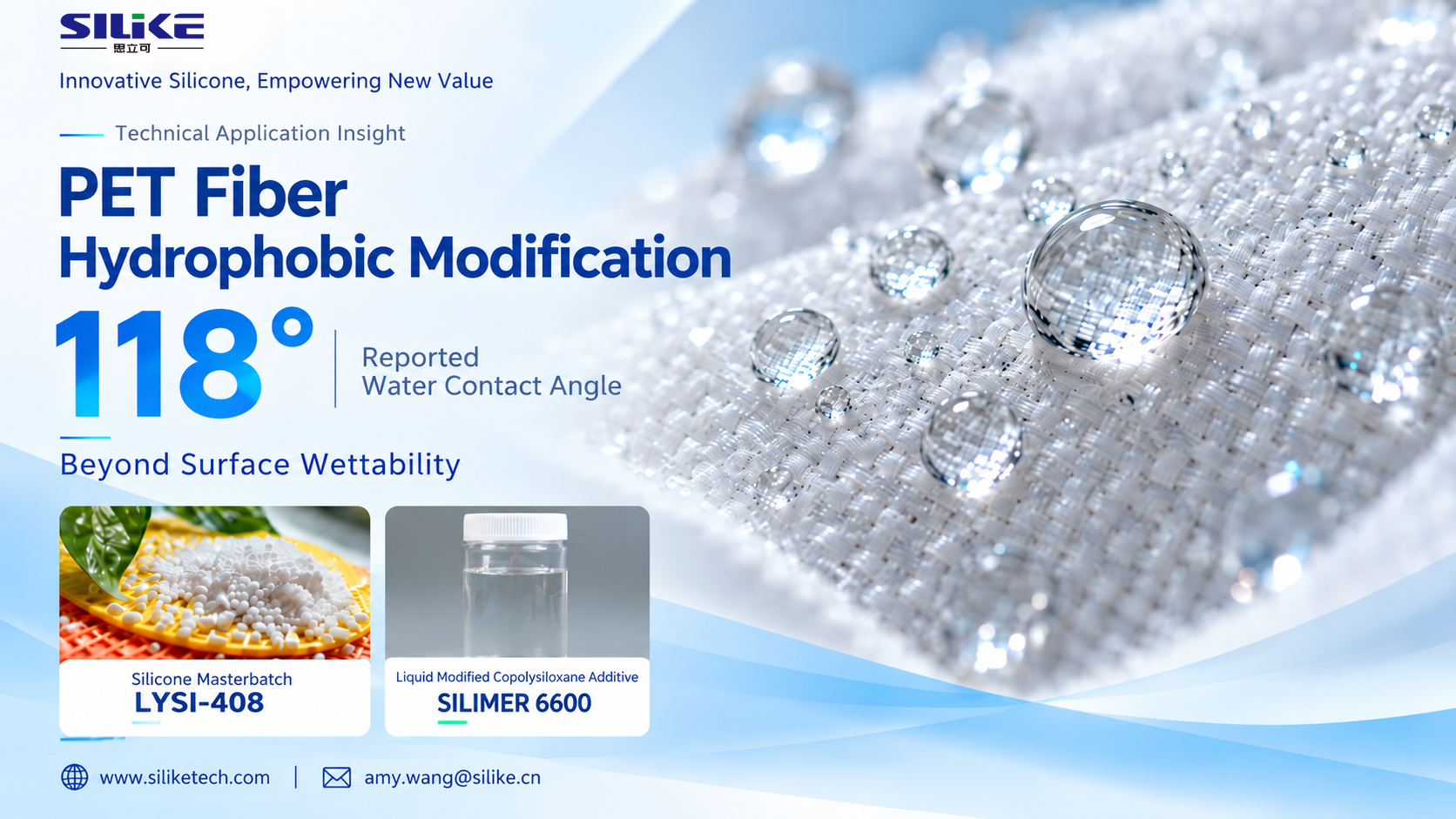
Key takeaway: A 118° water contact angle indicates hydrophobic wetting behavior for the tested sample, but it does not independently establish the finished textile’s water-repellency rating, resistance to water penetration, or durability.
The real challenge is translating laboratory surface-modification results into material performance that meets manufacturing and end-use requirements.
Based on SILIKE’s reported PET application evaluation, this article explores the potential of melt-incorporated silicone additives, the testing methods relevant to different water-repellency targets, and how manufacturers can develop a practical formulation evaluation strategy.
1. What Challenges Must Manufacturers Address in PET Fiber Hydrophobic Modification?
Polyethylene terephthalate (PET) is widely used in polyester filament yarns, woven and knitted fabrics, nonwovens, and technical textiles.
Although PET has relatively low moisture absorption compared with many natural fibers, certain functional applications require further modification of its surface-wetting characteristics.
However, improving PET fiber hydrophobicity can mean different things depending on the manufacturer’s end-use requirements.
Some manufacturers want to increase the water contact angle of a PET surface.
Others need their finished textiles to achieve a specified spray-test water-repellency rating or meet requirements for resistance to water penetration.
Without first defining the intended performance target, even a favorable laboratory contact-angle result may not solve the actual production challenge.
Which Performance Parameters Matter for Your Application?
| Development Objective | Recommended Evaluation | Key Question |
|---|---|---|
| Improve PET surface hydrophobicity | Water contact angle compared with a reference sample | Does the additive produce a meaningful and reproducible change in surface wettability? |
| Develop water-repellent polyester fabrics | Finished-fabric spray-test performance | Does the textile meet the required water-repellency rating? |
| Improve resistance to water penetration | Hydrostatic pressure or another specified water-penetration test | Can the fabric meet the required water-resistance specification? |
| Maintain stable PET fiber production | Spinning stability, spin-pack pressure, filament breakage, and fiber properties | Is the modified formulation compatible with production? |
| Maintain performance after washing or abrasion | Application-specific durability testing | Does the modified material retain the required performance after relevant exposure? |
| Develop one-sided water-repellent textiles | Independent evaluation of both fabric surfaces | Can the intended difference between the two surfaces be achieved? |
The first step in selecting additives for PET fiber hydrophobic modification is not choosing a dosage. It is defining the performance the finished product must achieve.
2. SILIKE PET Fiber Application Evaluation: A Reported 118° Water Contact Angle
To investigate silicone-based additives for PET fiber surface modification, SILIKE evaluated a combination of LYSI-408 and SILIMER 6600.
Reported Application Data
| Evaluation Parameter | Reported Information |
|---|---|
| Application | PET fiber |
| Silicone masterbatch | LYSI-408 |
| Modified copolysiloxane additive | SILIMER 6600 |
| Additive approach | Combined formulation |
| Reported water contact angle | 118° |
| Evaluation focus | PET surface hydrophobicity |
The reported result indicates that the tested PET application sample exhibited hydrophobic wetting behavior under the evaluation conditions.
It provides a basis for further investigation of silicone additives in PET fiber surface modification.
What Does the 118° Result Tell Us?
In general, a water contact angle greater than 90° is associated with hydrophobic wetting behavior.
Therefore, the reported 118° result suggests that the tested PET sample displayed hydrophobic surface characteristics.
However, before determining whether the formulation is suitable for commercial applications, several important questions remain:
• How much does the formulation improve surface hydrophobicity compared with the existing PET formulation?
• What are the individual contributions of silicone masterbatch LYSI-408 and silicone additive SILIMER 6600?
• Does the formulation affect spinning continuity or fiber mechanical properties?
• How do the surface characteristics change after drawing, winding, and textile manufacturing?
• Can the finished fabric meet the customer’s specified water-repellency or water-resistance requirements?
The reported 118° result alone cannot answer these questions or establish a specific synergistic effect between the two additives.
Technical note: The available application summary does not provide complete information about the tested sample configuration, contact-angle measurement method, or testing conditions. The reported value should therefore be treated as an application-specific result rather than a guaranteed performance value for other PET formulations or finished textiles.
Evaluating a Similar PET Fiber Application?
If your development project involves a target water contact angle, a specific water-repellency rating, or particular spinning requirements, SILIKE can discuss suitable additive candidates and potential next steps for application testing.
Discuss Your PET Fiber Hydrophobic Modification Requirements
3. Why Doesn’t a 118° Water Contact Angle Guarantee Finished-Textile Water Repellency?
This is an important distinction in the development of functional polyester materials.
Surface hydrophobicity is not the same as finished-textile water repellency or resistance to water penetration.
Water contact angle primarily describes how a water droplet interacts with a tested material surface.
However, a finished textile is not a continuous, nonporous polymer surface. It consists of fibers and yarns arranged into a structure that contains spaces through which water may move.
Even when the fiber surface exhibits hydrophobic characteristics, water may still penetrate through the fabric structure.
Yarn construction, fabric density, porosity, manufacturing processes, and finishing conditions can all influence the final performance.
Which Water-Repellency Test Should Manufacturers Use?
1. Water Contact Angle — Evaluating Surface Wettability
Water contact-angle measurements can be used to investigate the apparent hydrophobicity of PET material surfaces.
For fibrous or porous samples, particular attention should be paid to sample configuration, surface roughness, and consistent measurement procedures.
2. AATCC TM22 — Evaluating Fabric Surface Water Repellency
AATCC TM22, Water Repellency: Spray Test, evaluates a fabric’s resistance to surface wetting under specified spray conditions.
If a customer requires a particular finished-fabric spray-test rating, the fabric should be tested using the applicable method.
3. AATCC TM127 — Evaluating Resistance to Water Penetration
AATCC TM127, Water Resistance: Hydrostatic Pressure, evaluates a fabric’s resistance to water penetration under hydrostatic pressure.
This property is not equivalent to water contact angle or spray-test water repellency.
Which Result Is Most Important?
If the objective is to modify PET surface wettability, water contact angle may be an appropriate evaluation parameter.
If the objective is to develop fabrics that resist surface wetting, spray-test performance becomes important.
If the objective is to resist water penetration under pressure, an appropriate water-resistance test is necessary.
The test method should be determined by the customer’s intended application, not simply by the laboratory data already available for an additive.
4. When Should PET Fiber Manufacturers Consider Melt-Incorporated Silicone Additives?
PET fiber surface modification can be investigated at different stages of the manufacturing process.
One approach involves incorporating functional additives into the polymer formulation during processing.
Another involves applying surface treatments to fibers, yarns, or finished fabrics at later manufacturing stages.
These technologies operate differently, and neither approach should automatically be considered superior.
Melt-Incorporated Modification vs. Conventional Textile Water-Repellent Finishing
| Evaluation Factor | Melt-Incorporated Additives | Conventional Textile Finishing |
|---|---|---|
| Application stage | Polymer compounding or fiber formation | Subsequent fiber, yarn, or textile processing |
| Main development focus | Formulation compatibility, processing stability, and material surface properties | Finished-textile functionality and specified performance requirements |
| Key evaluation parameters | Additive incorporation, distribution, spinning stability, fiber quality, and surface characteristics | Finishing conditions, water-repellency performance, fabric handle, and durability |
| Important consideration | Fiber surface results may not translate directly into finished-fabric performance | Results depend on the finishing system, fabric construction, and processing conditions |
When Is a Melt-Incorporated Approach Worth Evaluating?
For manufacturers developing new functional PET fiber formulations, melt-incorporated silicone additives may be worth investigating when surface modification and polymer-processing behavior need to be considered together.
For manufacturers whose main objective is to meet a specified finished-fabric water-repellency standard, the performance of existing textile finishing technologies provides an important reference.
Projects requiring both fiber surface modification and finished-textile functionality may also benefit from comparing different processing approaches.
The suitability of melt-incorporated additives should be determined by the target performance, manufacturing compatibility, and application-specific test results—not by a single contact-angle measurement.
5. How Can Manufacturers Evaluate silicone-based additives LYSI-408 and co polysiloxane processing additive SILIMER 6600 for PET Fiber Hydrophobic Modification?
SILIKE’s reported 118° evaluation provides a starting point for further investigation.
However, for manufacturers preparing production trials, the most important step is designing a controlled evaluation that can demonstrate whether a candidate formulation provides meaningful application benefits.
Step 1: Define the Performance Target and Acceptance Criteria
First, establish the main development objective.
Is the goal to modify the water contact angle of the PET surface or achieve a particular finished-fabric water-repellency rating?
Determine whether there are additional requirements for spinning stability, fiber strength, fabric handle, or durability.
Where possible, translate these requirements into measurable acceptance criteria.
Step 2: Establish Comparative Formulations
Depending on the available equipment and trial conditions, manufacturers may consider the following comparison:
| Trial | Formulation | Evaluation Objective |
|---|---|---|
| Control | Existing PET formulation | Establish processing and performance baselines |
| A | PET + silicone masterbatch LYSI-408 | Evaluate the independent contribution of the silicone masterbatch |
| B | PET + co-polysiloxane processing additive SILIMER 6600 | Evaluate the independent contribution of the liquid additive |
| C | PET + LYSI-408 + SILIMER 6600 | Evaluate the combined formulation |
Comparing these formulations can help determine whether the combined system produces an application-relevant improvement.
Formulation details, addition levels, and processing conditions should be established according to the actual material system.
A result obtained from one PET application evaluation should not be treated as a universal formulation recommendation.
Step 3: Evaluate Processing Performance and Fiber Quality
For PET melt-spinning applications, manufacturers should assess whether the modified formulation remains compatible with the production process.
Relevant indicators may include:
• Melt pressure and processing stability
• Filter or spin-pack pressure trends
• Filament breakage frequency
• Filament uniformity and mechanical properties
• Surface friction and yarn handling
• Downstream drawing and winding performance
The appropriate indicators depend on the manufacturing process and the customer’s quality requirements.
If a formulation improves surface hydrophobicity but introduces unacceptable spinning instability or compromises fiber quality, its suitability must be reconsidered.
Step 4: Verify Surface and Finished-Textile Performance
Use consistent testing methods to compare the reference formulation with candidate additive systems.
For projects targeting finished-fabric water repellency, evaluate representative textiles after the relevant downstream processing stages.
Where durability matters, assess performance after appropriate washing, abrasion, or other application-specific exposure.
Step 5: Determine Whether Further Production Trials Are Justified
After testing, manufacturers should consider three questions:
Has the surface modification achieved the intended result?
Does the formulation maintain acceptable processing behavior and fiber quality?
Does the finished textile meet the customer’s specified performance requirements?
When these conditions are satisfied, the formulation may be considered for further scale-up trials or commercial application evaluation.
6. What Roles Can SILIKE LYSI-408 and SILIMER 6600 Play in PET Fiber Development?
SILIKE offers silicone-based additive technologies in different physical forms for polymer processing and surface-property modification.
LYSI-408: PET-Based Silicone Masterbatch
LYSI-408 Silicone Masterbatch is a pelletized formulation containing 30% ultra-high-molecular-weight siloxane polymer dispersed in a PET carrier.
Its published product information covers applications involving processing improvement, surface slip, and friction modification, with PET fibers among its listed application areas.
For PET fiber development, suitability should be determined by polymer compatibility, addition method, and actual spinning performance.
SILIMER 6600: Liquid Modified Copolysiloxane Additive
SILIMER 6600 is a liquid modified copolysiloxane processing additive.
Its established functions include processing lubrication, improved dispersion of selected formulation components, and surface-property modification in compatible thermoplastic systems.
In SILIKE’s reported PET fiber application, SILIMER 6600 was used together with LYSI-408 to investigate hydrophobic surface behavior.
The reported 118° contact angle does not establish that either product would independently achieve the same result.
For a specific PET fiber application, additive selection should be based on material compatibility, processing requirements, and controlled comparative trials.
Looking for Broader PET Fiber Processing and Surface-Performance Solutions?
If your primary challenges involve PET fiber processing stability, surface slip, friction control, or silicone masterbatch selection, explore SILIKE’s related technical article:
Silicone Additives for PET Fibers: Surface Performance and Processing Solutions
That article focuses on broader PET fiber additive selection and application considerations, while this technical insight addresses hydrophobic modification and finished-textile water-repellency evaluation.
7. Frequently Asked Questions About PET Fiber Hydrophobic Modification
Does a 118° water contact angle mean PET fiber modification has been successful?
It indicates that the tested sample exhibited hydrophobic wetting behavior under the evaluated conditions.
If the objective is to investigate surface wettability, this provides a useful reference.
However, whether the modification meets the intended application requirements must be determined through comparative testing, processing evaluation, and finished-product performance assessment.
Can PET-Based Silicone Masterbatch LYSI-408 or Liquid Modified Copolysiloxane Additive SILIMER 6600 independently achieve a 118° water contact angle?
The available application information reports the use of both additives in combination.
It does not establish that either product alone would achieve the same contact angle.
Separate comparative trials would be required.
Can melt-incorporated silicone additives replace conventional textile water-repellent finishes?
They may be evaluated as an alternative approach for selected surface-modification objectives, but should not automatically be considered direct replacements for conventional finishing technologies.
The suitability of either approach depends on the finished textile’s performance requirements and the actual production conditions.
Has SILIKE’s reported formulation been validated for continuous commercial PET fiber spinning?
The available information does not establish the formulation’s suitability for other continuous PET fiber spinning operations.
Application-specific trials are necessary to evaluate spinning stability, spin-pack pressure, filament quality, and downstream processing performance.
What Information Should Manufacturers Provide When Requesting an Evaluation?
It is helpful to share the PET resin grade, fiber or yarn type, current processing conditions, and the main performance challenge.
If a target contact angle or finished-fabric water-repellency standard has already been established, that information can also help guide technical discussions.
These details allow a more focused evaluation of suitable additives and potential trial options.
8. Looking for Additives for Water-Repellent PET Fibers?
Are you developing water-repellent PET fibers, functional polyester yarns, or textiles with specific surface-performance requirements?
SILIKE offers silicone-based additive technologies, including Siloxane Masterbatch LYSI-408 and Liquid Modified Copolysiloxane Additive SILIMER 6600, for application-specific evaluation of PET fiber surface modification and processing performance.
The reported combination provides a technical reference for further investigation of PET surface hydrophobicity. However, formulation suitability and finished-textile performance must be established under the customer’s actual application conditions.
Whether you are exploring a new melt-incorporated modification approach or evaluating additives for an existing PET formulation, SILIKE can help you discuss the next steps for technical evaluation.
To get started, simply share:
• Your PET resin grade and fiber or yarn type
• Your production process and current technical challenges
• Your target hydrophobicity or water-repellency requirements
SILIKE’s technical team can discuss potential additive candidates and the next steps for formulation trials or sample evaluation.
Discuss Your PET Fiber Hydrophobic Modification Requirements | Request Additive Samples
Chengdu SILIKE Technology Co., Ltd.
Website: www.siliketech.com
Email: amy.wang@silike.cn
Technical note: The reported 118° water contact angle is specific to the referenced PET application evaluation. It should not be interpreted as a guarantee of performance in other PET formulations, validated fiber-spinning conditions, or finished-textile water repellency. Actual performance must be confirmed through application-specific trials.
Post time: Oct-23-2026


