
How PFAS-Free Polymer Processing Aids Improve Layer Flow Balance, Die Stability, and Film Quality in Multilayer Extrusion
Introduction
Multilayer co-extrusion technology enables manufacturers to combine different polymers into high-performance films with enhanced barrier properties, mechanical strength, functionality, and cost efficiency. It is widely used in flexible packaging films, food packaging, barrier films, and industrial film applications.
However, as multilayer structures become more complex and production speeds increase, manufacturers often face extrusion challenges such as layer-to-layer melt flow imbalance, interfacial flow disturbances, die build-up, and increased film haze. These issues can affect layer uniformity, surface appearance, production stability, and downstream converting performance.
Traditionally, fluoropolymer-based processing aids (PPAs) have been used to improve extrusion stability and reduce melt-related defects. However, growing regulatory attention toward PFAS substances is accelerating demand for PFAS-free and fluorine-free polymer processing solutions.
SILIKE SILIMER Series PFAS-Free Polymer Processing Aids (PPAs) provide an innovative fluorine-free approach to improve melt flow balance, enhance die stability, reduce extrusion defects, and support more sustainable multilayer film manufacturing without compromising downstream processes such as printing, lamination, and heat sealing.
This article highlights common multilayer co-extrusion defects, explains their root causes, reviews the challenges of conventional processing solutions, and explores PFAS-free alternatives to help manufacturers achieve more efficient, sustainable, and scalable multilayer film extrusion processes.
What Are the Common Defects in Multilayer Co-Extrusion?
Multilayer co-extrusion requires multiple polymer melts to flow together through a single die while maintaining stable interfaces and precise layer thickness control. Differences in polymer properties can easily create processing instability.
Common multilayer extrusion defects include:
• Uneven layer distribution
• Layer thickness variation
• Interfacial flow instability
• Melt fracture and surface defects
• Die build-up during continuous production
• Increased film haze and reduced optical quality
• Frequent production interruptions for die cleaning
Understanding the root causes of these defects is the first step toward improving extrusion performance.
Main Causes of Multilayer Co-Extrusion Problems
1. Viscosity Mismatch Between Different Polymer Layers
One of the major challenges in multilayer extrusion is the difference in melt viscosity among various polymer layers.
Typical multilayer structures may include combinations of:
• Polyethylene (PE)
• Polypropylene (PP)
• Ethylene vinyl alcohol (EVOH)
• Polyamide (PA)
• Adhesive tie layers
Each polymer has different:
• Melt viscosity
• Shear response
• Melt elasticity
• Processing temperature requirements
During high-speed extrusion, these differences can cause uneven melt flow behavior between layers.
Potential consequences include:
• Poor layer-to-layer flow balance
• Uneven layer thickness
• Interface deformation
• Reduced film consistency
Improving melt flow compatibility between layers is therefore critical for stable multilayer extrusion.
2. Interfacial Flow Disturbances Between Polymer Layers
In multilayer co-extrusion, multiple polymer melts meet at the interface inside the die.
When the flow behavior of adjacent layers is significantly different, disturbances may occur at the interface.
Factors contributing to interfacial instability include:
• Different melt velocities
• Different melt elasticity
• Different shear stress responses
• Unbalanced rheological behavior
These disturbances may result in:
• Layer distortion
• Optical defects
• Film appearance issues
• Reduced product consistency
A stable interface requires balanced melt movement throughout the extrusion process.
3. Die Build-Up and Melt Instability During Continuous Production
During long-term extrusion operations, unstable melt flow and high friction between polymer melt and metal surfaces can contribute to die deposits.
The build-up can lead to:
• Increased cleaning frequency
• Production downtime
• Surface defects
• Lower productivity
For manufacturers operating high-output extrusion lines, maintaining stable die conditions is essential for improving operational efficiency.
4. Film Haze and Optical Quality Issues
For transparent and high-performance packaging films, optical appearance is a key quality requirement.
Multilayer extrusion instability may affect:
• Layer uniformity
• Surface smoothness
• Light transmission
• Film clarity
Excessive haze can reduce the visual appeal of packaging films and impact final product performance.
Why Are Manufacturers Looking for PFAS-Free Polymer Processing Aids?
Fluoropolymer-based PPAs have traditionally been used to improve extrusion performance by reducing melt fracture, lowering die deposits, and stabilizing processing conditions.
However, increasing global attention on PFAS (Per- and Polyfluoroalkyl Substances) regulations is driving the industry toward alternative technologies.
Manufacturers are increasingly seeking:
• Fluorine-free processing solutions
• PFAS-free additives
• Sustainable extrusion technologies
• High-performance alternatives without compromising production efficiency
This creates a growing demand for next-generation polymer processing technologies. Across the global plastics industry, masterbatch producers, compounders, and downstream converters are increasingly looking for PFAS-free polymer processing aids (PPAs) as sustainable alternatives to traditional fluoropolymer processing aids.
SILIKE offers sustainable PFAS-free processing additives in two main product forms(100% Pure PFAS -free polymer processing additives(PPAs, Carrier-Based fluorine-free Masterbatch Systems)), providing flexible formulation and processing options.
How SILIKE SILIMER Series PFAS-Free PPA Improves Multilayer Co-Extrusion Performance
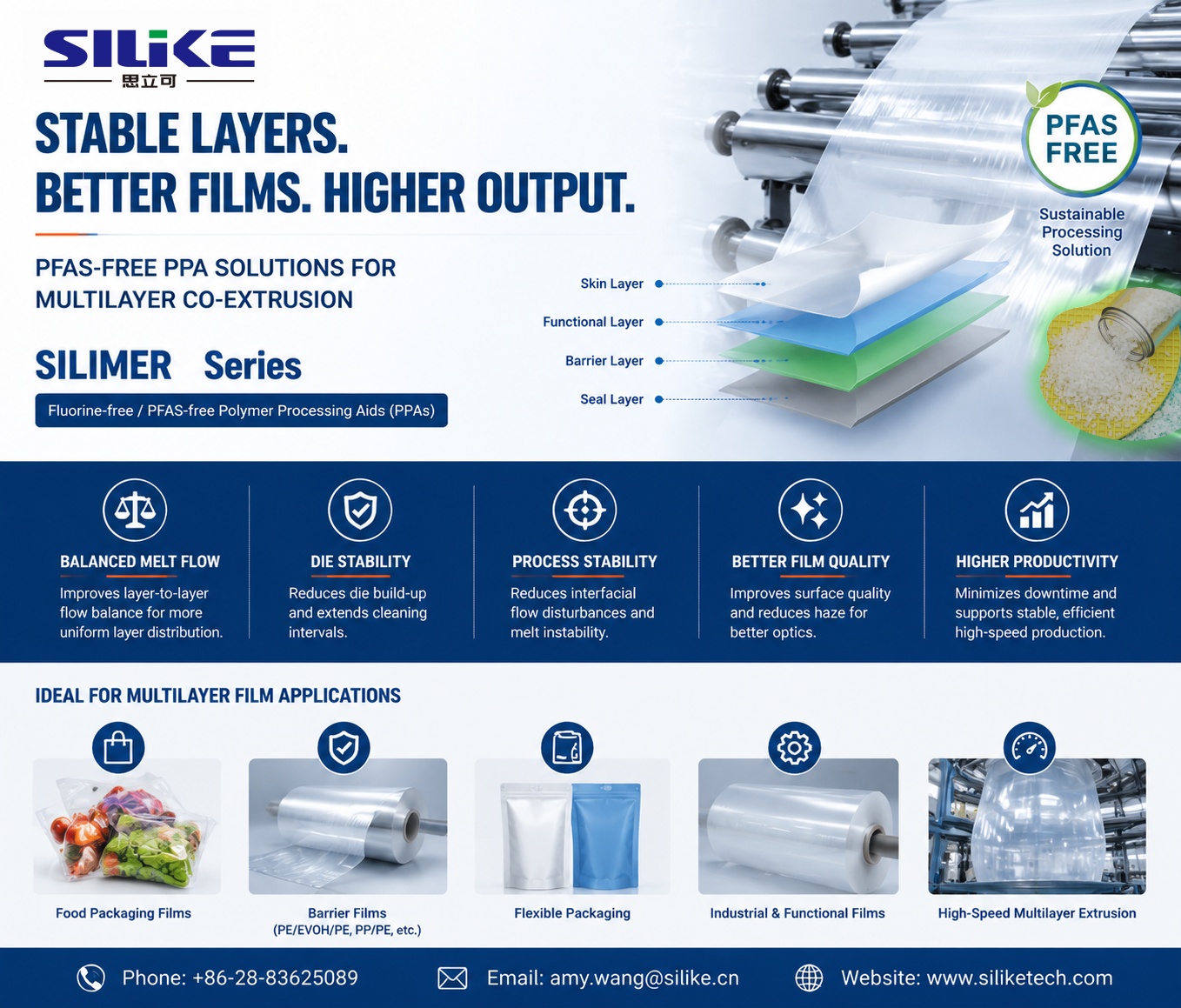
SILIKE SILIMER Series PFAS-Free Polymer Processing Aids are designed to improve extrusion stability through advanced silicone-based functional technology.
Unlike traditional fluoropolymer PPAs, SILIMER fluorine-free solutions provide processing improvement without fluorine-containing components.
1. Improve Layer-to-Layer Melt Flow Balance
During multilayer extrusion, balanced melt movement between different polymer layers is essential.
SILIMER Series fluorine-free PPAs help:
• Reduce melt friction
• Improve melt mobility
• Optimize melt flow behavior
• Enhance layer distribution stability
Benefits:
✔ More uniform layer thickness
✔ Improved interface stability
✔ More consistent film quality
2. Enhance Die Stability and Reduce Die Build-Up
Alternatives to fluoropolymer processing aids: SILIMER helps reduce friction between polymer melts and metal surfaces inside extrusion equipment.
This contributes to:
• Reduced die deposits
• Cleaner die operation
• Longer continuous production cycles
• Reduced maintenance downtime
For high-speed multilayer film production, improved die stability can significantly enhance productivity.
3. Improve Surface Quality and Reduce Extrusion Defects
By improving melt processing behavior, SILIMER Series non-fluorinated processing aids help manufacturers achieve:
• Smoother film surfaces
• Reduced melt-related defects
• Improved extrusion consistency
This is especially valuable for applications requiring high appearance standards.
4. Maintain Compatibility with Downstream Converting Processes
A major concern when introducing processing additives is whether they affect downstream operations.
At appropriate usage levels, SILIMER Series PFAS-Free PPAs are designed to maintain compatibility with:
• Printing
• Lamination
• Heat sealing
This allows manufacturers to improve extrusion performance while maintaining final product quality.
Key Performance Improvements of SILIMER PFAS-Free PPA in Multilayer Extrusion
| Multilayer Extrusion Challenge | SILIMER PFAS-Free PPA Solution | Manufacturing Benefit |
|---|---|---|
| Layer flow imbalance | Improved melt flow balance | More uniform layer distribution |
| Interface instability | Enhanced melt stability | Consistent multilayer structure |
| Die build-up | Reduced melt-metal friction | Longer production runs |
| Surface defects | Improved melt processing | Better film appearance |
| PFAS regulatory pressure | Fluorine-free technology | Sustainable processing solution |
Applications of PFAS-Free PPA in Multilayer Film Extrusion
SILIKE SILIMER Series PFAS-Free PPAs can support various multilayer extrusion applications, including:
Flexible Packaging Films
Benefits:
• Improved extrusion stability
• Better surface quality
• Reduced production interruptions
Barrier Films
Suitable for structures containing:
• PE/EVOH/PE
• PP/PE multilayer films
• Functional packaging structures
Food and Industrial Packaging Films
Supports:
• High-speed extrusion
• Stable layer distribution
• Consistent appearance
Frequently Asked Questions About PFAS-Free PPA for Multilayer Extrusion
1. What causes layer instability in multilayer co-extrusion?
Layer instability is commonly caused by viscosity differences, melt elasticity differences, and unbalanced flow behavior between polymer layers. These factors can create interface disturbances and uneven layer distribution.
2. Can PFAS-free PPAs replace traditional fluoropolymer processing aids?
Yes. PFAS-free PPAs such as SILIKE SILIMER Series are designed to provide extrusion processing improvements, including better melt flow stability, reduced die build-up, and improved surface quality without fluorine-containing components.
3. Will PFAS-free PPA affect printing and lamination performance?
When used at recommended dosage levels, SILIMER Series PPAs are designed to improve extrusion performance while maintaining compatibility with downstream converting processes such as printing, lamination, and heat sealing.
Conclusion: Building More Stable and Sustainable Multilayer Extrusion Processes
As multilayer film structures become more advanced, maintaining stable melt flow, precise layer distribution, and consistent surface quality becomes increasingly important.
PFAS-free polymer processing aids provide manufacturers with a sustainable pathway to improve extrusion performance while addressing evolving regulatory requirements.
SILIKE SILIMER Series PFAS-Free PPAs help multilayer film producers achieve:
♦ Improved layer-to-layer melt flow balance
♦ Reduced die build-up
♦ Better surface quality
♦ Sustainable fluorine-free processing
For manufacturers experiencing multilayer extrusion instability, haze issues, or die build-up challenges, SILIKE technical experts can provide application-specific recommendations and processing evaluations.
Optimize Your Multilayer Extrusion Process with PFAS-Free Technology
Contact SILIKE today to explore SILIMER PFAS-Free PPA solutions for your multilayer film extrusion applications.
Request a Free PFAS-Free PPA Sample Evaluation or fluoropolymer PPA replacement. Contact Amy Wang
Phone: +86-28-83625089
Mobile / WhatsApp: +86-15108280799
Website:www.siliketech.com
Post time: Jul-17-2026


