
TPEE (Thermoplastic Polyester Elastomer) is widely used in flexible tubing applications because it combines rubber-like elasticity with the processing advantages, fatigue resistance, and durability of thermoplastic materials.
However, TPEE tubes used in repeated sliding, contact, insertion, routing, or abrasion-prone environments may require additional surface modification. High surface friction can increase installation and assembly resistance, while repeated contact may lead to surface wear, scratches, and deterioration in appearance over time.
For these applications, the objective is not simply to make the tube “more slippery.” A practical TPEE surface modification solution should balance:
Lower Surface Friction + Better Slip + Improved Wear Resistance + Improved Scratch Resistance + Stable Processing
This article examines common approaches for improving TPEE tube surface performance and explains how high-molecular-weight silicone masterbatch can be evaluated as a solution for reducing friction and improving wear and scratch resistance.
Why Do TPEE Tubes Need Better Slip and Wear Resistance?
TPEE already offers a useful combination of elasticity, mechanical strength, fatigue resistance, and inherent wear resistance. However, actual tubing applications can expose the material to more demanding surface conditions.
During manufacturing, installation, and service, TPEE tubes may experience:
Sliding against metal, plastic, or rubber components
• Repeated insertion and removal
• Continuous contact and rubbing
• Bending and movement against surrounding components
• Scratching during handling and installation
• Friction under repeated or high-speed sliding conditions
When surface friction is too high, it may contribute to:
• Higher insertion and assembly force
• Increased frictional heat
• Faster surface wear
• Visible scratches or surface damage
• Deterioration in surface quality over time
For demanding TPEE tubing, reducing the coefficient of friction (COF) is therefore only one part of the formulation challenge.
The material must also maintain the required wear resistance, scratch resistance, mechanical properties, and extrusion performance.
What Should Be Considered When Modifying TPEE Tube Surfaces?
A surface additive should not be selected based on initial slip or COF reduction alone.
For example, some additives may provide strong initial slip but rely on migration to the surface. Other solutions may improve wear resistance but influence flexibility, appearance, or processing behavior.
A balanced TPEE tube formulation should therefore consider:
|
Performance Requirement |
Key Consideration |
| Surface Slip | Lower coefficient of friction (COF) |
| Wear Resistance | Resistance to repeated friction, abrasion, and material loss |
| Scratch Resistance | Resistance to localized surface damage |
| Processing | Stable extrusion and melt behavior |
| Surface Quality | Control of deposits, blooming, and surface defects |
| Long-Term Performance | Stable surface properties during service |
The appropriate solution depends on the TPEE grade, tube design, processing conditions, and actual service environment.
Common Solutions for TPEE Surface Modification
Several additive technologies can be considered when developing low-friction and wear-resistant TPEE tubing.
1. Fatty Acid Amide Slip Agents
Fatty acid amides such as erucamide, oleamide, and stearamide are commonly used as migrating slip agents in polymer formulations.
These additives migrate toward the polymer surface and form a lubricating layer that can reduce surface friction.
Typical advantages include:
• Cost effectiveness
• Easy incorporation
• Good initial slip improvement
• Established use in polymer modification
However, because the slip effect depends largely on surface migration, manufacturers may need to consider:
• Changes in COF over time
• Surface blooming or migration
• Potential surface contamination
• Performance changes under demanding service conditions
• Limited contribution to wear resistance
For TPEE tubes requiring more stable long-term surface performance, these factors should be evaluated during formulation development.
2. PTFE-Based Lubricants
PTFE is well known for its low coefficient of friction and excellent wear resistance.
It can be considered for applications requiring very low friction and high resistance to repeated wear.
However, formulators may also need to evaluate:
• Dispersion in the TPEE matrix
• Effects on processing behavior
• Surface appearance
• Formulation cost
• Compatibility with application-specific material requirements
For applications seeking fluorine-free or non-PTFE technologies, alternative surface modification approaches may therefore be considered.
3. High-Molecular-Weight Silicone Masterbatch
High-molecular-weight silicone masterbatch provides a different approach to TPEE surface modification.
Rather than relying primarily on the migration of low-molecular-weight lubricants, high-molecular-weight silicone can provide processing lubrication together with surface modification.
When properly incorporated into the polymer system, the silicone component can contribute to lower surface friction and improved resistance to friction-related surface damage.
This makes silicone masterbatch particularly relevant when several properties need to be addressed simultaneously: Low Friction + Slip + Wear Resistance + Scratch Resistance + Processing Performance
Why Use Silicone Masterbatch for TPEE Tubes?
A key advantage of silicone-based modification is its ability to influence both polymer processing and final surface behavior.
Lower Surface Friction
The lubricating characteristics of silicone can help reduce friction between the TPEE surface and contacting materials.
A lower COF can be particularly useful where tubes need to slide against surrounding components during installation or service.
Better Slip Performance
Reduced surface friction can make TPEE tubing easier to slide, insert, route, or assemble.
Improved Wear Resistance
Reducing friction at the contact interface can help limit friction-related surface damage and material loss during repeated sliding or rubbing.
Improved Scratch Resistance
Surface modification can also help reduce visible damage caused by handling, installation, or localized mechanical contact.
Improved Processing Lubrication
Silicone additives can provide lubrication during melt processing, which may help reduce processing friction and improve extrusion behavior depending on the formulation and processing conditions.
SILIKE LYSI-403 Silicone Masterbatch for TPEE Tube Applications
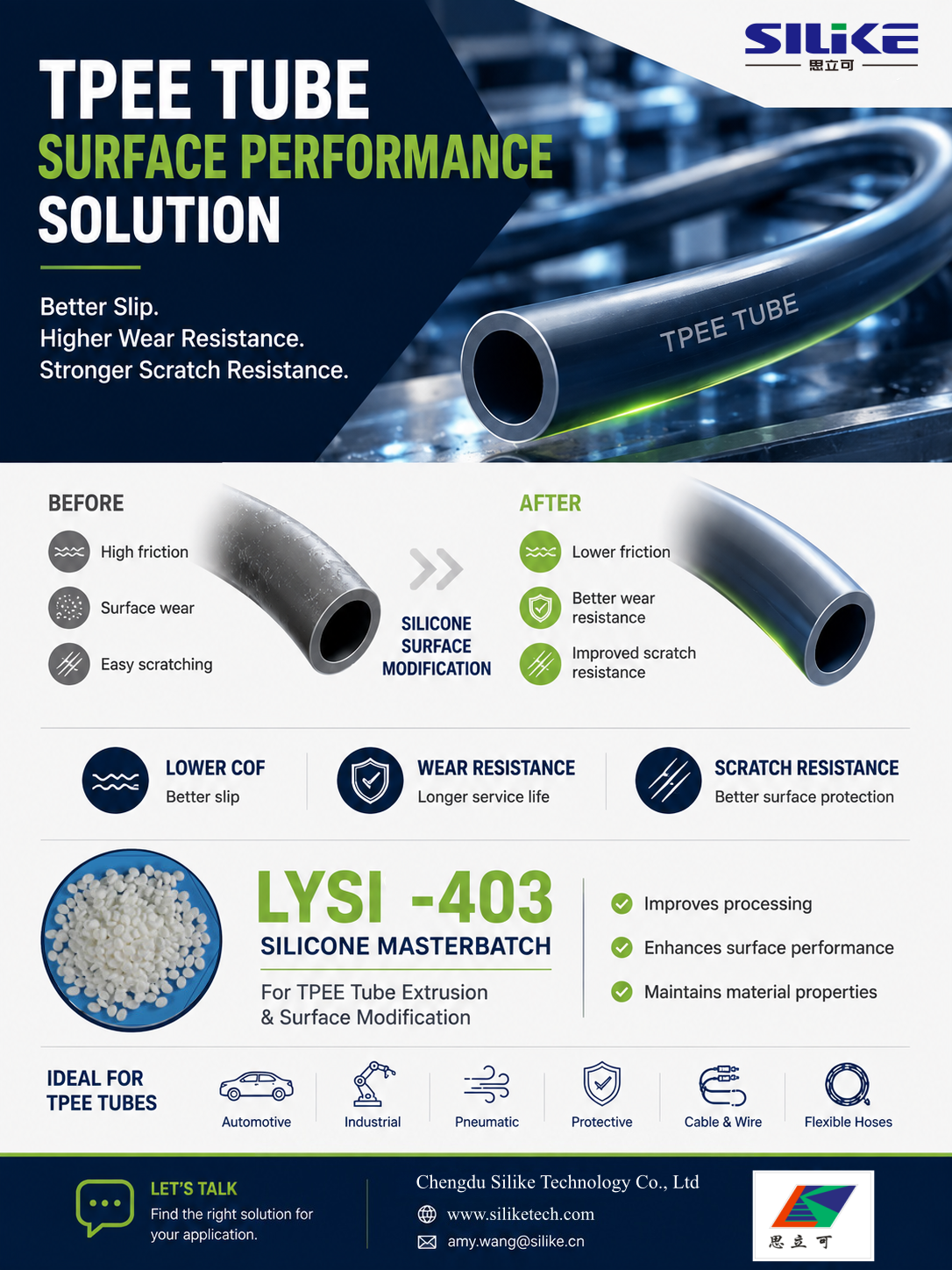
For TPEE tubes requiring improved surface slip and durability, SILIKE LYSI-403 Silicone Masterbatch can be evaluated as a processing additive and surface modification solution.
LYSI-403 siloxane masterbatch is a pelletized formulation with 50% ultra-high-molecular-weight siloxane polymer dispersed in thermoplastic polyester elastomer ( TPEE ). It is widely used as an efficient additive for TPEE-compatible resin systems to improve the processing properties and surface quality, such as better resin flow ability, mold filling & release, less extruder torque, lower coefficient of friction, greater mar and abrasion resistance.
In TPEE applications, the objective is to use silicone modification to target surface and processing performance while maintaining the essential properties required from the base polymer.
Depending on the TPEE formulation, dosage, and processing conditions, potential benefits to evaluate include:
• Reduced coefficient of friction
• Improved surface slip
• Improved wear resistance
• Improved scratch resistance
• Better processing lubrication
• Improved extrusion behavior
• Improved surface feel
Actual performance should be confirmed through laboratory and application-specific testing because results can vary with the TPEE grade, formulation, additive loading, processing conditions, and test method.
How Does SILIKE LYSI-403 silicone based masterbatch Modify TPEE Surface Performance?
The effect of silicone masterbatch can be considered at two stages: during melt processing and at the finished material surface.
During Processing
The silicone component can contribute to lubrication within the polymer system, helping reduce friction during melt processing.
TPEE Melt → Silicone Lubrication → Reduced Processing Friction → Improved Processing Behavior
The magnitude of the processing benefit depends on the formulation and extrusion conditions.
At the Finished Surface
Silicone modification can contribute to lower-friction surface behavior.
Silicone Modification → Lower Surface Friction → Better Slip → Reduced Friction-Related Surface Damage
This provides a practical route for improving the overall surface performance of TPEE tubing.
Wear Resistance and Scratch Resistance: What Is the Difference?
Although closely related, wear resistance and scratch resistance are not the same property.
Wear resistance describes the ability of a material to resist progressive damage or material loss caused by repeated friction and abrasion.
Scratch resistance refers more specifically to the ability of a surface to resist localized mechanical damage, visible scratching, whitening, or other appearance changes.
A TPEE formulation can perform well in one area without necessarily providing the same improvement in the other.
For this reason, both properties should be evaluated independently when developing TPEE tubes for demanding friction and abrasion environments.
TPEE Tube Slip vs. Wear Resistance: Finding the Right Balance
Increasing surface slip does not automatically provide the best wear resistance.
For example, a migrating slip agent may significantly reduce initial COF but may not provide sufficient protection against repeated abrasion.
Conversely, certain solid lubricants or fillers may improve wear performance but could influence flexibility, surface appearance, or extrusion behavior.
The target for flexible TPEE tubing should therefore be a balanced performance profile: Low COF + Wear Resistance + Scratch Resistance + Stable Extrusion + Maintained Mechanical Properties
This is one reason high-molecular-weight silicone masterbatch can be worth evaluating when both processing and surface properties need to be optimized.
Key Formulation Considerations for Silicone Masterbatch LYSI-403 in TPEE
There is no single additive dosage that is optimal for every TPEE formulation.
The appropriate level should be determined according to factors such as:
• TPEE grade
• Material hardness
• Existing additive package
• Tube wall thickness
• Extrusion temperature
• Screw configuration
• Target coefficient of friction
• Required wear resistance
• Required scratch resistance
• Surface appearance requirements
A practical formulation development strategy is to prepare several dosage levels and compare:COF + Wear/Abrasion + Scratch Appearance + Extrusion Behavior + Mechanical Properties
This approach helps identify the appropriate balance between surface performance and additive loading for the specific TPEE application.
How to Test Slip, Wear, and Scratch Resistance in TPEE Tubes
Subjective hand feel can provide an initial indication of surface slip, but reliable formulation development should be supported by quantitative testing.
Coefficient of Friction
COF testing can quantify changes in surface friction.
A useful comparison is:
Unmodified TPEE vs. TPEE +Silicone Masterbatch LYSI-403
under identical test conditions.
Depending on the application, both static and dynamic coefficients of friction may be relevant.
Wear Resistance
Select an abrasion or wear test appropriate to the actual service conditions.
Possible evaluation parameters include:
• Weight loss
• Volume loss
• Surface damage
• Changes after repeated friction
The test method should reflect the type of contact experienced by the final tube as closely as practical.
Scratch Resistance
Scratch testing can be used to evaluate:
• Scratch visibility
• Scratch depth
• Surface whitening
• Gloss change
• Permanent surface damage
Extrusion Performance
Surface modification should also be evaluated together with processing behavior.
Monitor parameters such as:
• Extrusion pressure
• Screw torque
• Melt stability
• Die buildup
• Surface smoothness
• Tube dimensional stability
A successful formulation should improve the targeted surface properties without introducing unacceptable processing, mechanical, or appearance issues.
Which TPEE Tube Applications Can Benefit from Lower Surface Friction?
Silicone-based additive modified TPEE can be considered for tubing applications involving frequent contact, sliding, routing, or abrasion, including:
• Automotive tubing
• Pneumatic tubing
• Industrial tubing
• Flexible hoses
• Protective tubing
• Cable and wire protection
• Tubes requiring easier insertion or installation
• Applications involving repeated sliding or rubbing
Because service conditions vary significantly between applications, final suitability should always be confirmed through application-specific testing.
Why Consider SILIKE LYSI-403 silicone masterbatch for TPEE Tube Surface Modification?
When selecting an additive for TPEE tubing, the key question should not simply be:
“Which additive gives the lowest COF?”
A more useful formulation question is:
“Which solution provides the required balance of surface friction, wear resistance, scratch resistance, processing behavior, and long-term performance?”
SILIKE LYSI-403 is a silicone-based plastic additive designed to improve TPEE processing and surface performance by providing effective lubrication, lower surface friction, and improved wear and scratch resistance.
The development concept can be summarized as:
TPEE + LYSI-403
→ Processing Lubrication
→ Lower Surface Friction
→ Better Slip
→ Improved Wear & Scratch Resistance
→ Better Overall Surface Performance
Conclusion
TPEE tubes provide a valuable combination of flexibility, durability, fatigue resistance, and thermoplastic processability. However, applications involving repeated contact, insertion, sliding, or abrasion may require additional control of surface friction, wear, and scratching.
Traditional fatty acid amide slip agents can provide effective initial lubrication, but their migration behavior and long-term surface performance should be considered. PTFE-based lubricants offer low friction and strong wear performance but may not be suitable where fluorine-free alternatives are preferred.
High-molecular-weight silicone masterbatch provides another practical route for TPEE surface modification.
By combining processing lubrication with surface modification, SILIKE Silicone Masterbatch LYSI-403 can be evaluated for TPEE tube applications requiring:
• Lower surface friction
• Better slip
• Improved wear resistance
• Improved scratch resistance
• Improved processing behavior
The optimal formulation should be established through application-specific trials using the actual TPEE grade, extrusion conditions, and required performance targets.
Looking for a Low-Friction and Wear-Resistant TPEE Tube Solution?
If you are developing TPEE tubing and need to reduce surface friction, improve wear and scratch resistance, or optimize extrusion performance, contact SILIKE to discuss your:
TPEE grade • Target COF • Wear requirements • Extrusion conditions • Application environment
SILIKE can help evaluate a silicone masterbatch solution for your specific TPEE tube formulation
Welcome visit our website:www.siliketech.comor directly contact Amy Wang via Email: amy.wang@silike.cn; Mobile / WhatsApp: +86-15108280799.
Post time: Aug-28-2026


