
A Targeted Wear-Resistance Solution for EVA Footwear Compounds
EVA is widely used in footwear applications due to its lightweight, flexibility, cushioning, and processing advantages. However, improving EVA shoe sole abrasion resistance remains a key challenge, especially for applications requiring longer service life and better wear performance.
For EVA footwear compounds, increasing hardness is not always the ideal solution. Higher hardness may affect flexibility, comfort, cushioning, and overall footwear performance.
A more targeted approach is to modify the friction and wear behavior of the EVA compound through functional additives.
SILIKE NM-2T Anti-Abrasion Silicone Masterbatch provides an additive-based solution for improving abrasion resistance in EVA and EVA-compatible systems.
Why Is EVA Abrasion Resistance Challenging?
Abrasion performance of EVA shoe soles is influenced by multiple factors, including:
• Polymer structure
• Foam morphology
• Surface friction
• Additive dispersion
• Processing conditions
• Contact and sliding behavior during use
During footwear applications, the outsole is continuously exposed to friction, compression, bending, and repeated contact with different surfaces.
Therefore, the formulation challenge is not simply achieving higher hardness, but maintaining a balance between:
Abrasion Resistance | Flexibility | Resilience | Cushioning | Processing Performance
NM-2T Anti-Abrasion Silicone Masterbatch for EVA
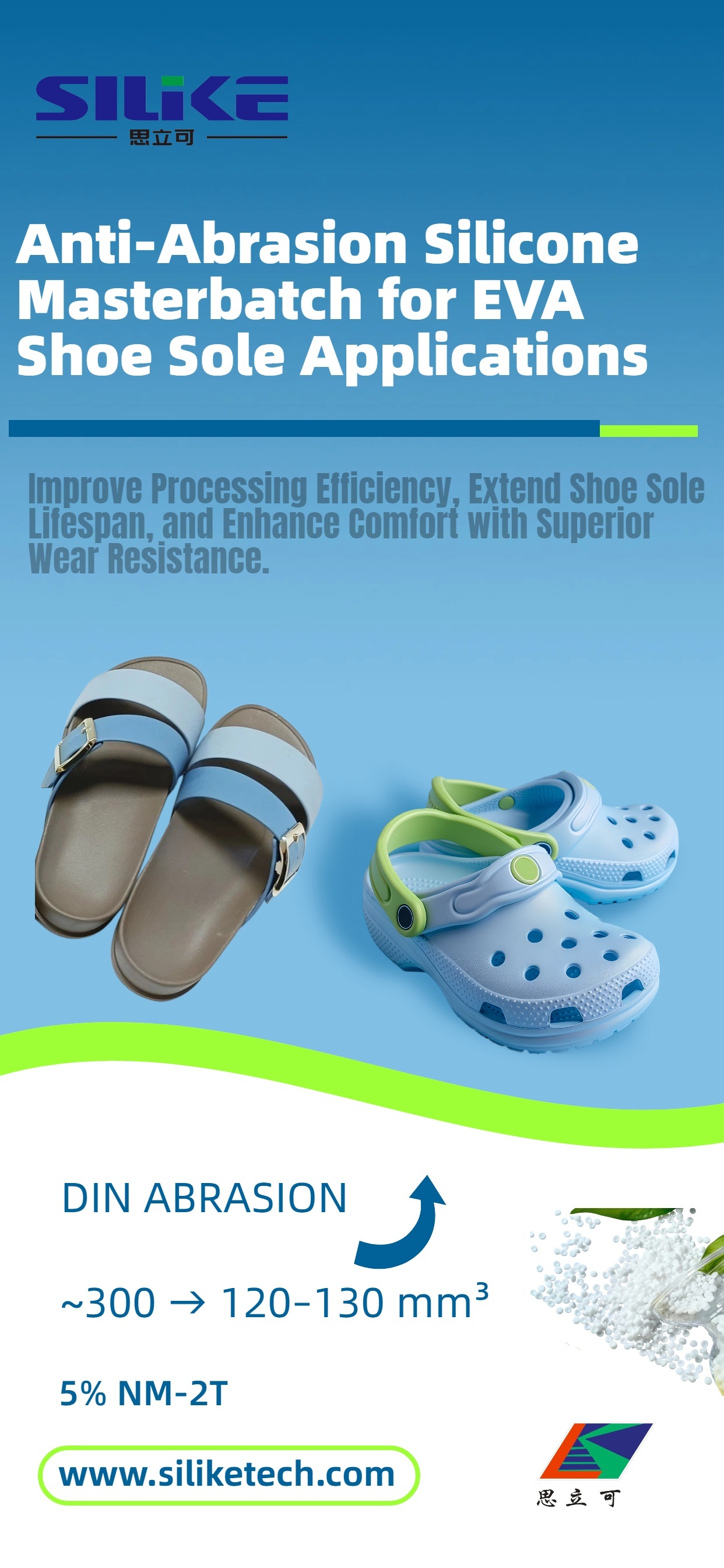
SILIKE NM-2T is an anti-abrasion silicone masterbatch (anti-wear agent) developed for EVA and EVA-compatible footwear compounds.
Supplied in a pelletized format, NM-2T contains 50% UHMW siloxane polymer incorporated into an EVA carrier system, enabling efficient addition through conventional polymer processing equipment.
The silicone-based functional component modifies friction behavior and polymer interfacial interactions, helping reduce material loss during abrasion testing and improve the wear resistance of EVA footwear components while maintaining the comfort and processing characteristics required for footwear applications.
How Does Anti-wear Masterbatch NM-2T Improve EVA Abrasion Resistance?
The UHMW siloxane component provides low-friction characteristics within the EVA matrix.
During abrasion, the interaction between the EVA surface and the contacting surface strongly affects material loss.
NM-2T works through:
NM-2T incorporation
↓
Improved silicone dispersion within EVA
↓
Modified friction and surface interaction
↓
Reduced wear during abrasion
↓
Improved EVA shoe sole durability
The actual performance depends on EVA grade, formulation design, processing conditions, and testing methods.
NM-2T Abrasion Performance in EVA Applications
Application testing demonstrates the potential of NM-2T to improve EVA abrasion resistance.
Under specified test conditions:
1% NM-2T addition, DIN abrasion reduced by approximately 10–15%
5% NM-2T addition, DIN abrasion reduced from approximately: 300 mm³ → 120–130 mm³
Lower DIN abrasion values indicate reduced material loss during abrasion testing.
These results demonstrate that NM-2T can provide a targeted approach for EVA wear-performance optimization.
Why Choose Anti-Abrasion Masterbatch Instead of Increasing Hardness?
For footwear applications, abrasion resistance is only one performance requirement.
A shoe sole must also maintain: Flexibility, Cushioning, Elastic recovery, Wearing comfort, and Lightweight characteristics.
Simply increasing hardness may improve certain wear properties but can negatively influence the overall footwear experience.
Anti wear additive NM-2T provides another formulation option by targeting friction and wear behavior without relying solely on hardness modification.
Processing Advantages of wear resistance agent NM-2T
Besides abrasion improvement, silicone-based technology may also contribute to processing performance depending on formulation and dosage.
Potential benefits include:
• Improved melt lubrication
• Reduced processing friction
• Better mold release behavior
The final processing effect depends on the EVA formulation, equipment, and processing parameters.
NM-2T Recommended Dosage in EVA
The typical evaluation range:
0.5–5 wt.%
The suitable dosage depends on the performance target.
| Application Target | Evaluation Direction |
|---|---|
| Processing improvement | Lower dosage evaluation |
| Friction modification | Moderate dosage evaluation |
| Abrasion resistance improvement | Moderate to higher dosage evaluation |
| Surface wear optimization | Higher dosage evaluation |
For production applications, dosage should be optimized based on the actual EVA formulation and footwear requirements.
NM-2T Application in EVA Footwear Compounds
NM-2T can be evaluated for:
• EVA shoe soles
• EVA outsoles
• EVA midsoles
• EVA slippers
• EVA foam footwear components
• Lightweight footwear materials
It is particularly suitable for applications where manufacturers need improved wear resistance while maintaining the existing EVA processing system.
NM-2T and Si-TPV: Different Solutions for Different EVA Requirements
Not every EVA development target is focused only on abrasion.
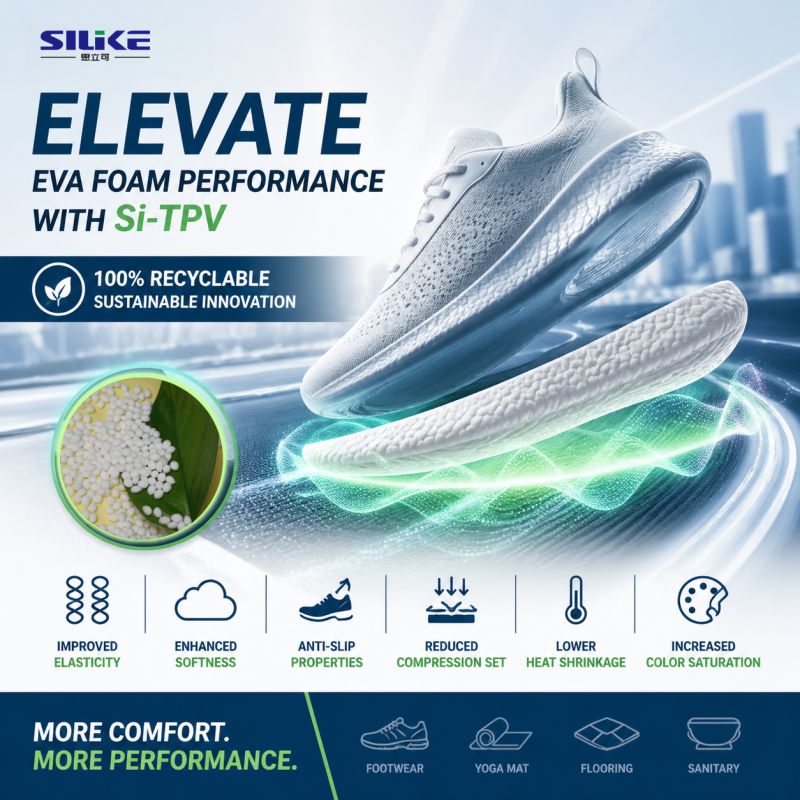
Some applications require broader modification of Softness, Elasticity, Resilience, Compression behavior, and Surface feel.
In these cases, SILIKE Si-TPV for EVA modification can be considered as an alternative technology approach.
The difference is:
| Technology | Primary Function |
|---|---|
| NM-2T Anti-Abrasion Silicone Masterbatch | Targeted improvement of abrasion resistance, friction behavior, and processing performance |
| Si-TPV | Broader EVA modification for softness, elasticity, resilience, and surface properties |
NM-2T and Si-TPV address different formulation objectives and can be selected according to the required material performance profile.
Conclusion
EVA remains a key material for lightweight and comfortable footwear, but achieving sufficient abrasion resistance can be challenging when the formulation must also retain flexibility, cushioning, resilience, and processability.
SILIKE NM-2T Anti-Abrasion Silicone Masterbatch provides a targeted formulation approach for EVA and EVA-compatible systems.
With 50% UHMW siloxane in an EVA carrier, NM-2T is developed to modify friction and wear behavior and improve abrasion resistance.
SILIKE application data shows:
1% NM-2T → approximately 10–15% reduction in DIN abrasion
and, in a specified application evaluation:
5% NM-2T → DIN abrasion reduced from approximately 300 mm³ to 120–130 mm³.
For EVA formulations where the performance target extends beyond abrasion and includes broader requirements for softness, elasticity, resilience, compression behavior, and surface feel, Si-TPV can be considered as an additional material modification technology.
The appropriate technology and dosage ultimately depend on the EVA grade, formulation, processing conditions, and finished footwear requirements.
Looking to Improve EVA Shoe Sole Abrasion Resistance?
Evaluate SILIKE Anti-Abrasion Silicone Masterbatch for your EVA footwear formulation.
Contact SILIKE for NM-2T samples, technical information, and application evaluation support.
Tel: +86- 28-83625089
Email: amy.wang@silike.cn
Website: www.siliketech.com
FAQ
What is NM-2T?
NM-2T is an anti-abrasion silicone masterbatch containing 50% ultra-high molecular weight siloxane polymer in an EVA resin carrier, developed for EVA and EVA-compatible systems.
Can NM-2T improve EVA shoe sole abrasion resistance?
Yes. NM-2T is specifically developed to improve abrasion and wear performance in EVA and EVA-compatible formulations. Application data shows reductions in DIN abrasion under specified test conditions.
What is the recommended NM-2T dosage for EVA?
The general dosage range is 0.5–5 wt.%. The optimum level depends on the EVA formulation and target performance and should be established through application testing.
What is the effect of 1% NM-2T in EVA?
SILIKE application data indicates that 1% NM-2T can reduce DIN abrasion by approximately 10–15% under the specified test conditions.
What happens when 5% NM-2T is added to EVA?
In one SILIKE application evaluation, 5% NM-2T reduced DIN abrasion from approximately 300 mm³ to 120–130 mm³ under the specified conditions.
Does NM-2T affect EVA hardness?
SILIKE reports that NM-2T does not significantly affect hardness and color under the specified application conditions. Actual results should be verified in the specific EVA formulation.
Can NM-2T improve EVA processing?
Depending on dosage and formulation, NM-2T can contribute to processing lubrication, material flow, mold filling, and mold release.
What is the difference between NM-2T and Si-TPV for EVA?
NM-2T is primarily a targeted anti-abrasion silicone masterbatch for wear, friction, lubrication, and related surface/processing performance. Si-TPV can be considered when broader modification of EVA properties such as softness, elasticity, resilience, compression behavior, and wear performance is required.
Can NM-2T be used in EVA slippers and shoe soles?
Yes. NM-2T is developed for EVA and EVA-compatible systems and can be evaluated for EVA shoe soles, slippers, midsoles, outsoles, and other footwear components.
Which abrasion tests can be used to evaluate NM-2T?
Depending on the application, abrasion performance can be evaluated using methods such as DIN, ASTM, NBS, AKRON, SATRA, and GB. The selected test method should reflect the target footwear application.
Post time: Aug-19-2026


