
Why does melt fracture occur in PE film extrusion?
Melt fracture is one of the most common surface defects in polyethylene (PE) film extrusion, especially in LLDPE, HDPE, and mLLDPE high-speed processing.
It typically appears as:
• Sharkskin surface texture
• Rough or irregular film appearance
• Flow instability at die exit
• Loss of optical clarity
Root cause
Melt fracture is caused by interfacial flow instability when polymer melt passes through the die under high shear stress.
When shear stress exceeds a critical threshold:
• The polymer melt cannot maintain smooth flow
• Stick–slip behavior occurs at the die wall
• The surface layer fractures periodically
This becomes more severe under:
• High line speed extrusion
• Narrow die gaps
• High molecular weight resins
• Metallocene-based PE grades
Why traditional fluoropolymer PPAs are used
For decades, fluoropolymer-based Polymer Processing Aids (PPAs) have been used to solve melt fracture issues in PE film extrusion.
They work by:
• Migrating to the die surface
• Forming a low surface energy fluorinated coating
• Reducing melt-die friction
• Enabling wall slip
This helps stabilize melt flow and eliminate sharkskin defects.
However, increasing regulatory pressure on PFAS-related substances is changing how processors approach this solution.
Why manufacturers are looking for non-fluoropolymer solutions
The shift away from fluoropolymer PPAs is driven by:
Regulatory pressure
• EU REACH PFAS restriction proposals
• US EPA TSCA PFAS reporting requirements
• Global PFAS monitoring initiatives
OEM and brand requirements
• PFAS-free packaging demands
• Sustainability compliance audits
• Circular economy targets
Technical and operational concerns
• Residual fluoropolymer contamination in recycling streams
• Export qualification risks
• Supply chain uncertainty
As a result, processors are actively seeking:
Can melt fracture be eliminated without fluoropolymers?
Yes.
Most polymer additive producers have launched PFAS-free processing aids, providing an alternative approach that does not rely on fluorinated surface coatings.
Instead of creating a permanent fluoropolymer film, these systems work through dynamic interfacial lubrication control.
How PFAS-free processing aids eliminate melt fracture
PFAS-free PPAs (especially silicone-based systems) reduce melt fracture through a different mechanism:
1. Interfacial slip stabilization
They modify the interaction between polymer melt and die surface, reducing stick–slip instability.
2. Reduced shear stress fluctuation
By smoothing flow behavior at the molecular level, they minimize sudden stress changes at the die exit.
3. Dynamic lubrication layer formation
A self-adjusting molecular layer forms at the interface, continuously stabilizing extrusion conditions.
4. Improved melt flow uniformity
The polymer melt maintains a more consistent velocity profile across the die.
SILIMER PFAS-free PPAs for melt fracture elimination
SILIKE SILIMER PFAS‑free processing aids are designed specifically for polyolefin extrusion systems that require high‑speed stability and high surface quality in film production.
They are developed as fluoropolymer PPA alternatives for:
• LLDPE film extrusion
• HDPE film processing
• mLLDPE high-speed blown film lines
How SILIMER PFAS-Free Processing Aid Alternative to Fluoropolymer PPAs technology works
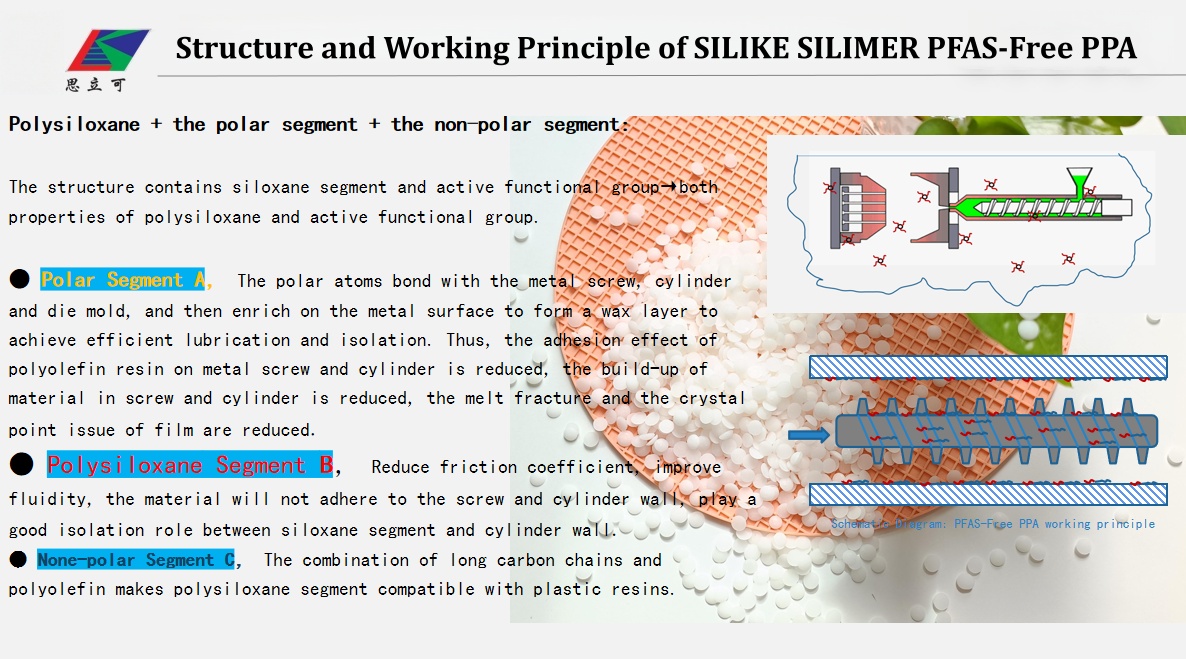
Performance Benefits of SILIKE SILIMER series PFAS‑Free and Fluorine‑Free Alternative Solutions in PE Film Extrusion
When applied in PE film production systems, SILIKE SILIMER series Non-PFAS Process Aids can help:
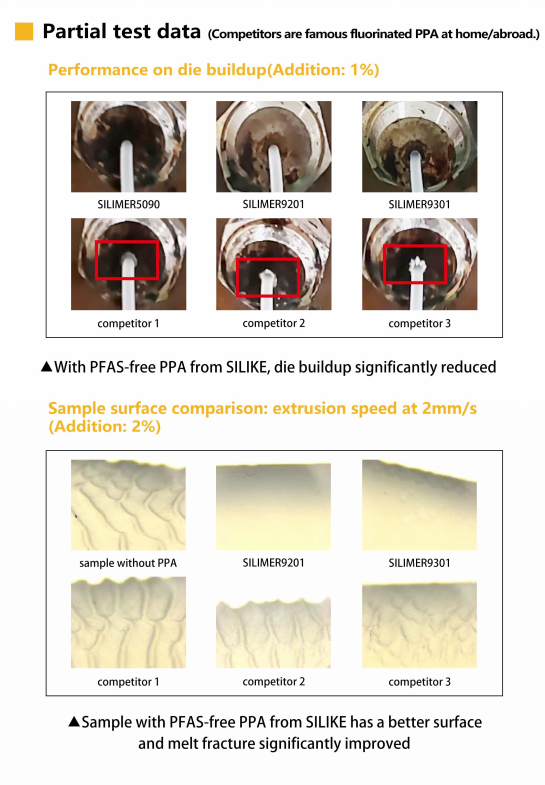
♦ Eliminate melt fracture and sharkskin defects
♦ Improve surface smoothness and maintain optical clarity
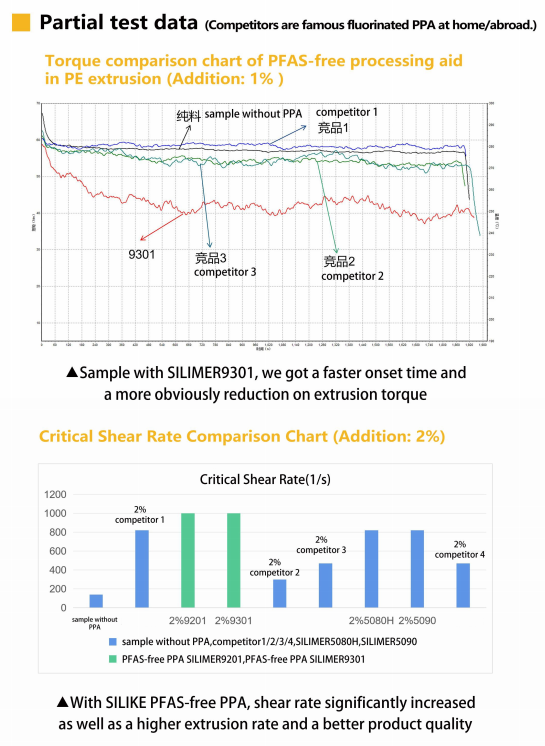
♦ Reduce extrusion pressure
♦ Enhance throughput stability
♦ Reduce die build-up and downtime
♦ Maintain stable performance at high line speeds
Where PFAS-free PPAs are most effective
They are widely used in:
Blown film extrusion
• LLDPE and mLLDPE films
• High-speed thin film production
• Packaging film applications
Cast film extrusion
• Optical and packaging films
• Multilayer structures
HDPE film systems
• Industrial films
• Form-fill-seal (FFS) Heavy-duty packaging
Recycled polyolefin processing
• Stabilizing inconsistent melt flow behavior
How to optimize melt fracture elimination without fluoropolymers
For best results, processors typically follow this approach:
Step 1: Identify baseline conditions
• Record current pressure, output, and defect level
Step 2: Introduce PFAS-free PPA
• Add at recommended low dosage level
• Ensure proper dispersion in masterbatch or compounding stage
Step 3: Stabilize interfacial behavior
• Allow system to reach steady-state lubrication balance
Step 4: Optimize processing parameters
• Adjust temperature profile
• Fine-tune line speed and screw speed
Step 5: Validate film quality
• Check surface smoothness
• Monitor haze and gloss stability
• Evaluate long-run stability
PFAS-free vs fluoropolymer PPAs in melt fracture control
| Performance Aspect | Fluoropolymer PPAs | PFAS-Free PPAs |
|---|---|---|
| Melt fracture elimination | Excellent | Excellent |
| Sharkskin reduction | Excellent | Excellent |
| High-speed stability | Good | Excellent |
| Die build-up control | Moderate | Improved |
| Regulatory compliance | PFAS concern | Fully PFAS-free |
| Recycling compatibility | Limited concern | Better alignment |
Practical Solutions for Stable, High-Speed Polyethylene Film Processing
Actual Data Comparison: SILIKE SILIMER series Fluorine-Free PPA vs. PFAS-Free Processing Aid
Frequently asked questions
Can melt fracture be eliminated completely without fluoropolymers?
Yes. SILIKE SILIMER series PFAS-free PPAs can fully eliminate melt fracture in most PE film extrusion systems when properly optimized.
Do PFAS-free PPAs affect film clarity or gloss?
No significant negative impact when used at recommended dosage levels.
Are fluorine-free solutions suitable for high-speed extrusion?
Yes.SILIKE SILIMER series PFAS-free polymer process aids are designed for high shear, high throughput conditions.
Can PFAS-free PPAs be used with recycled PE?
Yes. SILIKE SILIMER series PFAS-free PPAs can improve stability in recycled polyolefin processing.
Conclusion
Melt fracture in PE film extrusion is fundamentally a flow instability problem caused by interfacial friction at the die surface.
While fluoropolymer PPAs have historically been used to solve this issue, PFAS-free processing aids now provide a viable and increasingly preferred alternative.
PFAS-free solutions such as SILIKE SILIMER technology enable:
♦ Stable high-speed extrusion
♦ Defect-free film surfaces
♦ Reduced die build-up
♦ Regulatory compliance readiness
♦ Fluorine-free processing systems
Learn more about how to eliminate melt fracture in PE Film Extrusion without fluoropolymers or request a sample of SILIMER series PFAS-Free PPAs: amy.wang@silike.cn | www.siliketech.com
Post time: Jun-11-2026


