
As hygiene film manufacturers evaluate alternatives to conventional fluoropolymer processing aids (PPAs), simply finding an additive labeled “PFAS-free” is not enough.
The real challenge is maintaining the processing performance required for stable PE film extrusion, including:
• Melt-fracture control
• Reduced die build-up tendency
• Stable extrusion
• Consistent film surface quality
• Reliable long-run processing
For hygiene film applications without a specific silicone restriction, SILIKE recommends evaluating silicone-based PFAS-free processing aids as the preferred starting point.
For customers that specifically require both fluorine-free and silicone-free formulations, SILIKE can also provide corresponding PPA solutions.
However, the two technology routes should not automatically be considered performance-equivalent. Based on SILIKE’s current formulation development and application evaluation, fluorine-free and silicone-free processing aids may not deliver the same overall processing performance as silicone-based PFAS-free solutions under demanding extrusion conditions.
The appropriate choice therefore depends on both chemical restrictions and actual extrusion-performance requirements.
Why Are Hygiene Film Manufacturers Evaluating Alternatives to Fluoro-PPA?
Polymer processing aids are widely used in polyolefin extrusion to manage processing challenges associated with high shear and polymer–metal interactions.
Today, manufacturers are increasingly evaluating alternatives to conventional fluoropolymer PPA technologies as PFAS-related requirements and customer specifications evolve.
This is relevant to hygiene film applications such as:
• Diaper backsheet films
• Breathable PE films
• Feminine hygiene films
• Medical and protective films
• Other thin-gauge PE hygiene films
Changing an established PPA, however, can affect extrusion behavior.
The practical question is therefore not simply: “Is this PPA PFAS-free?”
It is: “Can this PFAS-free PPA maintain the extrusion stability, film quality, and production efficiency required for commercial hygiene film production?”
What Processing Challenges Matter When Replacing Fluoro-PPA?
Melt Fracture and Sharkskin
Under demanding shear conditions, instability at the die exit may produce melt fracture or sharkskin, resulting in rough film surfaces and reduced visual uniformity.
An appropriately selected PPA can help modify polymer–metal interfacial behavior and reduce or delay melt fracture under suitable processing conditions.
Die Build-Up
Deposits may gradually accumulate around the die lip during continuous extrusion.
Excessive die build-up can contribute to:
• Film surface defects
• More frequent die cleaning
• Production interruptions
• Reduced process consistency
For continuous hygiene film production, long-run die cleanliness may be more meaningful than film appearance during the first few minutes of a trial.
Extrusion Stability
Manufacturers should also monitor:
• Die pressure
• Extruder load
• Output consistency
• Melt behavior
• Film appearance over time
Replacing fluoro-PPA should therefore be approached as a processing optimization project rather than a simple one-to-one additive substitution.
Silicone-Based vs. Silicone-Free PFAS-Free PPA: Which Route Should You Choose?
An important distinction needs to be established first: PFAS-free does not necessarily mean silicone-free.
PFAS-free processing aids can use different functional chemistries. Some are silicone-based, while others are specifically designed to meet both fluorine-free and silicone-free requirements.
A practical selection framework is:
| Selection Factor | Silicone-Based PFAS-Free PPA | PFAS-Free & Silicone-Free PPA |
|---|---|---|
| PFAS-free requirement | ✓ | ✓ |
| Silicone-free requirement | No | ✓ |
| PE blown film extrusion | Recommended for evaluation | Can be evaluated |
| Melt-fracture control | Key performance target | Application-dependent |
| Die build-up control | Key performance target | Application-dependent |
| Extrusion stability | Key performance target | Application-dependent |
| Best suited when | Silicone is permitted and processing performance is the priority | Silicone exclusion is specifically required |
If silicone is permitted, SILIKE recommends starting with silicone-based SILIMER series PFAS-free polymer processing aids (PPA) technology.
If silicone is specifically prohibited, a fluorine-free and silicone-free PPA should be evaluated.
Why Does SILIKE Recommend Silicone-Based PFAS-Free PPA First?
For PE film extrusion without silicone restrictions, silicone-based PFAS-free processing aids are SILIKE’s preferred starting point because they can provide a strong overall balance of processing performance.
Depending on the polymer formulation, dosage, equipment, and operating conditions, the technology can be evaluated for:
Reduced Melt Fracture
Silicone-based processing aids can help modify interfacial behavior during extrusion, supporting melt-fracture and sharkskin control under appropriate conditions.
Reduced Die Build-Up Tendency
Improved polymer–metal interfacial behavior can help reduce the tendency for material to accumulate around the die lip, potentially supporting longer production runs between cleaning operations.
Stable Extrusion
Improved processing behavior can support more consistent extrusion conditions and a broader practical processing window.
Consistent Film Surface Quality
Reducing melt instability and die-related defects can contribute to more consistent film surface appearance.
For hygiene film manufacturers whose requirement is PFAS-free but not silicone-free, these combined processing targets make silicone-based PFAS-free technology the route we recommend evaluating first.
What If Both Fluorine-Free and Silicone-Free Are Required?
Some customers have additional formulation restrictions.
A fluorine-free and silicone-free PPA may be relevant when:
• Customer specifications explicitly prohibit silicone
• Downstream applications have silicone restrictions
• Masterbatch manufacturers are developing silicone-free product lines
• End users specifically request both fluorine-free and silicone-free chemistry
For these applications, SILIKE can also provide fluorine-free and silicone-free processing-aid options for evaluation.
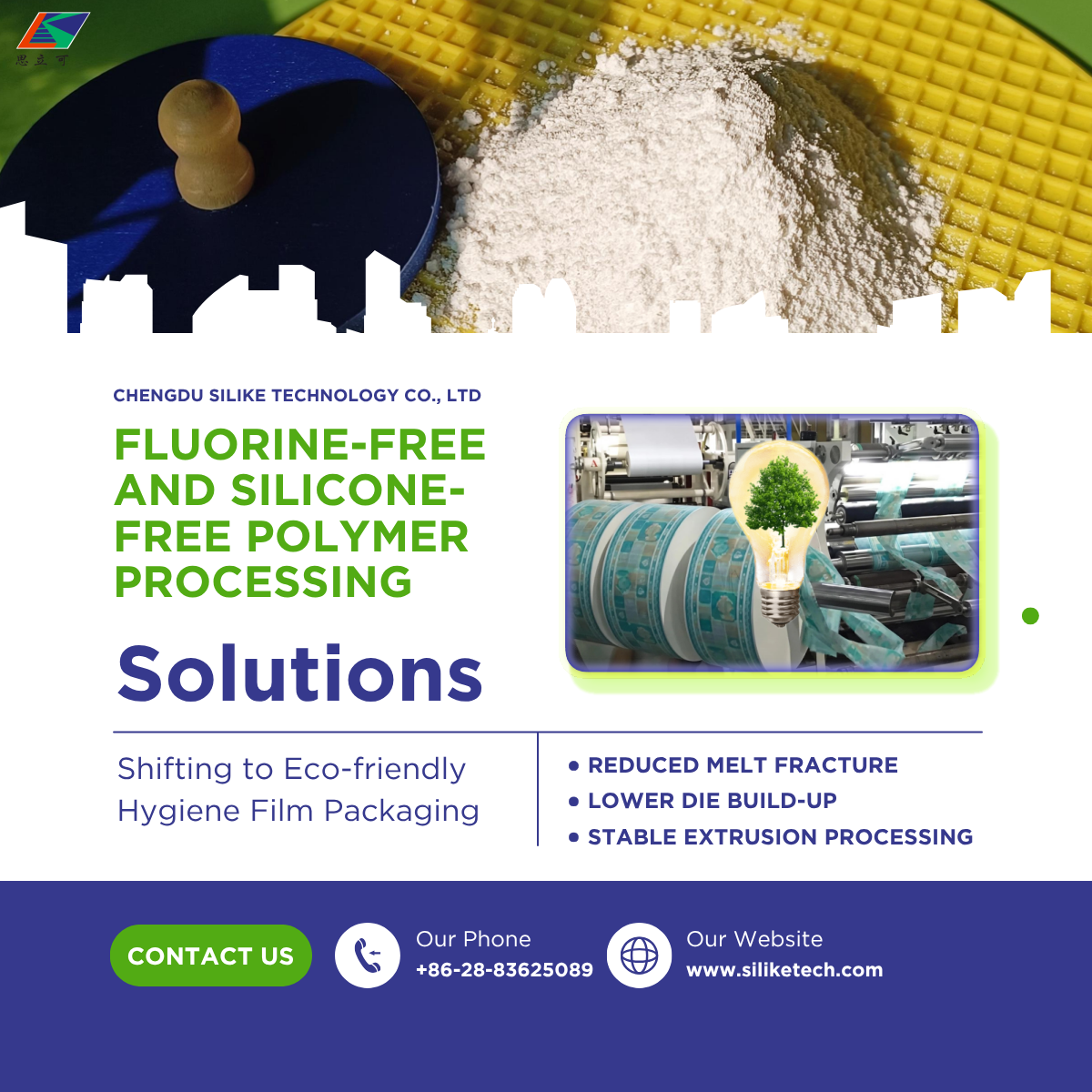
There is, however, an important performance consideration.
Based on our current evaluation, fluorine-free and silicone-free solutions may not provide the same overall processing performance as silicone-based PFAS-free processing aids, particularly when melt-fracture control, die build-up reduction, and extrusion stability need to be addressed simultaneously.
This does not mean silicone-free technology is unsuitable. It means that the additional chemistry restriction may require a different performance balance.
A simple decision logic is:
PFAS-free required + silicone permitted
→ Evaluate silicone-based PFAS-free PPA first
PFAS-free + silicone-free specifically required
→ Evaluate fluorine-free & silicone-free PPA
What Should You Evaluate in a Hygiene Film Extrusion Trial?
PPA selection should be based on actual extrusion performance rather than chemistry alone.
1. Melt-Fracture Performance
Monitor:
• Onset of sharkskin
• Film surface appearance
• Extrusion rate
• Die pressure
• Processing window
The objective is to determine whether surface stability can be maintained at the required production conditions.
2. Die Build-Up Over Time
Short trials may not fully reveal deposit behavior.
Where possible, evaluate:
• Die lip cleanliness
• Deposit formation over time
• Film defects
• Cleaning frequency
• Stable production duration
3. Extrusion Stability
Compare:
• Die pressure
• Extruder load
• Output consistency
• Melt behavior
• Film appearance over time
4. Complete Film Formulation
Hygiene films may contain combinations of LLDPE, LDPE, mLLDPE, mineral fillers, pigments, and other functional additives.
This is particularly important for breathable PE films, where relatively high mineral-filler loading can significantly influence processing behavior.
The PPA should therefore be evaluated in the complete formulation rather than neat PE alone.
5. Downstream Performance
Depending on the final film structure and application, manufacturers may also need to evaluate:
• Printing
• Lamination
• Sealing
• Surface treatment
• Film appearance
• Mechanical properties
Processing improvement should not create new downstream converting problems.
How Should You Transition from Fluoro-PPA?
A new PFAS-free PPA should not automatically be used at the same dosage as an existing fluoropolymer PPA.
A more reliable evaluation follows four steps:
1. Establish the baseline
Record the existing resin formulation, PPA type and dosage, extrusion temperature, output, die pressure, melt fracture, die build-up, and film appearance.
2. Define the chemistry requirement
Determine whether the application requires PFAS-free only or specifically PFAS-free + silicone-free.
3. Select and optimize the technology
If silicone is permitted, start with silicone-based PFAS-free PPA. If silicone is prohibited, evaluate the silicone-free route.
Optimize the dosage and processing conditions rather than assuming a one-to-one replacement.
4. Evaluate long-run performance
Compare: Melt fracture → die pressure → die build-up → output stability → film quality → cleaning interval
Actual production data provides a more meaningful comparison than additive chemistry alone.
PPA Active Ingredient or Ready-to-Use Masterbatch?
The appropriate product format depends on where the processing aid will be used.
For Masterbatch Manufacturers
Companies developing their own PPA formulations may prefer a PPA active ingredient, providing flexibility in:
• Carrier resin selection
• Active-content adjustment
• Customized masterbatch development
• Application-specific formulation design
For Hygiene Film Manufacturers
Film producers may prefer a ready-to-use PFAS-free PPA masterbatch for direct extrusion evaluation.
This can simplify dosing, handling, dispersion, and production trials.
SILIKE can support both routes according to the customer’s formulation and production requirements.
SILIKE PFAS-Free PPA Solutions for Hygiene Film Extrusion
SILIKE develops polymer processing aid technologies for film producers, compounders, and masterbatch manufacturers evaluating alternatives to conventional fluorinated PPAs.
Silicone-Based PFAS-Free Processing Aids
Recommended first when silicone is permitted.
Designed for polyolefin processing applications where manufacturers are looking to move away from conventional fluoropolymer PPA chemistry while targeting:
• Stable extrusion
• Reduced melt fracture
• Lower die build-up tendency
• Consistent surface quality
• Improved overall processing behavior
Fluorine-Free & Silicone-Free Processing Aids
Available when silicone exclusion is specifically required.
These solutions can be evaluated for customers requiring both fluorine-free and silicone-free chemistry, including customized PPA masterbatch development.
Application Support
SILIKE can support customers through: Film formulation → PPA selection → dosage evaluation → extrusion trial → performance comparison → process optimization
This allows the processing aid to be selected according to actual production requirements rather than chemistry classification alone.
Frequently Asked Questions
Is PFAS-Free PPA the Same as Silicone-Free PPA?
No. PFAS-free and silicone-free describe different chemistry requirements. A processing aid can be PFAS-free while using silicone-based technology.
If silicone is specifically prohibited, a PFAS-free and silicone-free processing aid should be evaluated separately.
Which PFAS-Free PPA Is Recommended for Hygiene Film Extrusion?
When silicone is permitted, SILIKE recommends evaluating SILIMER series products, which are PFAS-free polymer processing aids, first.
When both fluorine-free and silicone-free chemistry is specifically required, SILIKE can also provide corresponding processing-aid solutions for evaluation, including SILIMER 9700 in pure form and SILIMER 9701 in masterbatch form. Both are PFAS-free and siloxane-free PPA solutions.
Does Silicone-Free PPA Perform as Well as Silicone-Based PFAS-Free PPA?
Performance depends on the polymer formulation, dosage, equipment, and processing conditions.
Based on SILIKE’s current evaluation, fluorine-free and silicone-free solutions may not provide the same overall processing performance as silicone-based PFAS-free processing aids under demanding extrusion conditions.
Can PFAS-Free PPA Reduce Melt Fracture in PE Blown Film?
An appropriately selected PFAS-free processing aid can be evaluated for reducing melt fracture and sharkskin in PE blown film extrusion. Actual performance should be verified under the specific formulation and production conditions.
Can PFAS-Free PPA Be Used in Breathable PE Film?
Potentially. Breathable PE films may contain significant mineral-filler loading, so the processing aid should be evaluated in the actual filled formulation and production process.
Should I Choose a PPA Active Ingredient or a PPA Masterbatch?
Masterbatch manufacturers may prefer an active ingredient for greater formulation flexibility. Film manufacturers looking for direct production evaluation may prefer a ready-to-use PPA masterbatch.
Conclusion: Match the PPA Technology to the Processing Requirement
Choosing an alternative to conventional fluoro-PPA for hygiene film extrusion should not be based on PFAS-free status alone.
The first question should be:
Is silicone permitted?
If yes:
→ Start by evaluating a silicone-based PFAS-free PPA.
If no:
→ Evaluate a fluorine-free and silicone-free PPA.
For applications without silicone restrictions, SILIKE recommends silicone-based PFAS-free processing aids as the preferred starting point, particularly when melt-fracture control, reduced die build-up tendency, extrusion stability, and overall processing performance are priorities.
For customers that specifically require both fluorine-free and silicone-free chemistry, SILIKE can also provide corresponding processing-aid solutions for evaluation.
Ultimately, the right technology should balance: Chemistry requirements + film formulation + extrusion conditions + processing performance + downstream requirements.
Evaluating an Alternative to Fluoro-PPA for Hygiene Film Extrusion?
Whether you are a hygiene film manufacturer looking for a ready-to-use PFAS-free PPA masterbatch or a masterbatch producer developing a customized PFAS-free processing aid, contact SILIKE to discuss your PE formulation, current PPA system, processing conditions, and trial requirements.
Contact SILIKE Technology
Website: www.siliketech.com
Email: amy.wang@silike.cn
Mobile / WhatsApp: +86 151 0828 0799
Contact Amy Wang directly to discuss your PFAS-free PPA requirements or request a sample for evaluation.
Post time: Aug-28-2026


