
Technical Selection Guide | PFAS-Free Polymer Processing Aids for Film Manufacturers and Masterbatch Producers
When replacing a conventional fluoropolymer processing aid, selecting the right PFAS-free PPA chemistry is only part of the decision.
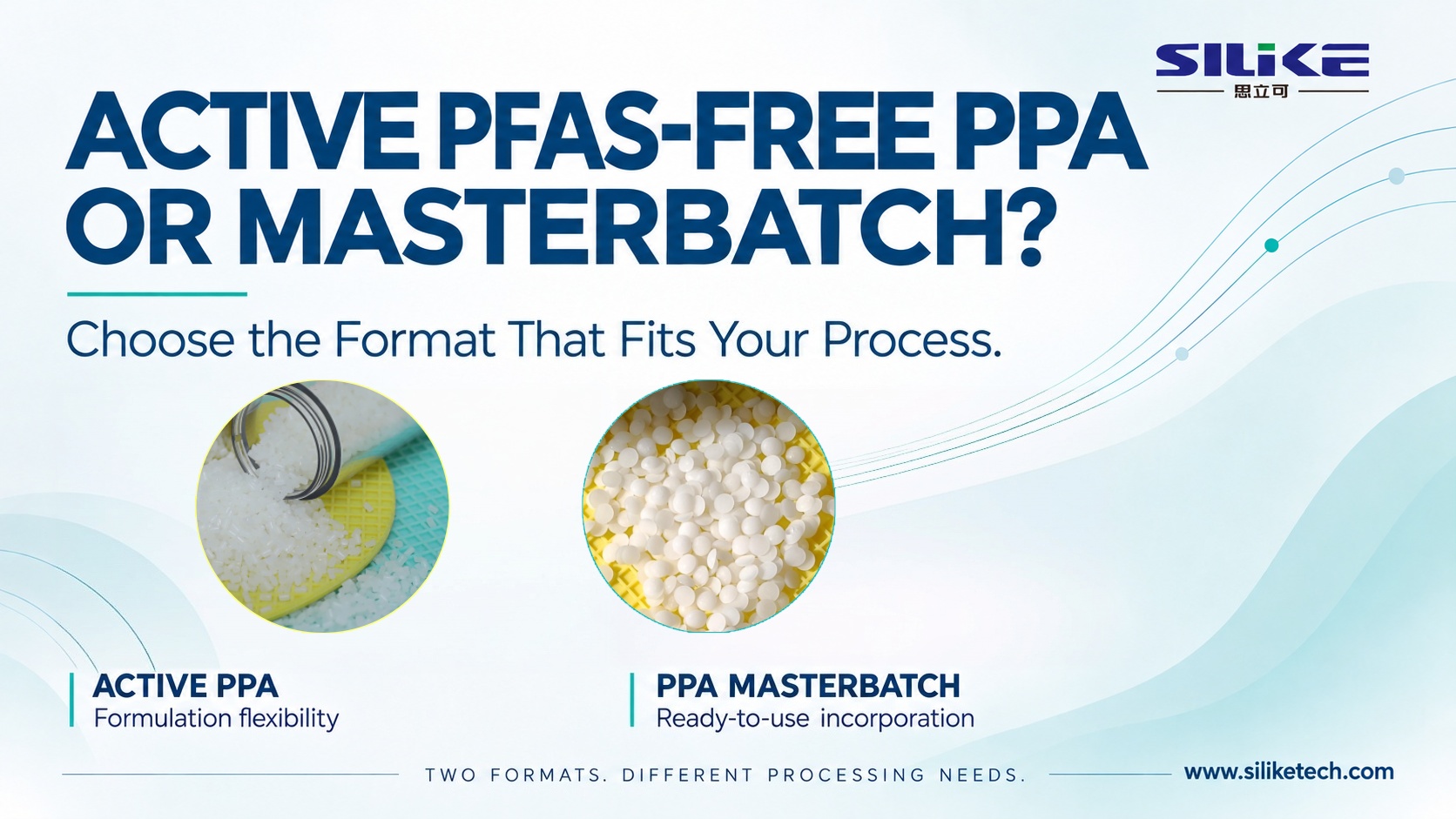
Another consideration is whether to use a concentrated active polymer processing aid or a ready-to-use PPA masterbatch.
For plastic film manufacturers, this choice affects additive incorporation, carrier compatibility, and production trials. For functional masterbatch producers, it influences formulation flexibility and compounding requirements.
Understanding these differences helps manufacturers select a suitable processing aid for their actual production needs.
Active PFAS-Free PPA vs. PPA Masterbatch: Key Differences
An active PFAS-free polymer processing aid is supplied as a concentrated additive without a conventional polymer carrier.
A PFAS-free PPA masterbatch contains the processing aid incorporated into a carrier resin, such as polyethylene (PE) or polypropylene (PP).
Both formats can be evaluated for extrusion processing improvement, but their handling and formulation requirements differ.
| Selection Factor | Active PFAS-Free PPA | PFAS-Free PPA Masterbatch |
|---|---|---|
| Product format | Concentrated additive | Additive in a polymer carrier |
| Typical users | Masterbatch producers and compounders | Film processors and compounders |
| Formulation flexibility | Customized carrier and concentration | Predefined carrier and concentration |
| Incorporation | Requires suitable dosing and dispersion capability | May simplify addition through compatible pellet-feeding systems |
| Key consideration | Dispersion and formulation consistency | Carrier compatibility and effective dosage |
Neither format is inherently superior. Selection should reflect the resin system, processing equipment, and required performance.
Active Concentration and Recommended Addition Level
When comparing active PFAS-free PPAs with PPA masterbatches, the effective active concentration in the final formulation should be considered alongside the product addition level.
For example, in LLDPE film extrusion, SILIKE generally recommends 1–3 wt% SILIMER 5090 PFAS-free PPA masterbatch, corresponding to an effective active concentration of approximately 500–1,500 ppm, depending on the formulation and processing requirements.
The optimum dosage should be determined according to the resin system, existing additive package, extrusion conditions, and target processing performance.
Equivalent active concentrations do not necessarily result in equivalent processing performance when different PPA technologies are compared.
Which PPA Format Fits Your Production Process?
For film manufacturers using existing pellet-feeding systems, a compatible PPA masterbatch may provide a practical starting point for evaluating improvements in melt fracture, die build-up, and extrusion stability.
For functional masterbatch manufacturers, active processing aids offer greater flexibility in carrier selection, active concentration, and additive formulation. However, dosing accuracy, dispersion, and compounding capability remain important.
The following matrix provides an initial selection reference.
| Production Requirement | Suggested Evaluation Direction |
|---|---|
| Customized functional masterbatch development | Active PFAS-free PPA |
| Direct addition during film extrusion | Compatible PPA masterbatch |
| Flexible carrier and active concentration | Active PFAS-free PPA |
| Simplified additive incorporation | Ready-to-use PPA masterbatch |
| mLLDPE/LLDPE/LDPE blown film extrusion | PE-compatible PPA masterbatch |
| PP cast or CPP film extrusion | PP-compatible PPA masterbatch |
| PFAS-free and siloxane-free formulation | Separate siloxane-free PPA technology |
Final selection should be verified under actual formulation and processing conditions.
What Matters During a PFAS-Free PPA Replacement Trial?
When replacing fluoropolymer-based PPAs, performance should be evaluated under controlled production conditions rather than comparing dosage alone.
Residual additives, equipment history, conditioning time, and processing conditions can influence the extrusion response.
Key evaluation parameters include:
• Melt fracture and sharkskin
• Die build-up and die drool
• Extrusion pressure and torque, where measured
• Production output and process stability
• Conditioning time
• Film appearance and relevant downstream properties
For more detailed guidance on changeover and performance assessment, refer to SILIKE’s PFAS-Free PPA Replacement Trial Guide-Solve Critical Polymer Processing Challenges – Without PFAS!
SILIKE PFAS-Free PPA Solutions
SILIKE develops SILIMER Series PFAS-free polymer processing aids for selected polyolefin extrusion applications, including active additives and polymer-carrier masterbatches.
SILIMER 9100, 9200, 9300, 9400, and 9600 series provide concentrated processing aid options for customized formulations and application-specific evaluation.
SILIMER 9301, 9201, 5090, and 5090H are available for selected PE extrusion applications, while SILIMER 9406, 9401, and 5091 provide PP-carrier options for compatible polypropylene extrusion processes.
PFAS-Free and Siloxane-Free Options
For applications requiring siloxane-free processing aid chemistry, SILIKE also offers separate technologies, including SILIMER 9700 in active form and SILIMER 9701 in masterbatch form.
These technologies differ in chemical composition and should be evaluated according to the resin system, processing conditions, and customer specifications.
Explore the broader SILIKE PFAS-Free Polymer Processing Aid Portfolio for additional product formats and application options.
Selecting the Right PFAS-Free PPA Starts with Your Formulation
The appropriate processing aid is not necessarily the product with the highest active concentration or lowest addition percentage.
For film processors, the priority is achieving the required extrusion performance within a stable production window. For masterbatch manufacturers, formulation flexibility and consistent additive incorporation may be equally important.
Developing a PFAS-Free PPA Masterbatch or Replacing Fluoropolymer PPA on Your Film Line?
SILIKE supports film manufacturers, compounders, and functional masterbatch producers evaluating PFAS-free polymer processing aid technologies.
Share your resin system, current processing aid, dosage, extrusion conditions, and target performance. SILIKE’s technical team can help identify suitable processing aid candidates and discuss a controlled evaluation approach.
Discuss Your Extrusion Formulation | Request Technical Information | Evaluate PFAS-Free PPA and fluorine-free PPA Masterbatch Samples
Email: amy.wang@silike.cn
Website: www.siliketech.com
Post time: Oct-09-2026


