
1. Why Oil-Resistant ABS Faces Processing Challenges in Injection Molding
Oil-resistant ABS used in kitchen appliance applications is designed to improve resistance to grease, heat, and household cleaning chemicals. However, these performance improvements often come with reduced processability during injection molding.
From a polymer processing perspective, this is mainly caused by increased melt viscosity and reduced molecular chain mobility after formulation modification. As a result, manufacturers typically experience higher injection pressure, slower mold filling, and increased demolding resistance in mass production.
These processing changes frequently lead to surface quality instability, including gloss variation, whitening, flow marks, and localized stress whitening, even when the material shows improved long-term durability in kitchen environments.
2. Why Kitchen Appliance Environments Are Highly Demanding for ABS
Kitchen appliances represent one of the most aggressive application environments for ABS materials due to continuous exposure to multiple stress factors:
• High temperature from cooking and heating systems
• Oil vapor and grease deposition on surfaces
• Frequent contact with alkaline cleaning agents
• Repeated humidity and thermal cycling
These combined conditions accelerate both physical and chemical aging of polymer materials.
Field performance feedback from appliance manufacturers shows that ABS housings in kitchen environments often degrade faster than those used in general consumer electronics applications.
3. Typical Failure Modes of ABS in Kitchen Applications
In real industrial applications, ABS used in kitchen environments commonly exhibits the following failure behaviors:
Surface degradation
• Yellowing under long-term heat and oil exposure
• Loss of gloss and surface dullness
• Whitening or haze caused by stress concentration
Mechanical aging
• Micro-cracking after repeated thermal cycling
• Reduced impact resistance over time
• Surface embrittlement under long-term exposure
Functional surface changes
• Sticky or tacky surface feel
• Increased dust adhesion due to surface energy changes
• Reduced tactile smoothness
These issues are typically the result of combined thermal, chemical, and mechanical stress rather than a single failure mechanism.
4. Material Evolution of ABS for Kitchen Appliance Applications
To meet increasing performance requirements, ABS systems have evolved through several stages:
Standard ABS
Balanced mechanical properties but limited resistance to heat and chemicals.
PC/ABS blends
Improved thermal resistance and structural stability under heat.
PP-based systems
Enhanced chemical resistance with lower surface energy characteristics.
Oil-resistant ABS (advanced formulation stage)
Improved resistance to grease, oil, and cleaning agents, with better long-term property retention under kitchen conditions.
However, this improved resistance introduces new challenges during processing.
5. Processing Instability and Manufacturing Challenges
Although oil-resistant ABS improves end-use durability, it often creates processing difficulties in injection molding production, including:
• Increased melt viscosity
• Higher injection pressure requirements
• Reduced flow length in complex mold structures
• Slower demolding efficiency
• Longer cycle time
• Higher energy consumption
• Reduced surface consistency in mass production
This creates a key engineering contradiction:
Improved durability in application, but reduced efficiency in manufacturing.
6. Surface Quality Issues in High-Resistance ABS Systems
In modified ABS formulations, surface defects are mainly caused by changes in melt flow and mold interaction behavior:
• Non-uniform melt flow during cavity filling
• Increased internal stress during cooling
• Higher friction at mold release interface
• Sensitivity to processing temperature variation
Common visible defects include:
• Flow marks
• Gloss inconsistency
• Whitening or haze
• Mold sticking marks
Therefore, improving chemical resistance alone is not sufficient to ensure stable industrial production quality.
7. Engineering Solution: Silicone-Based Processing Additives
Silicone-based processing additives are widely used in ABS systems to improve both processing stability and surface performance without changing the base resin system.
These additives act as processing additives and surface modifiers that enhance melt behavior and reduce friction during processing.
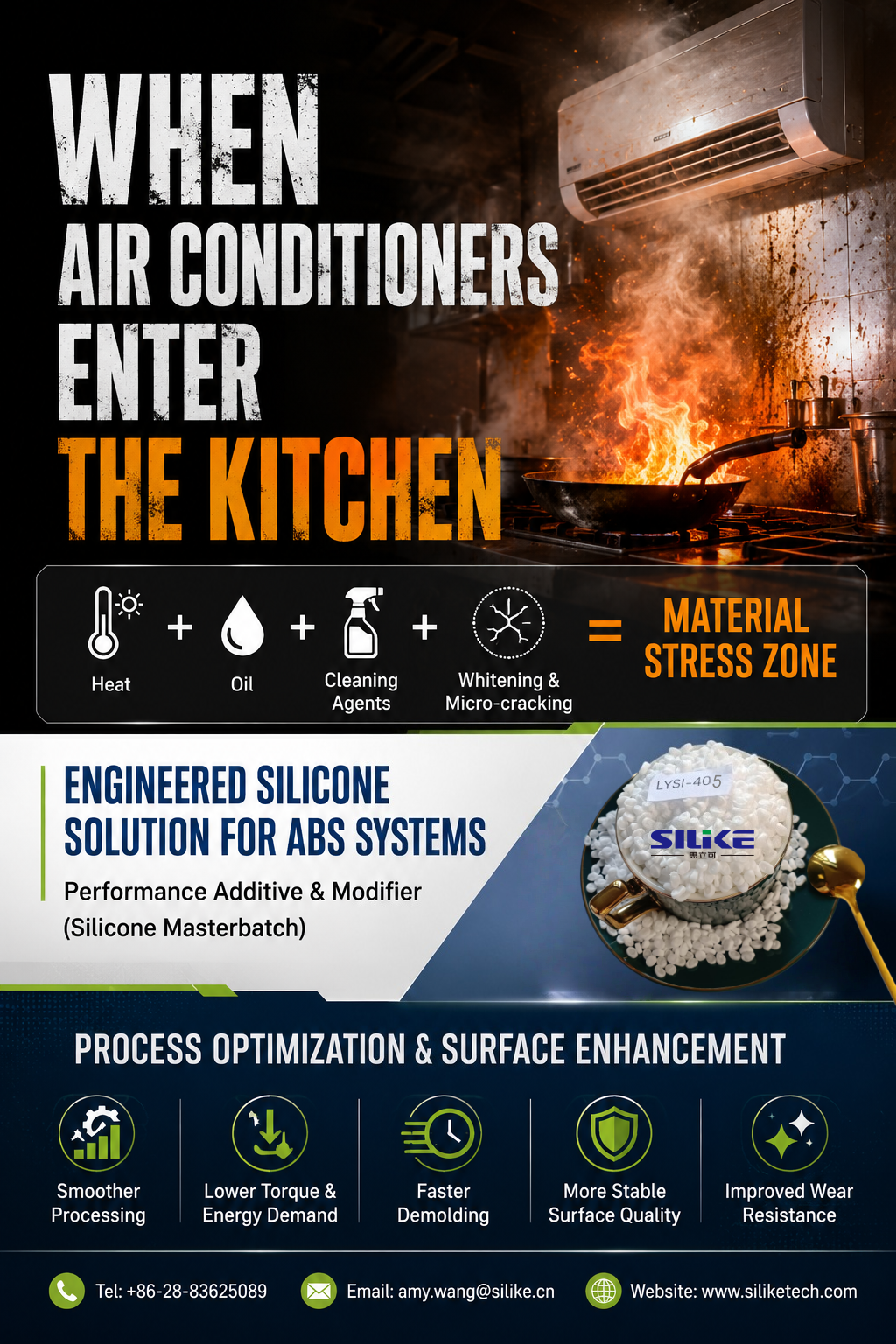
Key engineering benefits:
Processing improvement
• Improved melt flow stability
• Lower melt viscosity resistance
• Better mold filling performance
Production efficiency
• Reduced demolding resistance
• Shorter cycle time
• Lower injection pressure
Surface quality stability
• More consistent gloss
• Reduced flow marks
• Improved surface uniformity in mass production
This enables manufacturers to achieve a balance between durability and manufacturability.
8. Frequently Asked Questions (FAQ)
Q1: Why does oil-resistant ABS require higher injection pressure?
Because formulation modification increases melt viscosity, reducing flow efficiency during cavity filling.
Q2: What causes surface defects in ABS kitchen appliance housings?
Surface defects are mainly caused by flow instability, internal stress accumulation, and mold-release friction during demolding.
Q3: What is silicone masterbatch for ABS used for?
Silicone masterbatch for ABS is a processing and surface performance additive used in injection molding to improve melt flow behavior, reduce demolding resistance, and enhance surface quality. It helps ABS materials achieve more stable processing performance and better surface appearance consistency without changing the base resin system. It is commonly applied in ABS parts for kitchen appliances, electronics housings, and other injection molded engineering plastic products where both processing efficiency and surface quality are critical.
9. Technical Support and Material Optimization
For compounders, material engineers, and appliance manufacturers working with oil-resistant ABS systems, balancing long-term durability with stable processing performance is essential for scalable production.
If your production challenges include:
• High injection pressure requirements
• Demolding difficulty in complex molds
• Surface gloss inconsistency in mass production
• Cycle time instability or energy inefficiency
SILIKE offers a full range of silicone-based performance additives and modifiers for engineering plastics.
One of the key products, Silicone Masterbatch LYSI-405, is specifically designed for ABS systems to enhance both processing efficiency and surface performance.
In injection molding applications such as kitchen air-conditioning and appliance housings, silicone additive LYSI-405 helps improve melt flow behavior, reduce processing resistance, and stabilize surface quality under demanding conditions, including heat, humidity, and frequent cleaning exposure.
By optimizing the balance between processing and end-use performance, it supports more durable and consistent surface appearance in long-term appliance applications.
For application evaluation, material optimization, or technical support regarding ABS processing challenges, please contact SILIKE, a silicone masterbatch factory, processing additive manufacturer
Tel: +86-28-83625089 or via email: amy.wang@silike.cn. website:www.siliketech.com
Post time: May-22-2026


