
Die Build-Up Remains a Major Challenge in Polymer Extrusion
Die build-up is one of the most common processing challenges in polymer extrusion. Whether producing wire and cable compounds, blown films, pipes, profiles, or engineering plastic products, polymer processors may experience material deposits around the die after continuous operation.
Although die build-up may initially appear to be a minor maintenance issue, excessive material accumulation can gradually affect extrusion stability, product appearance, production efficiency, and manufacturing costs. Frequent cleaning interrupts production, increases material waste, and reduces overall equipment utilization.
As extrusion speeds continue to increase and polymer formulations become more complex, controlling die build-up has become increasingly important for processors seeking stable, high-quality production.
This article explains:
• What die build-up is
• Why it occurs during polymer extrusion
• Which materials are most susceptible
• How processing conditions influence die build-up
• How silicone-based additive technologies can help improve extrusion stability
What Is Die Build-Up?
Die build-up refers to the gradual accumulation of polymer residues, additives, fillers, pigments, or degradation products around the die exit during continuous extrusion.
Depending on the material system and processing conditions, deposits may appear as:
• Brown or black contamination
• Sticky polymer residues
• Carbonized material
• White filler deposits
• Surface contamination around the die lip
The severity of die build-up varies according to formulation design, extrusion equipment, processing temperature, shear rate, and additive compatibility.
If not properly controlled, these deposits may eventually transfer onto the extruded product, affecting both appearance and production consistency.
Why Does Die Build-Up Occur?
Die build-up is rarely caused by a single factor. Instead, it usually results from the interaction of material properties, formulation design, and processing conditions.
1. High Polymer–Metal Interfacial Friction
During extrusion, molten polymer continuously contacts the screw, barrel, and die surfaces.
Under high shear conditions, strong adhesion between the polymer melt and metal surfaces may increase the tendency for material accumulation.
Materials with relatively high melt viscosity or insufficient lubrication are generally more susceptible to this phenomenon.
2. High Filler Loading
Modern thermoplastic compounds often contain significant amounts of functional fillers, such as:
• Aluminum hydroxide (ATH)
• Magnesium hydroxide (MDH)
• Calcium carbonate
• Talc
• Glass fiber
Although these fillers improve flame retardancy or mechanical performance, they can also increase melt viscosity and processing resistance, making stable extrusion more challenging.
3. Processing Temperature
Both excessively high and insufficient processing temperatures may contribute to die build-up.
Higher temperatures can accelerate polymer degradation or additive volatilization, while lower temperatures may reduce melt flowability and increase shear stress.
Maintaining an appropriate processing window is therefore essential for stable extrusion.
4. Excessive Shear Stress
High extrusion output is often associated with higher screw speed and greater shear stress.
When the stress at the die exit exceeds the ability of the polymer melt to flow smoothly, surface instability may occur, increasing the likelihood of material accumulation around the die.
Which Polymer Systems Are More Susceptible?
Although die build-up can occur in many thermoplastic materials, it is more frequently observed in applications such as:
• Polyethylene (PE) film extrusion
• Polypropylene (PP) compounds
• Wire and cable compounds with high ATH or MDH loading
• Highly filled engineering plastics
• Pipe extrusion
• Profile extrusion
Each material system presents different processing characteristics, so additive selection should be based on the specific formulation and application requirements.
How Can Silicone-Based Additives Help?
One effective approach to reducing die build-up is improving melt lubrication and modifying the interaction between the polymer melt and metal processing surfaces.
High molecular weight silicone masterbatch is commonly evaluated for this purpose because it can influence melt flow behavior without fundamentally changing the polymer matrix.
Potential benefits may include:
• Reduced polymer–metal friction
• Improved melt flow stability
• Lower extrusion torque
• Cleaner die surfaces during continuous production
• Reduced frequency of die cleaning
The actual performance depends on polymer type, additive formulation, processing conditions, and dosage level.
Why Silicone Masterbatch Instead of Conventional Lubricants?
Traditional lubricants can improve processing under certain conditions, but they may not always provide a balance between processing efficiency and long-term surface performance.
Silicone masterbatch as a plastic additive and polymer modifier combines processing modification with surface enhancement, making it suitable for applications requiring both stable extrusion and improved finished-product quality.
Depending on the formulation, silicone masterbatch may also contribute to:
• Improved surface smoothness
• Lower coefficient of friction
• Better scratch and abrasion resistance
SILIKE Silicone Masterbatch Solutions for Extrusion Stability
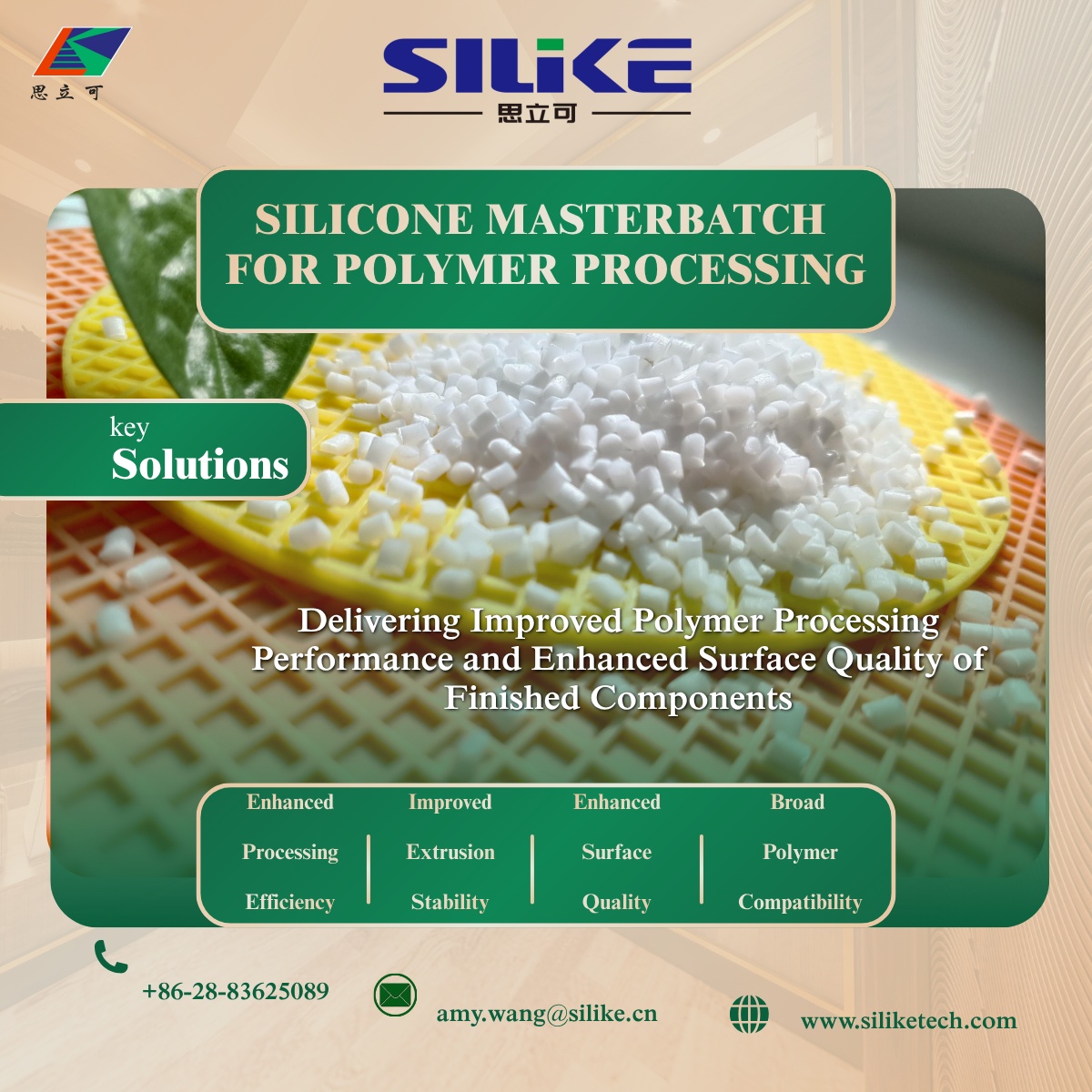
SILIKE develops silicone masterbatch solutions designed to help polymer processors address common extrusion challenges across a wide range of thermoplastic applications.
With experience in silicone-polymer integration and application development, SILIKE works with customers to evaluate formulation compatibility, optimize processing conditions, and recommend silicone masterbatch solutions based on specific production requirements.
Typical applications of silicone masterbatch include:
• Wire and cable compounds
• PE and PP film extrusion
• Pipe and profile extrusion
• Automotive plastics
• Engineering plastics
• TPU and TPE materials
Application-specific evaluation is recommended to identify the most suitable solution for each polymer system.
Conclusion
Die build-up is a complex processing phenomenon influenced by polymer characteristics, formulation design, filler systems, and extrusion conditions. While there is no universal solution, understanding the underlying mechanisms allows manufacturers to develop more stable and efficient processing strategies.
For many thermoplastic applications, silicone masterbatch provides an effective means of improving melt-flow behavior, reducing polymer–metal friction, and supporting cleaner, more consistent extrusion.
Through application-focused development and technical support, SILIKE continues to help polymer processors optimize extrusion performance and improve manufacturing efficiency across a broad range of thermoplastic materials.
Contact SILIKE for a free formulation review and to receive the Technical Data Sheet (TDS) for the SILIKE LYSI series silicone masterbatch (siloxane-based polymer additives). Our expert team is ready to provide customized solutions, sample requests, and comprehensive technical support to help you overcome processing challenges. reduce Die Build-Up & die drool, and boost your product’s competitiveness!
Phone: +86-28-83625089
Email:amy.wang@silike.cn
Website:www.siliketech.com
Post time: Jul-23-2026


