
Why the Plastics Industry Is Moving Toward PFAS-Free Processing Aids
In recent years, PFAS regulations have become a major topic across the global plastics industry. Governments and environmental agencies are increasingly restricting per- and polyfluoroalkyl substances (PFAS) due to their persistence in the environment and potential health concerns.
Traditionally, many polymer processing aids (PPAs) used in extrusion processes were based on fluoropolymers, which often contain PFAS-related chemistries. These additives have long been used to improve processing efficiency and eliminate issues such as melt fracture, die build-up, and unstable extrusion flow.
However, with growing regulatory pressure and sustainability goals, many manufacturers are now actively seeking PFAS-free PPA alternatives that deliver similar performance without relying on fluorinated substances.
This shift has accelerated the development of next-generation processing technologies, including silicone-based PFAS-free polymer processing aids.
What Is a Polymer Processing Aid (PPA)?
A polymer processing aid (PPA) is an additive used during polymer extrusion to improve processing stability and surface quality.
PPAs are commonly used in materials such as:
• Polyethylene (PE)
• Polypropylene (PP)
• Linear low-density polyethylene (LLDPE)
• High-density polyethylene (HDPE)
• Film and pipe extrusion compounds
Typical functions of PPAs include:
• Eliminating melt fracture
• Reducing die build-up
• Improving extrusion stability
• Enhancing surface smoothness
• Increasing processing efficiency
Without effective processing aids, extrusion processes may suffer from surface defects, inconsistent output, and higher energy consumption.
Traditional Fluoropolymer-Based PPA
For decades, fluoropolymer-based PPAs have been widely used to improve extrusion performance.
Key Advantages
• Effective melt fracture elimination
• Improved polymer flow at die surfaces
• Stable extrusion performance
Limitations
Despite their effectiveness, traditional fluoropolymer PPAs face increasing challenges:
• Potential environmental concerns related to PFAS
• Growing global regulatory restrictions
• Increasing pressure from brands seeking sustainable materials
• Limited acceptance in environmentally sensitive applications
These factors are driving the transition toward fluorine-free alternatives.
PFAS-free polymer processing aids are additives designed to deliver extrusion performance improvements without using fluorinated chemicals.
Many next-generation PFAS-free PPAs use silicone-based technologies, which provide lubrication and surface modification effects during extrusion.
These plastic additives help manufacturers achieve:
• Stable extrusion processing
• Reduced melt fracture
• Improved surface finish
• Lower die build-up
• Enhanced processing efficiency
All while avoiding PFAS-related chemistries.
PFAS-Free PPA vs Fluoropolymer PPA
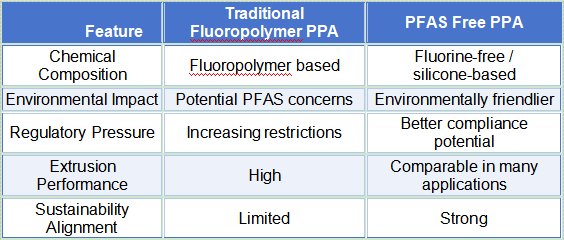
For many polymer manufacturers, PFAS-free solutions provide an opportunity to maintain processing performance while improving environmental compliance.
How Silicone-Based PFAS-Free PPAs Improve Extrusion Processing?
Silicone-based fluorine-free processing aids work by creating a lubricating interface between the polymer melt and the metal die surface.
This mechanism helps:
♦ Reduce shear stress during extrusion
♦ Improve polymer flow behavior
♦ Minimize surface defects
♦ Stabilize extrusion output
As a result, manufacturers can achieve higher productivity, improved product quality, and reduced downtime.
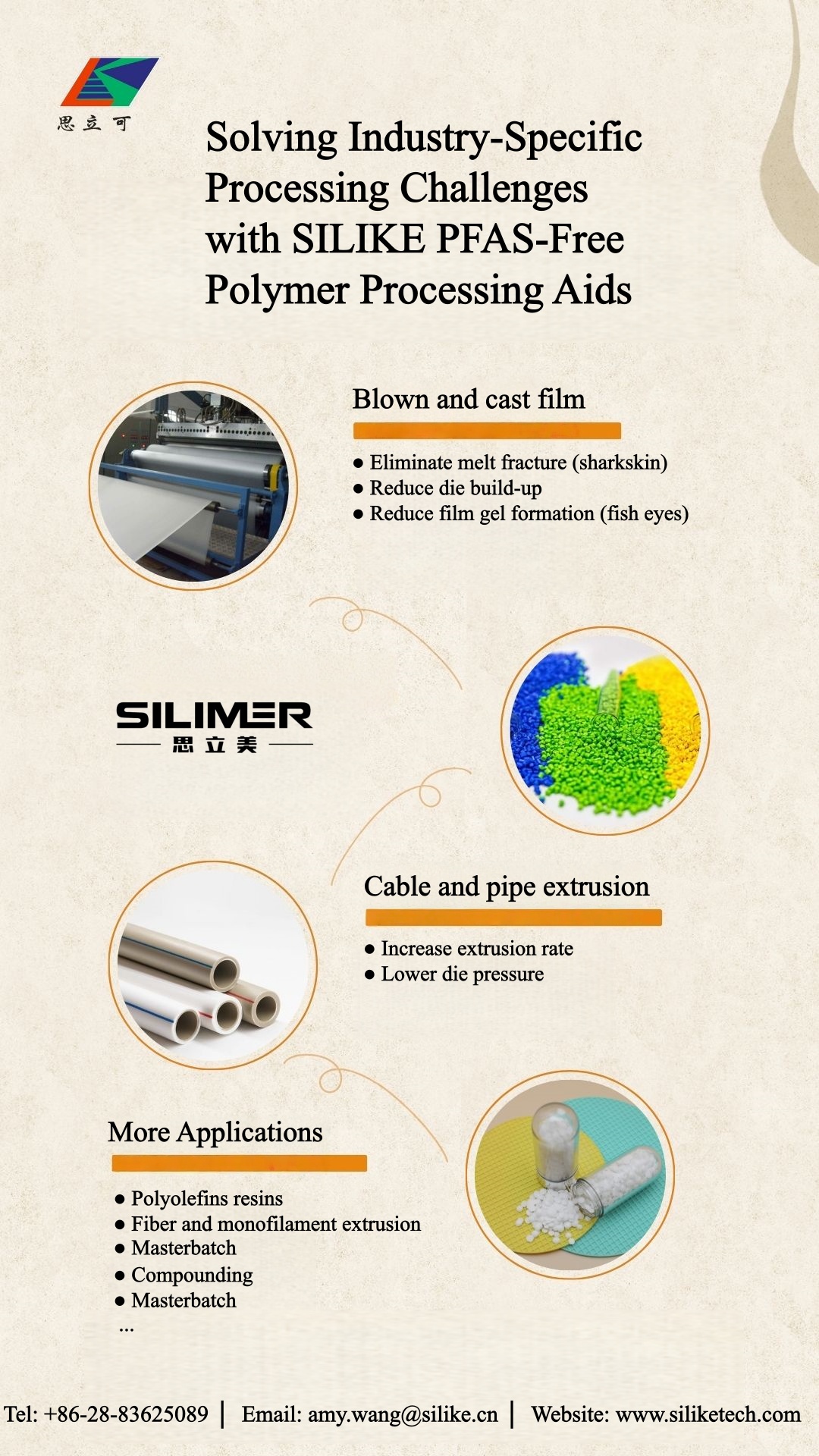
Applications of PFAS-Free Processing Aids
PFAS-free PPAs are increasingly used across a wide range of polymer processing applications, including:
Film and Packaging
• Blown films
• Cast films
• Stretch films
Pipe and Tubing
• HDPE pipes
• Pressure pipes
• Water supply systems
Wire and Cable
• Insulation compounds
• Jacketing materials
Consumer and Industrial Plastics
• Injection molded parts
• Extruded profiles
• Automotive plastic components
These industries are actively exploring PFAS-free technologies to align with sustainability goals and regulatory expectations.
Choosing the Right Processing Aid for Your Application
When selecting a processing aid for polymer extrusion, manufacturers typically consider:
• Processing stability
• Surface quality improvement
• Compatibility with base polymers
• Regulatory compliance
• Sustainability goals
Modern PFAS-free additives allow manufacturers to balance processing performance, environmental responsibility, and long-term regulatory readiness.
The Future of Sustainable Polymer Processing
As environmental awareness and regulations continue to evolve, the plastics industry is entering a new era of sustainable materials innovation.
Technologies such as silicone-based additives, PFAS-free processing aids, and advanced thermoplastic elastomers are helping manufacturers improve product performance while reducing environmental impact.
By adopting next-generation processing solutions, companies can achieve both operational efficiency and sustainability objectives.
Frequently Asked Questions
1. What does PFAS-free mean in plastics processing?
PFAS-free means that a material or additive does not contain per- and polyfluoroalkyl substances, a group of chemicals known for their persistence in the environment.
Using PFAS-free additives helps manufacturers reduce environmental impact and comply with emerging regulations.
2. Do PFAS-free processing aids perform as well as fluoropolymer PPAs?
In many applications, modern PFAS-free processing aids can deliver comparable extrusion performance, including melt fracture elimination and improved surface finish.
Performance depends on polymer type, processing conditions, and formulation.
3. What industries are switching to PFAS-free additives?
Industries increasingly adopting PFAS-free additives include:
• Packaging films
• Automotive plastics
• Wire and cable materials
• Consumer electronics
• Food-contact packaging
Explore Fluorine-Free or PFAS-Free Processing Solutions
Looking for sustainable fluorine-free polymer processing aids for extrusion applications?
SILIKE’s SILIMER PFAS-Free Polymer Processing Aids and silicone additives are designed to improve extrusion stability, reduce surface defects, and support environmentally responsible plastics manufacturing.
Explore alternatives to fluoropolymer PPAs with SILIKE’s high-performance PFAS-free additives.
Contact us today to learn more about how our solutions can enhance your polymer processing needs.
Sample and commercial quantities of SILIKE SILIMER PFAS-Free Processing Aids are available. For more details, visit https://www.siliketech.com/pfas-free-solutions-for-eu-ppwr-compliance/ or contact our customer support at amy.wang@silike.cn
Post time: Mar-13-2026


