
Thermoplastic compounds require a specific performance balance: they must be efficient to extrude, mold, and convert, while also meeting strict end-use specifications for visual aesthetics, haptic feedback, tribological behavior, and surface functionality.
Achieving this balance depends on polymer compatibility, additive chemistry, carrier resin selection, and loading levels. At SILIKE, we engineer and manufacture silicone-based additives that simultaneously address specific processing bottlenecks and surface property requirements.
Optimizing Processability During Conversion
During extrusion, injection molding, blow molding, or film production, a thermoplastic melt is subjected to high shear stress, elevated temperatures, and metal-to-polymer friction. Properly selected processing aids effectively manage these parameters.
♦ Lower Melt Viscosity & Improve Flow: Internal lubricants and compatible modifier systems increase melt mobility. This facilitates consistent mold filling, stabilizes extrusion profiles, and measurably reduces extruder torque and die pressure.
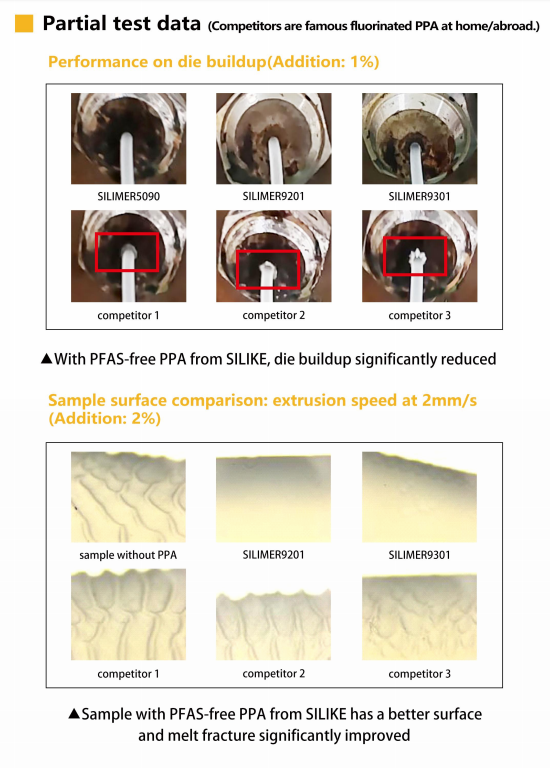
♦ Mitigate Melt Fracture (Sharkskin): At critical shear rates—particularly in polyolefin film, pipe, and profile extrusion—polymer melts can exhibit flow instabilities leading to melt fracture. Appropriate processing aids alter the flow dynamics at the die wall, mitigating surface roughness and sharkskin defects.
♦ Minimize Die Build-up (Drool): Accumulation of degraded polymer, pigments, or fillers at the die lip disrupts continuous production. Formulating with tailored additive packages minimizes die deposits, maintaining dimensional stability and maximizing equipment uptime.
♦ Enhance Dispersion: In highly filled compounds, additives promote the homogeneous distribution of mineral fillers, pigments, or functional particulates. Optimized dispersion yields uniform rheological behavior and consistent mechanical properties.
♦ Improve Production Efficiency: By stabilizing melt flow and reducing internal/external friction, processors can optimize line speeds and cycle times without compromising the mechanical integrity of the finished part.
Modifying Surface Properties Without Secondary Operations
Functional additives are formulated to migrate or concentrate at the polymer-air interface during the cooling phase. This mechanism modifies the surface characteristics of the finished component, eliminating the need for secondary coating operations.
Typical additive approaches for specific surface parameters include:
| Surface Parameter | Functional Result in Finished Compound |
| Lower Coefficient of Friction (COF) | Reduced sliding friction, optimized conveying, decreased surface drag |
| Scratch & Mar Resistance | Minimized visual scuffing, sustained surface integrity under mechanical stress |
| Optimized Haptic Properties | Controlled tactile feedback (e.g., reduced tackiness, silky/dry touch) |
| Gloss Control / Surface Finish | Mitigation of flow marks, reduction in surface roughness (Ra) |
| Anti-block Performance | Decreased adhesion forces between film layers or stacked molded parts |
The SILIKE Silicone Masterbatch Mechanism
For compounding PP, PE, TPE, TPU, and various engineering plastics, a silicone masterbatch is frequently specified to integrate processing efficiency with long-term surface modification.
By utilizing ultra-high molecular weight (UHMW) siloxane polymers dispersed in specific carrier resins, SILIKE Masterbatches function through a dual-mechanism:
1. Rheological Modification (Internal): Reduces internal intermolecular friction and external polymer-to-metal friction, lowering torque and preventing flow-induced surface defects during extrusion or molding.
2. Surface Modification (External): Decreases the static and kinetic coefficient of friction (COF), improves scratch and abrasion resistance, and provides a specific tactile finish on the final part.
Application Case: In PP/TPO/TPV automotive interior components—such as door panels, dashboards, center consoles, and instrument panels, including highly filled PP/talc systems—SILIKE Anti-scratch Silicone Masterbatch features enhanced matrix compatibility with polypropylene resins (CO-PP/HO-PP). This minimizes phase segregation and prevents additive exudation, thereby reducing fogging, VOC emissions, and odor without generating surface stickiness. At a dosage of 1.5–3%, it enables PP/TPO systems to meet stringent OEM scratch testing standards, such as VW PV3952 and GM GMW14688 (achieving a color change of ΔL < 1.5 under a 10 N load), while delivering long-lasting scratch protection, reduced dust buildup, improved surface aging resistance, and supporting a consistent haptic finish across the molded component.
Selecting the Right SILIKE Solution
A successful thermoplastic additive solution requires matching the specific processing challenge with the correct polymer chemistry. SILIKE provides targeted plastics additive technologies engineered for specific thermoplastic requirements.
| Processing / Performance Challenge | Recommended SILIKE Solution | Key Functional Mechanism |
|---|---|---|
| Improve processing & Surface Enhancement | Silicone Masterbatch | UHMW siloxane dispersion provides efficient internal and external lubrication, optimizing processing performance and surface properties. It improves melt flow, reduces processing torque, die pressure, and energy consumption, while enhancing mold release and productivity. At the same time, it reduces friction, improves scratch and wear resistance, and provides better slip performance and surface feel. |
| Scratch Resistance Improvement | Anti-scratch Silicone-based Masterbatch | Silicone-based surface modification enhances surface lubricity, reduces friction-induced damage, and improves scratch resistance |
| Abrasion Resistance Improvement | Anti-abrasion Silicone Masterbatch | UHMW silicone polymer migration forms a lubricating layer, reducing frictional wear and improving durability |
| Soft-Touch & Elastomer Modification | Si-TPV | Dynamic vulcanized silicone rubber phase provides elastic recovery, soft touch, and long-lasting tactile performance |
| Extrusion Stability & Melt Processing | SILIMER PFAS-Free PPA | Reduction of melt-wall friction improves flow stability, reduces melt fracture, and die build-up |
Formulation Variables and Regulatory Compliance
Modifying one compound property can inadvertently impact others. Formulation development requires a systematic evaluation of matrix compatibility, surface-energy requirements, and regulatory specifications.
As global regulatory frameworks—such as the EU’s Packaging and Packaging Waste Regulation (PPWR) and impending global PFAS restrictions—evolve, polymer manufacturers require verified material data to support their transition toward more sustainable processing.
As processors actively seek fluorine-free alternatives to maintain extrusion efficiency, our SILIMER PFAS-Free PPA series provides a highly functional and safe solution. Designed to perform without fluoropolymers, it serves as a reliable alternative for polymer manufacturers transitioning away from traditional fluorinated processing aids while maintaining excellent surface quality and stable output.
Conclusion
Optimizing thermoplastic processability and surface characteristics is most efficiently achieved through the integration of multifunctional, polymer-compatible additive systems.
At SILIKE, our siloxane-based polymer processing aids technology and targeted surface modifier solutions provide compounders and processors with measurable improvements in both manufacturing efficiency and end-use component performance.
For technical inquiries, TDS requests, and material evaluation, contact Amy way.
Phone: +86-28-83625089
Email:amy.wang@silike.cn
Website:www.siliketech.com
Post time: Aug-21-2026


