
Highly filled LSZH and HFFR cable compounds often face challenges such as die drool, poor surface quality, and unstable extrusion. Silicone masterbatch provides an effective solution by improving melt flow, enhancing filler dispersion, and reducing the coefficient of friction. This results in significantly improved production efficiency, superior surface finish, and maintained mechanical properties for wire and cable manufacturers.
1. Common Pain Points in LSZH/HFFR Cable Compound Processing
In today’s drive for higher fire safety standards, cable manufacturers increasingly rely on Low Smoke Zero Halogen (LSZH) and Halogen-Free Flame Retardant (HFFR) compounds. To meet stringent flame retardancy requirements, these compounds are typically heavily loaded with inorganic fillers like Aluminum Trihydrate (ATH) or Magnesium Hydroxide (MDH). While these fillers enhance safety, they introduce significant processing hurdles that can compromise both efficiency and quality.
What are the typical processing issues in LSZH cable compounds?
Compounders handling high-filler LSZH and HFFR materials frequently encounter these typical problems:
• Excessive Die Drool: The buildup of polymer and additives at the extruder die head leads to frequent line stops for cleaning, drastically reducing uptime.
• Poor Filler Dispersion: High loading levels make it difficult to achieve a uniform distribution of inorganic fillers within the polymer matrix, affecting material consistency.
• Rough Surface Finish: Extruded cables often exhibit uneven surfaces or “sharkskin” effects, which negatively impact product aesthetics and marketability.
• Degraded Mechanical Properties: Issues like reduced elongation at break and lower impact strength can prevent the final product from meeting industry standards.
• Unstable Extrusion: Fluctuating extruder torque and limited line speeds result in inconsistent production and high scrap rates.
These challenges are particularly prevalent in LLDPE/EVA/ATH systems where mineral filler loading reaches 55%–70%, making the material exceptionally difficult to process .
2. What Customers Really Want: Seamless Production and Quality
From the perspective of a wire and cable manufacturer, the core requirement is straightforward:
“I want my LSZH or HFFR cable compound to extrude smoothly, deliver a clean and professional surface finish, and maintain robust mechanical properties without constant line interruptions.”
However, the reality often involves:
• Unexpected quality rejects and scrap due to die buildup.
• Forced reductions in production speed to minimize surface defects.
• Inconsistent cable appearance and high waste rates.
• Labor-intensive maintenance for cleaning extruders and dies.
These inefficiencies not only drive up costs but also impact delivery timelines and brand reputation.
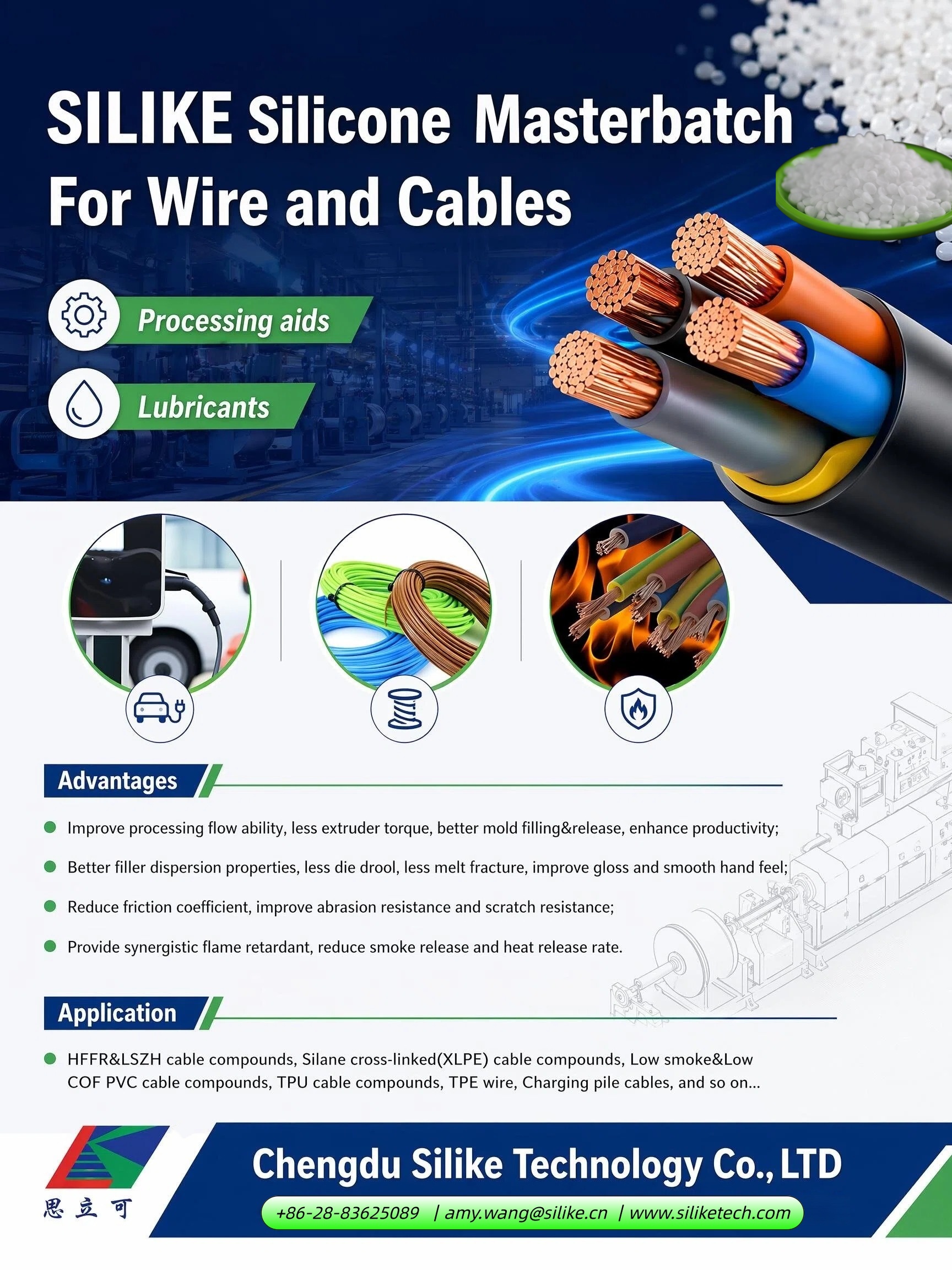
SILIKE LYSI series silicone masterbatch LYSI-401 is specifically engineered for highly mineral-filled polyolefin compounds used in wire and cable. It functions as more than just a lubricant; it is a high-performance processing aid that balances processability with final product performance. By incorporating a small amount (e.g., 1%) of SILIKE silicone additive LYSI-401, manufacturers can achieve significant improvements:
|
Improvement Area |
Mechanism of Action |
Expected Result |
|
Die Drool |
Reduces friction between melt and metal surfaces |
Significantly reduced or eliminated die buildup; fewer line stops |
|
Melt Flow |
Enhances polymer melt mobility and reduces viscosity |
Smoother extrusion, lower torque, and potential for higher line speeds |
|
Filler Dispersion |
Improves wetting and distribution of fillers |
More uniform filler dispersion; reduced agglomeration |
|
Surface Quality |
Lowers surface coefficient of friction (COF) |
Smooth, glossy surface finish with a premium feel |
|
Mechanical Performance |
Optimizes the interface between polymer and filler |
Improved elongation at break and impact strength |
|
Flame Retardant Synergy |
Promotes uniform distribution of flame retardants |
Enhanced synergy with FR systems; maintained safety ratings |
4. Addressing Real Production Pain Points
SILIKE LYSI series silicone masterbatch directly targets the daily challenges faced by cable compounders:
• For Die Drool: Less buildup at the die means cleaner surfaces and maximized production uptime.
• For Rough Surfaces: Improved lubricity and reduced COF ensure a smoother, more consistent finish that meets high-end market demands.
• For Poor Dispersion: Optimized material flow helps inorganic fillers and pigments disperse more evenly throughout the compound.
• For Low Mechanical Performance: Helps the compound regain or even enhance critical properties like impact strength and elongation.
5. Applications: Where Are These Pain Points Most Common?
The processing advantages of silicone masterbatch are most critical in the following applications:
• LSZH Cable Compounds
• HFFR Cable Compounds
• Silane Crosslinking Cable Compounds
• Low Smoke PVC Cable Compounds
• Low-COF Cable Jacket Compounds
• TPU and TPE Wire Applications
For compounders seeking to balance processing efficiency, surface quality, and cost-effectiveness, silicone masterbatch provides a practical and proven solution for modern wire and cable formulations.
6. FAQ (Frequently Asked Questions) about Silicone Masterbatch for LSZH and HFFR Wire & Cable Compounds: Processing and Surface Quality Improvement
6.1 What primary problems does silicone masterbatch solve in cable compounds?
It primarily addresses processing hurdles such as die drool, poor filler dispersion, high extruder torque, and rough surface finishes in highly filled formulations.
6.2 Why is silicone masterbatch particularly effective for LSZH and HFFR?
These compounds contain high levels of ATH or MDH, which make them difficult to process. Silicone masterbatch improves extrusion stability and significantly enhances the surface finish of these challenging systems.
6.3 Can silicone masterbatch support Low-COF cable applications?
Yes. It significantly improves surface lubricity and lowers the coefficient of friction, which is essential for cable jackets and wire applications requiring low-friction performance.
6.4 What is the typical dosage for silicone masterbatch?
Generally, the recommended dosage ranges from 0.5% to 3%, depending on the specific formulation, filler type, and desired processing improvements. We recommend small-scale trials for optimization.
6.5 Does silicone masterbatch affect the electrical properties of the cable?
SILIKE LYSI series silicone masterbatch is designed to have minimal impact on electrical properties at recommended dosage levels. We suggest conducting standard electrical tests for your specific application to verify performance.
7. Get Expert Technical Support Today
Are you looking for high-performance lubricant processing aids to enhance your wire and cable compound performance?
Contact us for a free formulation review and to receive the Technical Data Sheet (TDS) for the SILIKE LYSI series silicone masterbatch. Our expert team is ready to provide customized solutions, sample requests, and comprehensive technical support to help you overcome processing challenges and boost your product’s competitiveness!
Phone: +86-28-83625089
Email:amy.wang@silike.cn
Website:www.siliketech.com
Post time: Jun-18-2026


