
The rapid growth of the new energy industry—from electric vehicles (EVs) to charging infrastructure and renewable energy—has created higher performance demands on cable materials. Thermoplastic Polyurethane (TPU) is increasingly favored over PVC and XLPE due to its flexibility, durability, and eco-friendly profile.
However, unmodified TPU still presents critical challenges that impact cable performance, safety, and cost efficiency:
• High friction coefficient → cables stick together, complicating installation and handling.
• Surface wear and scratches → diminished aesthetics and shorter service life.
• Processing difficulties → stickiness during extrusion or molding causes poor surface finish.
• Outdoor aging → long-term exposure compromises smoothness and durability.
For cable manufacturers, these issues directly affect user experience, safety compliance, and total cost of ownership.
How to Optimize TPU Formulations for EV and Energy Applications
BASF, a global leader in the chemical industry, launched a groundbreaking TPU grade — Elastollan® 1180A10WDM, engineered to meet the demands of fast-charging pile cables.
This new grade offers:
• Enhanced durability, flexibility, and wear resistance.
• Softer touch and easier handling, without sacrificing mechanical strength.
• Superior weatherability and flame retardancy.
This demonstrates the industry’s clear direction: TPU modification is essential for next-generation energy cables.
Effective Solution: Silicone-Based Additives Upgrade TPU Cable Materials
Silicone-based additives provide a proven path to enhance TPU performance while retaining its inherent environmental and mechanical benefits. When compounded into TPU, these additives deliver measurable improvements in surface quality, durability, and processability.
Key Benefits of Silicone-Based Additives in TPU Cables
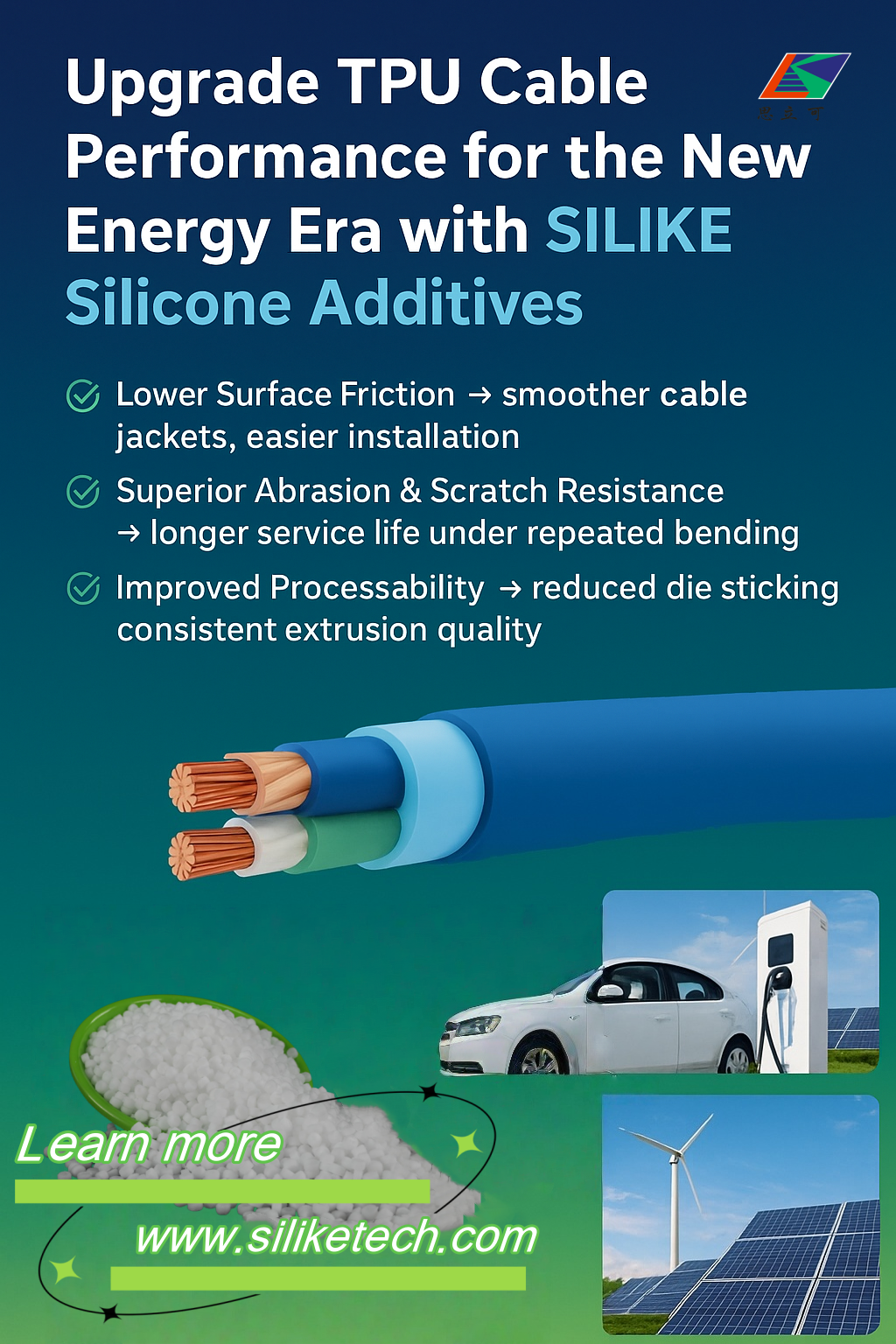
Lower surface friction → smoother cable jackets, reduced stickiness, easier handling.
Improved abrasion & scratch resistance → extended service life even under frequent bending.
Enhanced processability → reduced die sticking during extrusion, ensuring consistent surface quality.
Flexibility retention → maintains TPU’s excellent bendability at low temperatures.
Sustainable compliance → fully meets RoHS & REACH environmental standards.
Applications in the New Energy Era
Siloxane additive enhanced TPU enables cable solutions that are safer, longer-lasting, and more sustainable across high-demand applications:
EV Charging Cables → abrasion-resistant, flexible down to –40 °C, reliable in all climates.
Battery & High-Voltage Cables → chemical/oil resistance, longer lifespan, reduced maintenance costs.
Charging Infrastructure Cables → superior UV and weather resistance for outdoor stations.
Renewable Energy Systems → long-term durability and flexibility for solar and wind power.
With silicone-modified TPU, manufacturers can reduce warranty claims, lower ownership costs, and enhance sustainability profiles.
Proof: SILIKE’s Expertise in TPU Additive Innovation
At SILIKE, we specialize in silicone-based additive solutions tailored for next-generation cable materials.
1. SILIKE Silicone Masterbatch LYSI-409 → engineered to improve resin flow, mold release, abrasion resistance, and extrusion efficiency.
Proven in EV charging pile cables and high-voltage wiring.
Delivers scalable and reliable performance.
+6% addition → improves surface smoothness, enhances scratch/abrasion resistance, and reduces dust adhesion.
+10% addition → adjusts hardness and elasticity, creating softer, more resilient, high-quality fast-charging pile cables.
Provides soft-touch feel, matte surface finish, and long-term durability.
All solutions are fully compliant with RoHS, REACH, and global environmental regulations.
With over 20 years of experience and a strong focus on customer-oriented research and development in silicone additives for plastics and rubber, SILIKE is always on the path of innovating silicone materials and empowering new value. Our comprehensive range of thermoplastic additives is designed to enhance TPU cables, ensuring they are not only optimized for today’s demands but also equipped to tackle the energy challenges of tomorrow. Together, we are paving the way for a more innovative and sustainable future.
Are your cables equipped to handle the real-world demands of the EV infrastructure?
By blending TPU or TPE with SILIKE’s silicone-based additives, Wire and Cable manufacturers achieve:
• Reduced hardness + enhanced abrasion resistance.
• Visually appealing matte surface finish.
• Non-tacky, dust-resistant feel.
• Long-term smoothness and soft-touch experience.
• This balance of performance, durability, and aesthetics positions silicone-enhanced TPU as a material of choice for the new energy era.
Contact SILIKE to request samples or technical datasheets and explore how our silicone-based additives can elevate your cable performance.
Visit: www.siliketech.com, Email us at: amy.wang@silike.cn
Frequently Asked Questions
Q1: Why does TPU need modification for EV cables?
While TPU is flexible and durable, it has high friction and wear issues. Silicone-based additives solve these challenges by improving smoothness, abrasion resistance, and processability.
Q2: How do silicone additives improve TPU cable performance?
They reduce surface friction, enhance durability, and improve extrusion quality while maintaining TPU’s flexibility and eco-friendly profile.
Q3: Are silicone-additives modified TPU cables environmentally compliant?
Yes. They are recyclable and fully compliant with RoHS, REACH, and global sustainability standards.
Q4: Which applications benefit most?
EV charging cables, high-voltage battery wiring, outdoor charging infrastructure, and renewable energy systems.
Q5: How can I test these additives in production?
You can request silicone additives or Si-TPV samples or datasheets from SILIKE to validate TPU + silicone additive performance in real-world cable manufacturing
Post time: Sep-05-2025


