
Modern aquaculture and fish farming heavily rely on efficiency, consistency, and system reliability. One of the most critical components is the automatic feeding system, where pipes transport feed from storage silos to fish cages or ponds.
Traditional pipes, such as PVC, cement, or steel, have inherent drawbacks:
High internal friction requires pumps to consume more energy to drive water flow. This can account for 30%-50% of total energy consumption in a recirculating aquaculture system (RAS).
Susceptibility to corrosion, abrasion from feed, and disinfectants, which can lead to aging, scaling, higher maintenance and replacement costs, and potential contamination affecting water quality and fish health. Is there a pipe that allows smoother water flow, greater durability, and cost efficiency from the start?
The answer is High-Density Polyethylene (HDPE) pipes.
HDPE pipes, especially PE80 and PE100 grades, are chosen for their corrosion resistance, lightweight structure, and high-pressure strength, making them the industry’s preferred choice.
Why are HDPE pipes widely used in Aquaculture?
HDPE pipes have extremely smooth inner walls, with a Manning roughness coefficient of only 0.009, much lower than cement pipes (0.013) or used steel pipes (above 0.015).
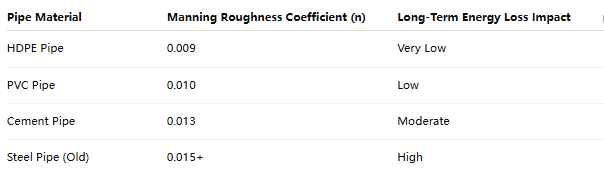
Smooth inner wall → Reduced water resistance: For 24/7 recirculating aquaculture systems (RAS), pumps require less energy to achieve the same flow rate, potentially saving tens of thousands of dollars annually in electricity.
Corrosion resistance: Unlike steel, HDPE resists seawater, chemicals, and biofouling.
Lightweight and flexible: Easy to install in floating cages or nearshore systems.
High impact strength: Can withstand waves, storms, and handling stress.
Long service life: PE80 and PE100 pipes typically last 20–50 years in aquatic environments.
For feeding systems specifically, HDPE provides the necessary pressure resistance to transport feed efficiently over long distances. Yet, wear and surface friction remain ongoing challenges.
Common Challenges of HDPE Pipes for Aquaculture and Fish Farming
1. Internal Pipe Wear
Even small feed pellets create continuous abrasion as they flow through pipes at high speed. Over time, this gradually erodes the pipe surface.
2. Friction Build-Up
Over prolonged use, HDPE surfaces may lose smoothness, increasing internal friction, leading to: Higher energy consumption in feeding systems, feed pellet breakage reducing feed quality and irregular feed flow and potential blockages.
3. Marine Conditions
Saltwater, UV exposure, and bio-growth accelerate pipe degradation, further stressing surfaces.
PE80 vs. PE100: Which Grade Performs Better?
Aquaculture pipes are mainly produced in PE80 or PE100.
PE80: Good strength, suitable for medium-pressure systems, cost-effective.
PE100: Higher density, better pressure resistance, superior long-term performance.
Both grades, however, face wear and friction challenges without additional surface modification or additives.
The Role of Additives in Improving Pipe Performance
To enhance the longevity of HDPE aquaculture pipes, manufacturers often integrate processing aids, lubricants, or additives:
• Reduce internal friction → smoother feed flow
• Increase abrasion resistance → slower wear rate
• Enhance processability → more consistent extrusion
• Improve surface finish → reduce microbial attachment
However, Silicone-based additives have proven particularly effective in addressing these issues.
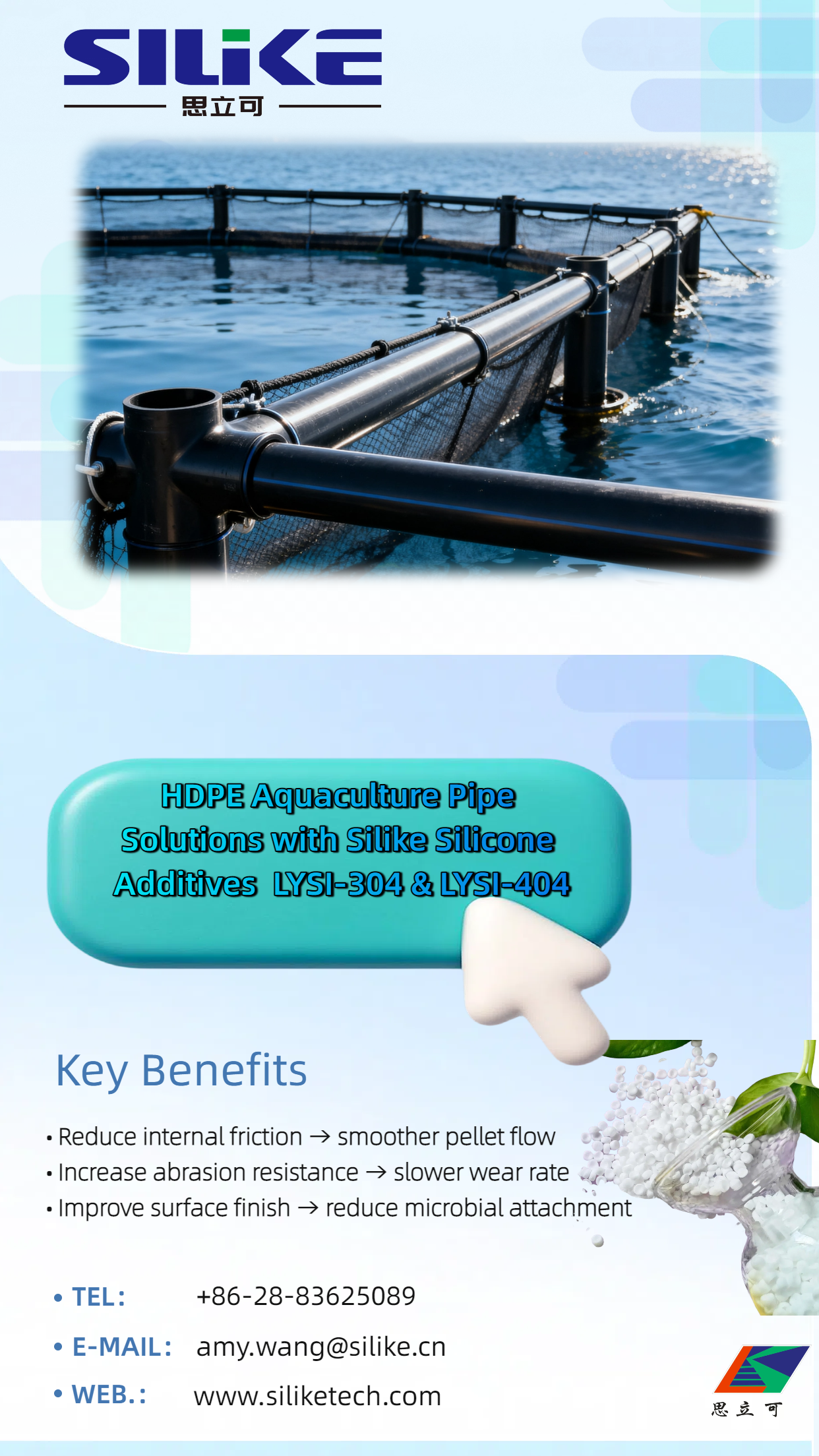
Application cases: SIILIKE Silicone Masterbatch LYSI-404 for Anti-Wear Solutions
One proven solution is Silike Silicone Masterbatch LYSI-404, a silicone processing lubricant designed for polyolefins such as PE80 and PE100. It is widely used as an additive in HDPE resin systems to improve processing performance and surface quality.
With silicone-based Additives, HDPE pipe’s properties such as low coefficient of friction (CoF), demolding, and dispersion are significantly enhanced. At the same time, the surface becomes smoother, which improves anti-friction performance, scratch resistance, and abrasion resistance.
Why Silicone Additive LYSI-404 Can Tackle Wear and Friction Challenges?
1) Creates a lubricating micro-layer within the polymer matrix
2) Lowers the coefficient of friction
3) Minimizes surface abrasion caused by feed pellets
4) Improves extrusion efficiency and surface smoothness
Key Benefits of Silicone Additive for Aquaculture HDPE Pipes:
√ Longer lifespan of feeding pipes
√ Reduced feed pellet damage, maintaining feed quality
√ Enhanced surface durability in harsh marine conditions
√ By integrating silicone processing aids LYSI-404, or LYSI-304, both manufacturers and fish farms can achieve performance improvement and cost savings.
If your company manufactures HDPE pipes and wants to improve the durability and efficiency of your aquaculture feeding systems, and is looking to develop pipes with diameters ranging from 90 mm to 110 mm for pneumatic transport of salmon feed in 200-meter rolls, particularly pipes with enhanced abrasion resistance for pneumatic conveying systems, you may be interested in an additive that improves the anti-abrasive properties, and reduce of COF of PE100/ PE80.
Contact Silike to get your anti-abrasion and scratch-resistant silicone additives for HDPE solutions in fish farming.
Visit our website: www.siliketech.com
Call us at: +86-28-83625089 or +86-15108280799
Email: amy.wang@silike.cn
Post time: Sep-19-2025


