
Introduction: The Persistent Challenges of PA/GF Materials
Glass fiber reinforced polyamides (PA/GF) are a cornerstone in modern manufacturing due to their exceptional mechanical strength, heat resistance, and dimensional stability. From automotive components and consumer electronics to aerospace structures and industrial machinery, PA/GF materials are widely used in high-performance applications requiring durability, precision, and reliability.
Despite these advantages, PA/GF materials present persistent challenges that can compromise production efficiency, product quality, and end-use performance. Common pain points include warpage, poor melt flow, tool wear, and glass fiber exposure (floating fibers). These issues increase scrap rates, elevate production costs, and demand additional post-processing—challenges that frequently affect R&D, production, and procurement teams alike.
Understanding and addressing these challenges is crucial for manufacturers aiming to maximize the potential of PA/GF materials while maintaining operational efficiency and meeting stringent quality standards.
Pain Point 1: Complex and Hard-to-Control Processing
Warpage and Deformation
PA/GF materials are highly anisotropic due to the orientation of glass fibers. During cooling, uneven shrinkage often causes warpage in large or geometrically complex components. This compromises dimensional accuracy, increases scrap and rework rates, and consumes time and resources. For industries like automotive and aerospace, where tight tolerances are critical, even minor warpage can result in component rejection.
Poor Melt Flow
The addition of glass fibers significantly increases melt viscosity, creating flowability challenges during injection molding. High melt viscosity can lead to:
• Short shots
• Weld lines
• Surface defects
These issues are especially problematic for thin-wall components or parts with intricate mold designs. High viscosity also demands greater injection pressure, increasing energy consumption and stress on molding equipment.
Accelerated Tool Wear
Glass fibers are abrasive and hard, accelerating wear on molds, runners, and nozzles. In injection molding and 3D printing, this shortens tooling life, raises maintenance costs, and can reduce production uptime. For 3D printing, filaments containing PA/GF can wear down nozzles, affecting both part quality and throughput.
Insufficient Interlayer Bonding (for 3D Printing):
In the field of additive manufacturing, PA/GF filaments may experience weak bonding between layers during the printing process. This results in reduced mechanical properties of the printed parts, making them unable to meet the expected strength and durability requirements.
Pain Point 2: Glass Fiber Exposure and Its Impact
Glass fiber exposure, also known as “floating fibers,” occurs when fibers protrude from the polymer surface. This phenomenon can negatively affect both aesthetics and performance:
Compromised Appearance: Surfaces appear rough, uneven, and dull. This is unacceptable for applications requiring high visual appeal, such as automotive interiors, electronics housings, and consumer devices.
Poor Tactile Feel: Rough, scratchy surfaces reduce user experience and perceived product quality.
Reduced Durability: Exposed fibers act as stress concentrators, lowering surface strength and abrasion resistance. In harsh environments (e.g., humidity or chemical exposure), fiber exposure accelerates material aging and performance degradation.
These issues prevent PA/GF materials from reaching their full potential, forcing manufacturers to compromise between quality, aesthetics, and production efficiency.
Innovative Solutions for PA/GF Processing Challenges
Recent advancements in material science, additive technology, and interface engineering provide practical solutions to these long-standing issues. By integrating modified PA/GF compounds, silicone-based additives, and fiber-matrix compatibility enhancers, manufacturers can minimize warpage, improve melt flow, and significantly reduce glass fiber exposure.
1. Low-Warp PA/GF Materials
Low-warp PA/GF materials are specifically designed to address warpage and deformation. By optimizing:
• Glass fiber type (short, long, or continuous fibers)
• Fiber length distribution
• Surface treatment technologies
• Resin molecular structure
these formulations reduce anisotropic shrinkage and internal stresses, ensuring dimensional stability of complex injection-molded parts. Specially formulated PA6 and PA66 grades demonstrate improved deformation control during cooling, maintaining tight tolerances and consistent part quality.
2. High-Flow PA/GF Materials
High-flow PA/GF materials tackle poor melt flow by incorporating:
• Special lubricants
• Plasticizers
• Polymers with narrow molecular weight distribution
These modifications reduce melt viscosity, allowing complex molds to fill smoothly at lower injection pressures. Benefits include: improved production efficiency, reduced defect rates, lower tool wear and maintenance costs.
Silicone-Based Processing Aids
SILIKE silicone additives serve as high-performance lubricants and processing aids.
Their active silicone components improve filler distribution and melt flow, increasing extruder throughput while reducing energy consumption. Typical dosage: 1–2%, compatible with twin-screw extrusion.
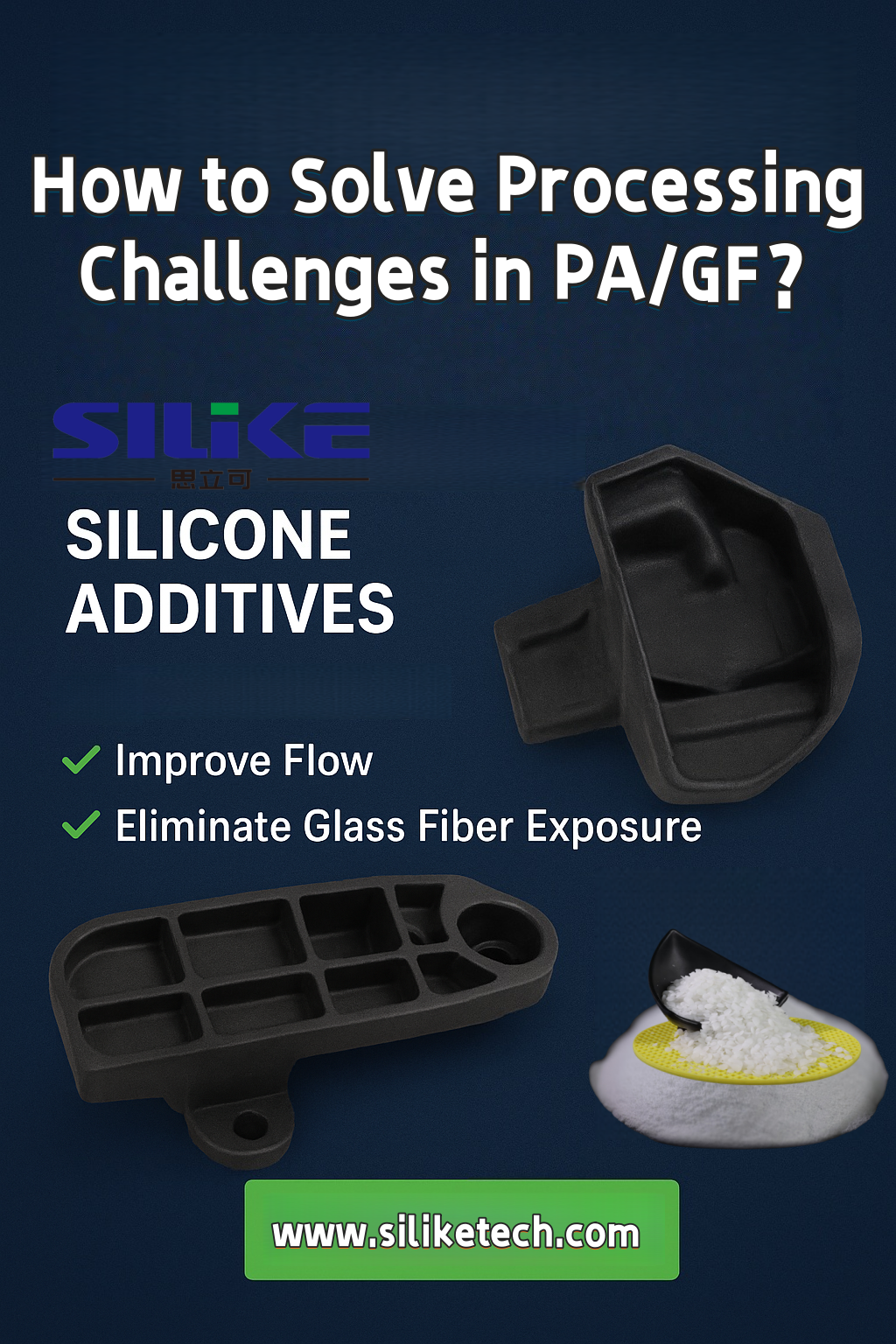
Benefits SILIKE’s Silicone-Based Processing Aids in PA6 with 30%/40% glass fiber (PA6 GF30 /GF40):
• Smoother surfaces with fewer exposed fibers
• Improved mold filling and flowability
• Reduced warpage and shrinkage
Which silicone additives are recommended to minimize glass fiber exposure and enhance melt flow in PA/GF and other engineering plastic formulations?
SILIKE Silicone Powder LYSI-100A is a high-performance processing aid
This silicone additive for diverse thermoplastic applications, including halogen-free flame-retardant wire & cable compounds, PVC, engineering plastics, pipes, and plastic/filler masterbatches. In PA6-compatible resin systems, this silicone-based plastic additive reduces extruder torque and glass fiber exposure, improves resin flow and mold release, and enhances surface abrasion resistance—delivering both processing efficiency and superior product performance.
It is used in thermoplastic products such as PE, PP, PVC, PMMA, PC, PBT, PA, PC/ABS, etc., for processing enhancement and surface improvement.
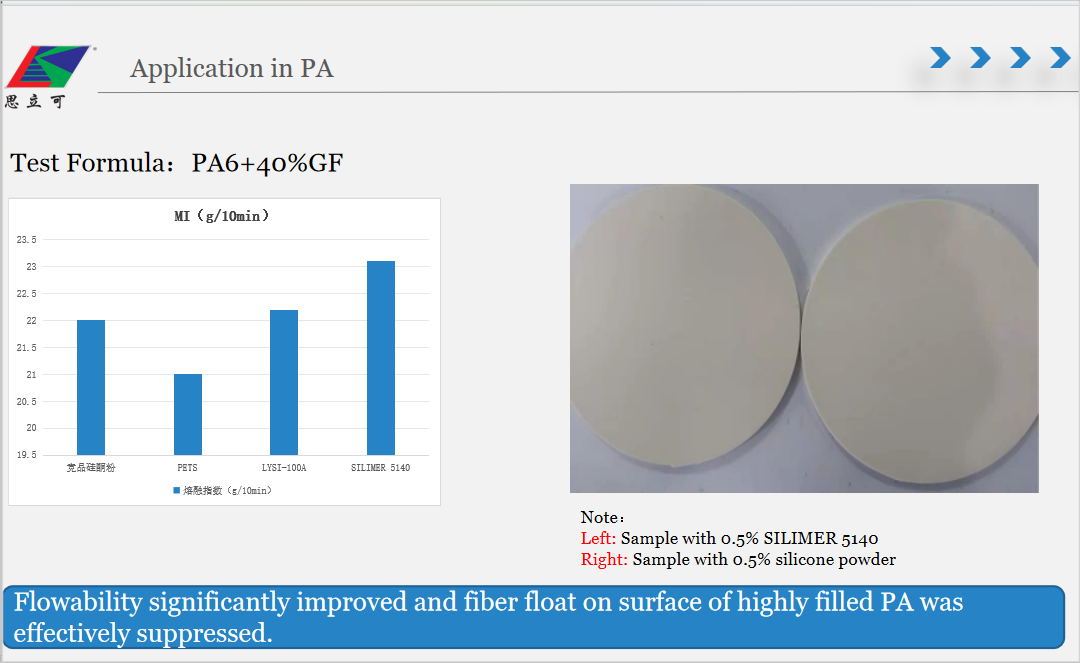
Adding SILIKE Silicone Powder LYSI-100A or Copolysiloxane Additives and Modifiers SILIMER 5140 to PA6 GF40 formulations can significantly reduce fiber exposure, enhance mold filling, and deliver proven improvements in surface quality, processing lubrication, and overall product durability.
4. Interface-Compatibility Enhancement
Poor adhesion between glass fibers and the polyamide matrix is a primary cause of fiber exposure. Using advanced coupling agents (e.g., silanes) or compatibilizers (maleic anhydride-grafted polymers) strengthens fiber-matrix bonding, ensuring fibers remain encapsulated during processing. This not only improves surface aesthetics but also enhances mechanical performance and durability.
5. Long Fiber Thermoplastics (LFT)
Long fiber thermoplastics (LFT) provide a more complete fiber network than short fibers, offering:
• Higher strength and stiffness
• Reduced warpage
• Improved impact resistance
Modern manufacturing technologies, including pultrusion and direct LFT injection molding, have optimized LFT processability, making it suitable for high-performance and structural applications.
Why Manufacturers Should Consider These Solutions?
By adopting silicone-based processing aids and advanced PA/GF compounds, manufacturers can:
Deliver high-quality, consistent products
Reduce equipment maintenance and downtime
Improve material utilization and production efficiency
Meet both performance and aesthetic standards
Conclusion
PA/GF materials offer exceptional potential, but warpage, poor flow, tool wear, and fiber exposure have historically limited their applications.
high-efficiency solutions—such as SILIKE silicone additives (LYSI-100A, SILIMER 5140), low-warp PA/GF compounds, and interface-enhancement technologies—provide practical strategies to overcome these challenges.
By integrating these solutions, manufacturers can improve surface quality, maintain dimensional stability, reduce scrap, and optimize production efficiency—delivering products that meet both industrial standards and customer expectations.
If you are looking to solve PA/GF processing challenges and glass fiber exposure issues, contact SILIKE to explore our silicone additive solutions and take your product quality and efficiency to the next level. Tel: +86-28-83625089 or via email: amy.wang@silike.cn.
Post time: Sep-12-2025


