
The Legacy and Challenges of Nylon-66
On February 28th, 1935, a groundbreaking achievement in materials science occurred when American scientist Wallace Hume Carothers successfully synthesized Nylon-66, a polyamide with remarkable properties. With its high melting point of 263°C, exceptional resistance to ordinary solvents, and a silk-like appearance, this innovative polymer set a new global standard for fiber durability and strength. It wasn’t just a milestone for the textile industry; it was a critical breakthrough in the evolution of polymer chemistry.
Fast forward to today, and Nylon-66 remains an essential material in high-performance industries such as textiles, automotive, electronics, and wire and cable. However, as performance requirements increase, processing PA66 presents ongoing technical hurdles that manufacturers struggle with daily.
The Processing “Pain Points” of PA66
While PA66 is prized for its toughness, its inherent molecular structure leads to several processing obstacles:
• Poor Melt Flow & High Extrusion Pressure: The high viscosity of PA66 melt limits fluidity, leading to increased energy consumption, equipment wear, and restricted production speeds.
• The “Glass Fiber Floating” Nightmare: To achieve extreme structural strength, PA66 is frequently reinforced with 30%–50% Glass Fiber (GF). Because the flow rates of glass fiber and the nylon matrix are inconsistent, fibers often migrate to the surface. This results in “Floating Fiber”—unsightly white, rough streaks that ruin the surface finish and create stress concentration points, compromising the part’s structural integrity.
• Surface Defects & Loss of Optical Clarity: High processing stress can lead to “sharkskin” (melt fracture) or die build-up, causing surface roughness and distorting the optical clarity of transparent polyamides. This is particularly problematic for applications where visual quality is critical, such as in high-end wire and cable coatings.
These processing pain points not only impact product quality but also lead to higher scrap rates, longer production cycles, and increased operational costs—ultimately affecting your bottom line.
As a pioneer in silicone-based polymer modification, SILIKE provides all kinds of high-performance siloxane additives, silicone masterbatches, polymer additives, and surface improvement modifiers technologies that enhance the durability, processability, and stability of Nylon-66, Polyamide 66 GF systems
SILIKE’s Silicone Additives: The Effective Solution for PA66 Processing
SILIKE offers a portfolio of specialized solutions designed to transform the processability of polyamide systems:
1. SILIKE Silicone Masterbatch
Widely used as an efficient processing lubricant and release additive, SILIKE Silicone Masterbatch LYSI-307 and Silixone Masterbatch LYSI-407 are ideal for PA6-compatible resin systems. It improves processing properties and surface quality by providing:
• Enhanced resin flowability and easier mold filling/release.
• Reduced extruder torque and a lower coefficient of friction (COF).
• Greater mar and abrasion resistance.
Key Benefit: Optimized production of polyamide thermal break strips, allowing for faster output and seamless mold release.
2. SILIKE SILIMER 5150: The Modified Silicone Wax Innovation
SILIKE’s silicone-based plastics additive SILIMER 5150 is specifically engineered to tackle the most demanding PA66 processing challenges, particularly for glass-fiber-reinforced and transparent applications:
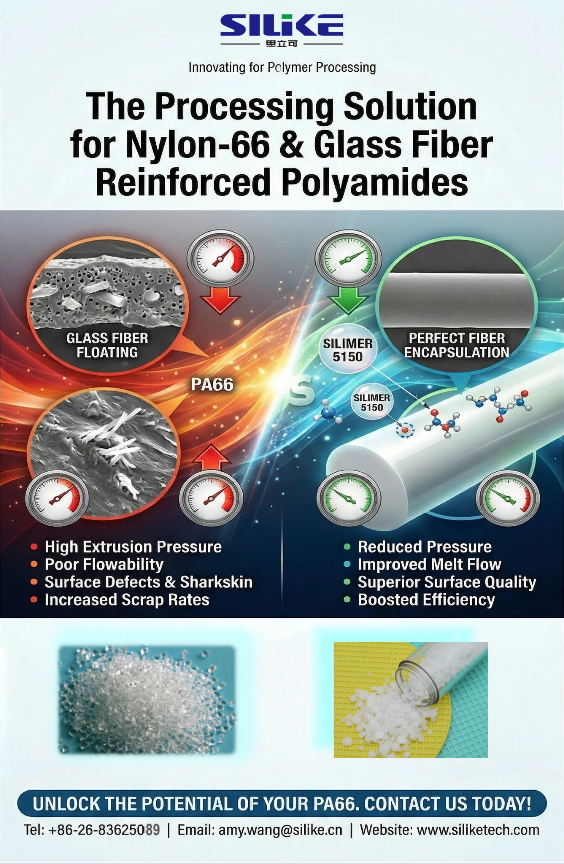
• Eliminates “Floating Fibers”: By improving the compatibility and flow balance between the resin and glass fibers, Silicone lubricant-dispersing agent SILIMER 5150 ensures that fibers are uniformly encapsulated, preventing migration to the surface. This results in a flawless, uniform finish even at high GF loadings.
• Enhanced Melt Fluidity: Acting as a powerful internal and external lubricant, Modified Silicone Wax significantly reduces melt viscosity and extrusion pressure. This boosts efficiency and protects your equipment from excessive wear.
• Superior Surface Quality: SILIKE silicone-based additive minimizes surface roughness and prevents die build-up or “sharkskin” defects, ensuring a high-gloss, premium finish that meets stringent aesthetic standards.
• Preserved Optical Clarity: Unlike traditional waxes, SILIKE silicone-based additives and production aid SILIMER 5150 maintain the transparency of PA66 even under high stress—making it the perfect choice for clear wire and cable coatings.
• Improved Durability: Beyond processing, SILIKE’s Silicone Additives enhance the abrasion resistance of the final part, increasing product longevity and reducing long-term maintenance costs.
Unlock the Full Potential of PA66 with SILIKE
Are you ready to optimize your PA66 processing and overcome the challenges that hinder your production? SILIKE is the partner you’ve been looking for. With high-performance siloxane additive SILIMER 5150 and our silicone masterbatches, you can streamline your production process, enhance product quality, and boost your profitability.
Get in touch with SILIKE today to learn how we can elevate your PA 66 manufacturing standards, or PA66 GF modification and silicone-based performance additives solutions.
Tel: +86-28-83625089
Email: amy.wang@silike.cn
Website: www.siliketech.com
FAQ: Optimizing PA66 & Glass Fiber Reinforced Polyamide Processing
Q1: How can I eliminate “Floating Fiber” (white streaks) on the surface of Glass Fiber reinforced PA66?
A: “Floating Fiber” occurs when the flow rates of the nylon matrix and glass fibers are inconsistent. Using SILIKE SILIMER 5150, a modified silicone wax additive, improves the interfacial compatibility and flow balance. This ensures the PA66 resin effectively encapsulates the fibers (30%–50% GF), resulting in a smooth, uniform surface finish without visible fiber streaks.
Q2: What is the best way to reduce extrusion pressure and improve melt flow in PA66 production?
A: High melt viscosity in PA66 often leads to high extrusion pressure and equipment wear. SILIKE Silicone Masterbatch LYSI-407 and SILIMER 5150 act as high-performance internal and external lubricants. They significantly reduce melt viscosity and extruder torque, allowing for lower processing temperatures, reduced energy consumption, and higher production throughput.
Q3: Can processing additives improve PA66 surface quality without losing optical clarity?
A: Yes. While traditional waxes may cause clouding or “haze,” SILIKE SILIMER 5150 is specifically designed for transparent polyamides. It minimizes surface defects like “sharkskin” and die build-up while maintaining the essential optical clarity and transparency required for high-end wire and cable coatings and optical-grade PA66 components.
Post time: Feb-28-2026


