
Why EVA Dosing Bags /Low Melt EVA Bags for Rubber Additives Block Over Time (18–24% VA) and How to Achieve Stable Slip Performance?
• Blocking in EVA dosing bags/Low Melt EVA Bags is mainly caused by additive migration, not a lack of slip
• Conventional slip agents rely on migration to the surface, which leads to instability over time
• EVA films with 18–24% VA are more sensitive to surface energy changes and additive redistribution
• Non-migrating slip systems provide more stable COF and handling performance
• The key to solving blocking is controlling migration, not increasing slip dosage
What are EVA Chemical Dosing Bags or Low-melt EVA bags?
EVA chemical dosing bags are packaging films made from ethylene-vinyl acetate (EVA) designed to contain and transport chemical additives, allowing them to be introduced into downstream processing systems such as rubber compounding or polymer processing.
They are commonly used to:
• Help protect additives from external contamination and moisture
• Facilitate handling and dosing of materials in controlled quantities
• Support automated or semi-automated feeding processes
Definition:
EVA dosing bags are functional packaging materials intended for additive containment and delivery. Depending on the application, they may either remain separate from the final product or be introduced into the process along with their contents.
In certain rubber compounding applications, low-melt EVA bags are designed to soften or melt under processing conditions, allowing the bag material to disperse within the compound together with the additives. In such cases, the packaging becomes part of the final formulation.
Why Low Melt EVA Bags Matter in Modern Processing?
Low Melt EVA bags are no longer treated as simple packaging. In many rubber and compounding operations, they are part of the production workflow and directly influence:
• Additive dispersion
• Mixing stability
• Batch consistency
• Process efficiency
With increasing automation and tighter process control, film surface behavior has become a critical performance factor, not just a packaging concern.
Why Do Low Melt EVA Bags Block Over Time?
Blocking is commonly misunderstood as a friction issue. In reality, it is primarily a surface stability problem caused by additive migration.
Common assumption: Blocking happens due to insufficient slip.
In practice, Blocking is caused by unstable additive distribution over time.
The Role of Additive Migration
Conventional slip agents (such as fatty amides) function by migrating from the bulk of the polymer to the surface.
While this can initially reduce friction, the mechanism depends on migration, which is inherently dynamic and unstable.
Over time, this can lead to:
× Uneven additive distribution
× Surface depletion
× Drift in coefficient of friction (COF)
× Reappearance of blocking and tackiness
This explains why EVA films may perform well initially but degrade during storage.
Why 18–24% VA EVA Films Are More Sensitive
EVA films in the 18–24% VA range are widely used in dosing bag applications due to their balance of flexibility and processability.
However, higher VA content increases:
• Material polarity
• Interlayer adhesion
• Sensitivity to surface energy changes
As a result, these films are more prone to blocking and slip instability when migration is not controlled.
Conventional Slip Systems vs Migration Instability
Conventional slip systems rely on the formation of a surface layer through migration. Limitations of this approach:
• Performance depends on additive movement
• Surface concentration changes over time
• Long-term instability in COF
• Risk of inconsistency during storage and use
In low-melt EVA bag applications, this instability is especially critical because the film enters the compounding system directly.
A more effective approach focuses on controlling surface behavior at the formulation level, rather than relying on migratory additives.
Non-Migrating Slip & Anti-Block Masterbatch
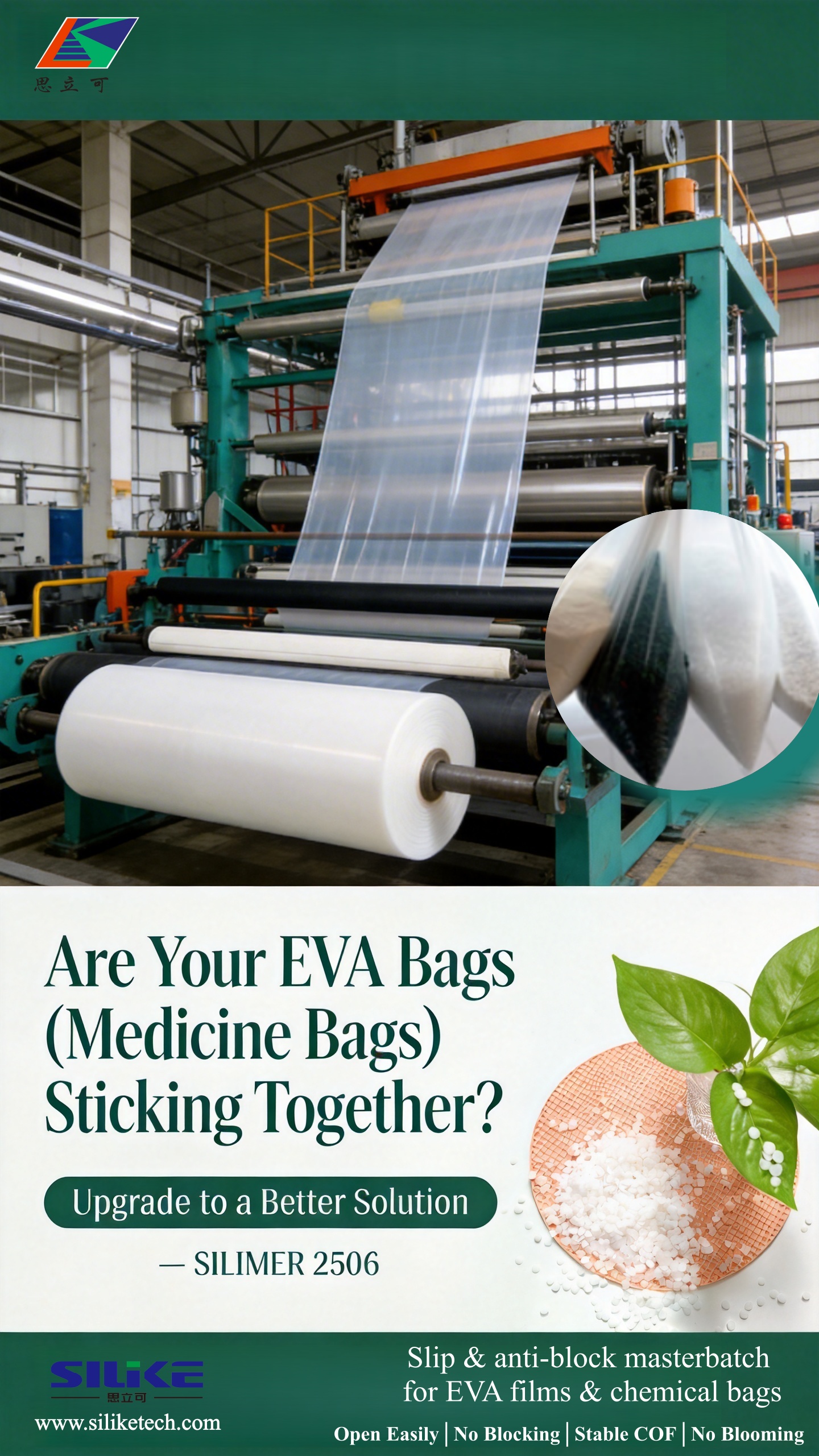
SILIMER 2506 is a newly launched silicone-based slip and anti-block masterbatch developed by SILIKE, specifically designed for EVA film and EVA bag applications, including Low Melt EVA Bags, EVA Dosing Bags, and EVA Medicine Bags.
It utilizes a specially modified silicone polymer (copolysiloxane) as the active component. Unlike conventional slip additives, it effectively addresses common limitations such as surface precipitation, unstable slip performance over time, and performance fluctuations caused by temperature changes.
Key Characteristics of EVA film additive SILIMER 2506
• Enhances film opening and effectively prevents blocking during processing
• Non-blooming behavior → eliminates migration-related issues
• No surface depletion over time
• Maintains a stable coefficient of friction (COF)
• Delivers consistent handling performance during storage and processing
Benefits of EVA Bags (Medicine Bags) Based on Feedback from Manufacturers
Using a non-migrating slip and anti-block masterbatch in an EVA bag can result in:
√ More consistent film feeding
√ Reduced blocking during storage
√ Stable opening performance over time
√ Lower need for manual intervention
√ Improved batch-to-batch consistency
From a processing perspective:
√ More predictable mixing behavior
√ Reduced variability caused by additive migration
√ Better compatibility with automated systems
Application Scope of Stable Slip Additive SILIMER 2506
This functional film additive is particularly relevant for:
♦ EVA chemical dosing bags
♦ Rubber additive packaging systems(Low Melt EVA Bags)
♦ Automated feeding systems in compounding operations
♦ EVA films with 18–24% VA content
FAQ
1. Why do EVA dosing bags /Medicine Bags/low-melt EVA Bags stick together over time?
Because conventional slip agents migrate unevenly, leading to surface depletion and increased tackiness during storage.
2. What causes blocking in EVA films (18–24% VA)?
Blocking is mainly caused by additive migration, which results in unstable surface energy and uneven slip distribution over time.
3. How can blocking in EVA dosing bags/Low Melt EVA Bags be prevented?
By reducing reliance on migratory slip agents and using formulation strategies that stabilize surface properties without migration.
4. Why doesn’t increasing the slip dosage solve the problem?
Adding more slip can worsen migration imbalance, leading to unstable long-term performance rather than resolving the root cause.
5. What is the advantage of non-migrating slip and Anti-Block Masterbatch?
SILIKE SILIMER 2506 slip and anti-Block masterbatch is a Non-Migrating Slip & Anti-Block Additive, providing consistent surface performance over time without blooming or depletion, improving handling stability and reducing variability.
Whether you are using EVA Chemical Dosing Bags or Low Melt EVA Bags for Rubber Additives, contact SILIKE to learn more about the functional film additives SILIMER 2506 and how it can help prevent blocking and slip instability in EVA films without migration.
Tel: +86-28-83625089 or via Email: amy.wang@silike.cn. Website:www.siliketech.com
Post time: Apr-01-2026


