
Why Traditional Dispersants Often Fail and How Hyperdispersants Solve It
In the injection molding of color masterbatch, manufacturers frequently face:
• Color inconsistency between batches
• Pigment streaks and specking on molded parts
• Gloss variation and surface haze
• Unstable dispersion during high-shear injection
• Reduced mechanical performance due to poor compatibility
Even when using conventional dispersants or dispersing agents, performance often fails under real injection molding conditions.
Why?
Because most systems are designed for dispersion formation, not for maintaining dispersion stability under processing stress.
Dispersant / Dispersing Agent in Polymer Systems
A dispersant (or dispersing agent) is a functional additive used in pigment-containing polymer systems to:
• Improve pigment wetting
• Reduce particle agglomeration
• Stabilize pigment distribution in a polymer matrix
In industrial plastics, these additives are commonly referred to as:
• Pigment dispersant
• Dispersing agent for color masterbatch
• Polymer dispersing additive
• Wetting and dispersing agent
They are widely used in engineering plastics, masterbatch production, and technical compound systems.
Why Traditional Dispersants Fail in Injection Molding
1. Wetting-Only Design Limitation
Most dispersants focus only on initial wetting, not long-term stability.
2. Shear Re-Agglomeration
During injection molding:
• High shear flow
• Thermal cycling
• Pressure variation
→ Pigments can re-agglomerate even after successful compounding.
3. Rheology Instability
Many conventional dispersing agents adjust viscosity but fail to stabilize pigment distribution during injection molding.
4. Resin Compatibility Gap
Different systems (PP / PE / ABS / PC / PET / PVC) create inconsistent dispersion behavior, affecting color uniformity.
Mechanism Block: Why Hyperdispersant Systems Perform Better
Modern pigment dispersion requires a three-layer stabilization model:
1. Interfacial Wetting – Reduce pigment–polymer interfacial tension
2. De-Agglomeration – Break pigment clusters into primary particles
3. Steric Stabilization – Prevent re-agglomeration under shear and heat
→ Traditional dispersants typically cover only Layer 1
→ Advanced hyperdispersants cover Layers 1 + 2 + 3
Dispersion Solution: Silicone-Based Hyperdispersant Approach
(A Practical Guide to Improving Pigment Dispersion, Color Consistency, and Processing Stability in Plastic Compounds and Masterbatches)
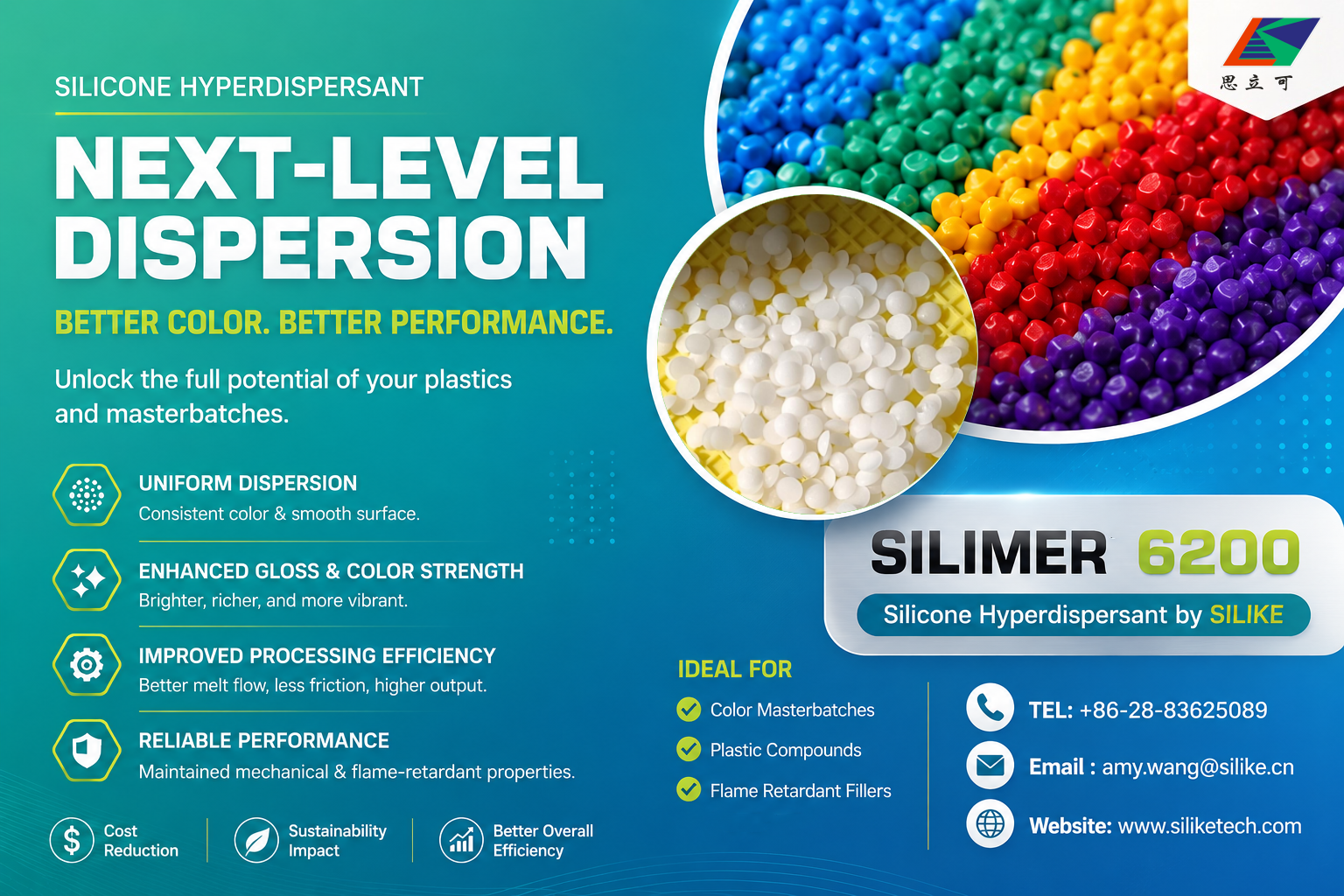
SILIKE SILIMER 6200 silicone hyperdispersant is specifically developed for preparing color concentrates and technical compounds. It can also be applied for single pigment dispersion and tailor-made color concentrates for demanding dispersion processes. Providing:
• Improved pigment wetting efficiency
• Uniform dispersion in the melt
• Stable rheology during injection molding
• Prevention of re-agglomeration
• Enhanced surface appearance and color consistency
Compatible with:
PP | PE | PS | ABS | PC | PVC | PET| PBT
Performance Impact in Real Processing Systems
When using a hyperdispersant-assisted system:
• Color deviation between batches decreases
• Surface streaks and flow marks are reduced
• Gloss consistency improves
• Scrap rate due to appearance defects decreases
• Masterbatch transfer stability improves
Application Areas
• Automotive interior trim (PP / ABS systems)
• Consumer electronics housings (PC / ABS)
• Color masterbatch production
• Engineering plastic compounds
• Fiber-reinforced colored polymers (GF-PP, GF-PA)
Selection Guide (For Engineers & Formulators)
Use hyperdispersant-assisted systems when you observe:
• Persistent pigment specking after compounding
• Unstable color during injection molding
• Incompatibility between masterbatch and resin
• High pigment loading requirements
• Gloss or shade inconsistency in production
Recommended evaluation approach:
• Test across multiple shear conditions
• Validate in the final injection molding step (not only during compounding)
• Confirm long-term stability under thermal cycling
FAQ: Dispersants for Plastics and Masterbatch
Q1: What is the difference between a dispersant and a dispersing agent?
A dispersant focuses on pigment wetting and stabilization, while a dispersing agent refers more broadly to processing aids that assist dispersion during compounding and molding.
Q2: Why do dispersing agents fail in injection molding?
Because most systems do not prevent pigment re-agglomeration under high shear and thermal stress.
Q3: What is a hyperdispersant?
A hyperdispersant is an advanced additive system that provides wetting, de-agglomeration, and long-term stabilization of pigments in polymer matrices.
Summary
Stable color masterbatch performance in injection molding depends on dispersion thermodynamics and interfacial stabilization, not pigment concentration alone. Hyperdispersant systems provide multi-stage stabilization—wetting, de-agglomeration, and long-term dispersion maintenance—ensuring superior color uniformity, rheological stability, and surface quality across polymer systems.
Conversion / Contact
If your current dispersant or dispersing agent system cannot maintain color stability under real injection molding conditions, evaluate a hyperdispersant-assisted dispersion system to:
• Improve pigment dispersion stability
• Enhance surface appearance and gloss
• Reduce scrap and production variability
Contact SILIKE to get a complete dispersion solution for plastic compounds and masterbatches, including color masterbatches, functional masterbatches, high-loading pigment masterbatches, and flame retardant compounds. Reach out for technical evaluation, sample testing, processing trials, and application consultation to optimize pigment dispersion, improve color consistency, and enhance product performance.
Post time: Jun-05-2026


