
High-transparency TPU has become a preferred material for consumer electronics, wearable devices, protective gear, and medical components. Its exceptional clarity, flexibility, abrasion resistance, and biocompatibility make it a versatile choice.
Yet manufacturers working with transparent TPU films, molded TPU parts, and high-clarity elastomer components know a different side of the story: transparent TPU is one of the most challenging materials to demold. Sticking during demolding often leads to surface defects, reduced transparency, longer cycle times, and inconsistent product quality.
Even with optimized parameters—adjusted melt temperature, slower injection speed, improved mold polish—many factories still struggle with sticking, haze, drag marks, glossy spots, and unstable appearance. These problems not only reduce yield but also disrupt production continuity.
This article explains why high-transparency TPU is notoriously difficult to process and introduces a new silicone-based release additive technology that is redefining the standard for optical TPU parts — offering clean release,and stable surface quality without affecting mechanical durability or yellowing resistance.
1. Why Is High-Transparency TPU So Hard to Demold?
Compared with conventional TPU grades, transparent TPU typically falls in the 85A–95A hardness range and features a more regular polymer chain structure to achieve optical clarity.
This structure significantly narrows the processing window. During molding, transparent TPU becomes highly viscoelastic, resulting in stronger adhesion to the mold surface.
As a result, manufacturers frequently encounter:
1) Severe Mold Sticking and Difficult Ejection
The high adhesion between TPU and polished mold surfaces leads to:
deformation during ejection
surface tearing or whitening
stress marks on thin-wall sections
For transparent TPU phone cases, thin shields, and wearable components, these defects are unacceptable.
2) Haze Caused by External Release Agents
Traditional oily release sprays often leave trace residues that interfere with optical clarity. Even a thin film of residue can cause:
loss of gloss
increased haze
uneven transparency
sticky or oily surface feel
In high-end transparent products, such contamination is a critical quality failure.
3) Flow-Related Defects: Drag Marks, Silver Streaks, Bright Spots
Non-uniform cooling or insufficient melt flow leads to:
streaks along the flow path
water-wave drag marks
silver lines
localized bright spots or optical distortion
These defects may persist even when the mold is polished to a mirror finish.
4) Low and Unstable Yield Rates
Manufacturers often report:
cycle-to-cycle inconsistency
frequent mold cleaning
unpredictable defect rates
irregular shrinkage or warpage
This is especially problematic in mass production of high-transparency parts.
2. Why External Release Agents Fail for Transparent TPU
Many factories attempt to solve demolding issues using external release agents. However, for transparent TPU, this approach typically causes additional problems.
1) Residue Migration Leads to Optical Distortion
Oily layers disrupt the uniformity of the transparent TPU surface. As they migrate, haze increases and optical clarity declines.
2) Instability at High Temperatures
At TPU injection temperatures (190–220°C), release agent residue may:
carbonize on the mold surface
cause burn marks or bright spots
reduce surface consistency
3) Poor Compatibility with Secondary Processing
Residual release agents negatively affect:
bonding
printing
painting
coating
overmolding
For these reasons, many OEMs prohibit external release agents for optical-grade components.
The industry is shifting toward internal mold-release modification rather than surface spraying.
3. How to Solve the Problem of High-Transparency TPU Being Difficult to Demold?
Material-Level Breakthrough: A New Demolding Approach for High-Transparency TPU
SILIKE Copolysiloxane Additives — High-Lubrication Silicone-Based Release Modifier (SILIMER 5150)
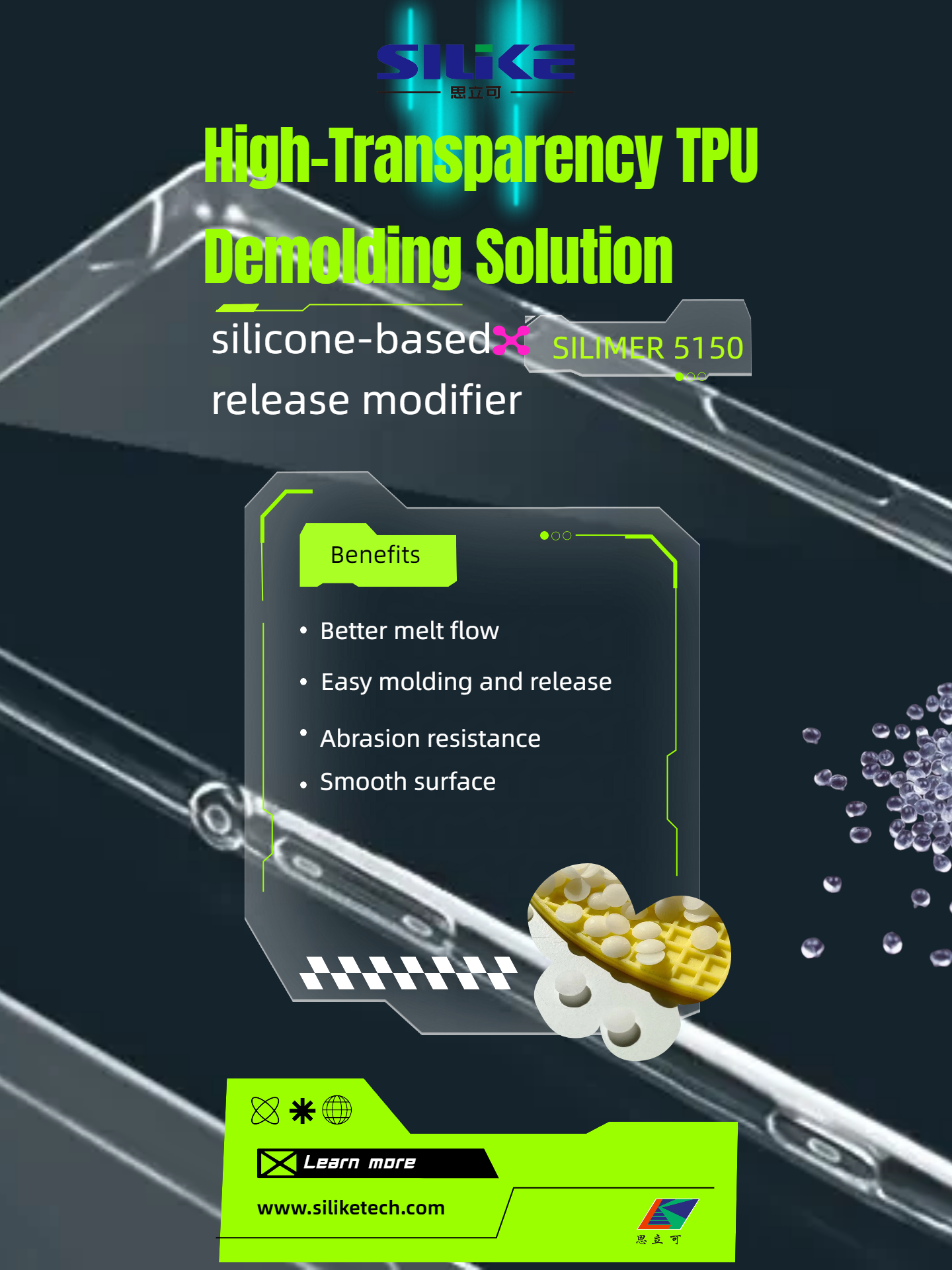
Although SILIMER 5150 was originally developed as a high-lubrication silicone wax to enhance scratch resistance, surface gloss, and texture retention in plastics such as PA, PE, PP, PVC, PET, ABS, TPEs, polymer alloys, and WPC, market feedback has revealed unexpected success in high-transparency TPU demolding applications.
TPU Processors have discovered that the easy-to-use pelletized additive provides:
improved melt flow
better mold filling
enhanced abrasion resistance
smoother surface finish
TPU mold release improvement
These benefits collectively upgrade TPU processing efficiency far beyond the additive’s initial design scope.
Why SILIMER 5150 Works as a High-Performance Release Additive for TPU
SILIMER 5150 is a functionally modified silicone wax engineered with a unique molecular structure that ensures excellent compatibility with TPU. It delivers strong lubrication performance without precipitation, blooming, or compromising transparency.
Instead of applying chemicals externally on the mold surface, the TPU is internally modified so that adhesion naturally decreases during molding.
This eliminates the haze, residue, or instability normally associated with external release agents.
4. Practical Guide: How to Optimize Demolding for High-Transparency TPU
To achieve defect-free, stable demolding, manufacturers should optimize material, mold, and process parameters.
(1) Material Optimization
Use internally modified TPU with Silicone-Based additive SILIMER 5150.
Maintain moisture below 0.02%.
Select TPU grades with enhanced flow for thin-wall parts.
(2) Process Parameter Optimization
Mold temperature: 30–50°C
Melt temperature: 195–210°C
Injection speed: medium–high for uniform flow
Cooling time: ensure full stabilization before ejection
Back pressure: moderate to avoid overheating
Balanced parameters help prevent drag marks, poor filling, and sticking.
5. Benefits of Using Copolysiloxane Additive and Modifier SILIMER 5150 for High-Transparency TPU Demolding
This Silicone-Based Release Modifier technology is particularly effective for high-hardness, high-transparency TPU grades, which are traditionally the most difficult to demold. By integrating this additive solution, TPU manufacturers gain an immediate competitive advantage — achieving higher-quality surfaces, lower rejection rates, and more consistent production performance. Its benefits extend across TPU applications in electronics, sporting goods, automotive interiors, and medical packaging, where clarity, surface aesthetics, and processing stability are critical.
For inquiries about TPU release additive, sample requests of the best additive for TPU demolding, or technical support on how to fix TPU sticking in molding, please contact SILIKE. Get your TPU sticking problem solution and TPU mold release improvement.
Tel: +86-28-83625089, Email: amy.wang@silike.cn, Website: www.siliketech.com
Post time: Dec-12-2025


