
The Hidden Challenge in High-Speed Plastic Film Production
In high-speed composite film production, manufacturers often encounter white powder precipitation on film surfaces, especially in BOPE, CPE, and polypropylene films. This issue affects:
• Food and pharmaceutical packaging safety
• Lamination strength and adhesion consistency
• Production efficiency, causing frequent roller cleaning and scrap
Traditional amide-based slip additives migrate uncontrollably, leading to visible residues (blooming) and inconsistent film surface quality.
Your production line isn’t failing—the additive is migrating.
Why White Powder Appears on Composite Films
Key causes of white powder and surface blooming include:
• Low molecular weight additives migrating to the surface over time
• Temperature fluctuations accelerating migration
• Accumulation forming wax-like residues
• Lack of anchoring mechanisms in traditional slip and anti-block additives
These issues are common in polyolefin films, including BOPE and CPE, and can significantly reduce production yield and product quality.
The Solution: SILIKE Non-Migratory Slip Technology, Non-Migratory Slip & Anti-Block Additives
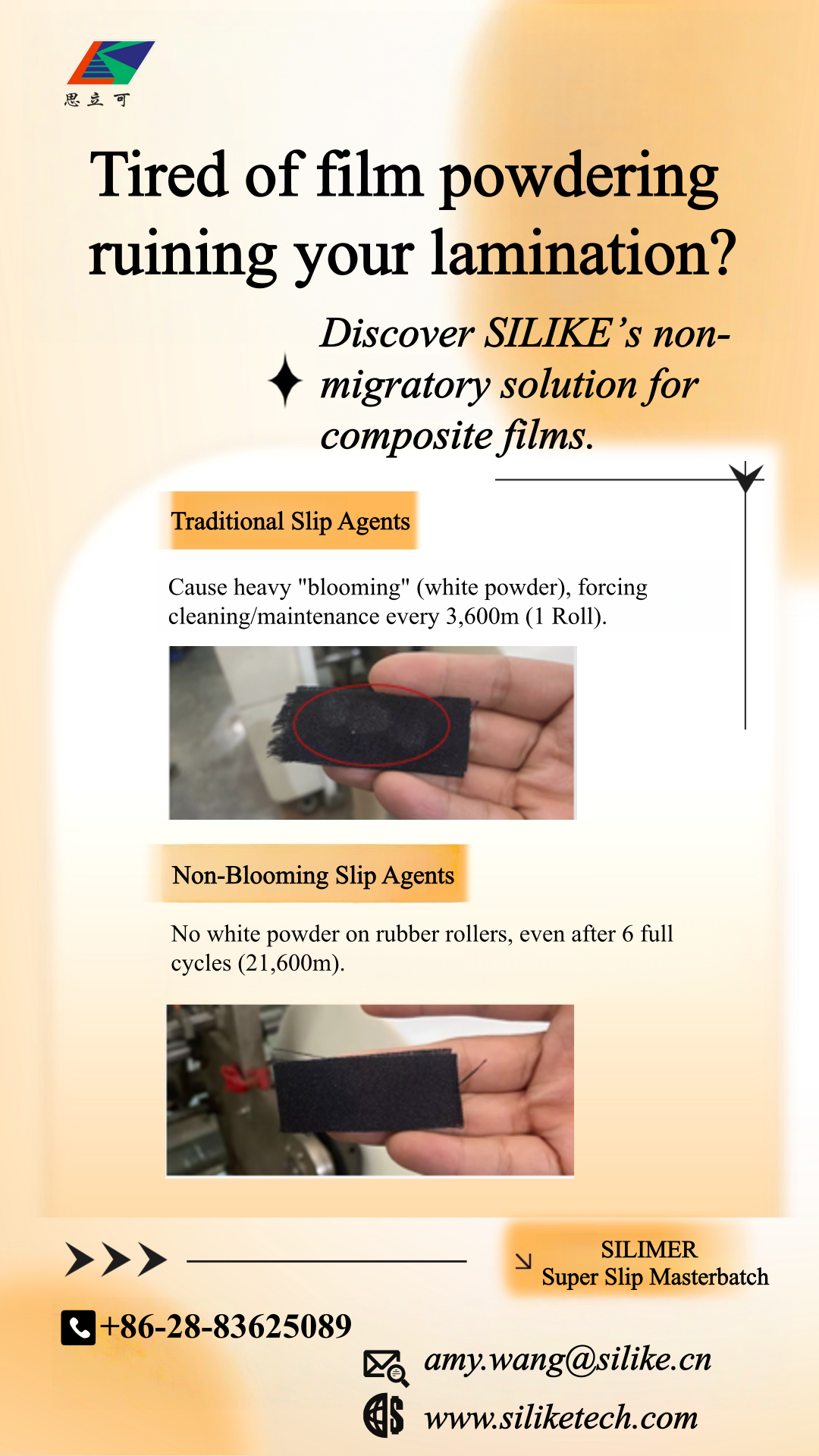
SILIKE SILIMER Series provides non-migratory slip masterbatches designed to prevent additive migration at the molecular level.
Key Features:
• Copolymerized polysiloxanes with active functional groups anchor in the polymer matrix
• Maintain stable COF and anti-blocking performance
• Preserve heat sealability, print clarity, and haze properties
• Prevent white powder formation, reducing maintenance and scrap
Example Product: SILIMER 5064MB1
• Ideal for BOPE, CPE, oriented flat films, and polypropylene composites
• Delivers permanent, stable slip even under high-temperature conditions
Benefits for Film Manufacturers
By adopting SILIKE Non-Migratory Slip Additives, manufacturers achieve:
√ Stable lamination and adhesion
√ Reduced roller cleaning frequency
√ Consistent film surface quality
√ Lower total production costs
√ Enhanced food-contact safety compliance
These advantages are especially critical in high-speed plastic film lines, improving efficiency and product consistency.
Applications
SILIMER 5064MB1 and related non-migratory slip masterbatches are ideal for:
• BOPE films (Biaxially Oriented Polypropylene)
• CPE films (Chlorinated Polyethylene)
• Oriented flat films and polyolefin-based composite films
• Plastic bags and other packaging films
FAQ: Non-Migratory Slip and Anti-Block Additives
Q1: What causes white powder on composite packaging films?
A: White powder is caused by migration of low molecular weight slip additives (typically amides) to the film surface, forming residues over time.
Q2: How can blooming be prevented?
A: Using non-migratory slip masterbatch with anchoring molecular structures can prevent additive migration and eliminate blooming.
Q3: Does non-migratory slip affect COF performance?
A: No. It maintains stable COF while preventing contamination and improving lamination consistency.
Q4: Is it safe for food packaging?
A: Yes. Non-migratory technology reduces the risk of additive transfer to food-contact surfaces.
Are you looking for Slip Agents for Plastic Films, Anti-Block Additives, Plastic Bag Slip Additives, or Stable Slip Agent Additives for your Composite Film Production?
Or if your Plastic Films production line experiences:
♦ White powder on film surfaces
♦ Frequent roller cleaning
♦ Unstable lamination performance
It’s time to move beyond traditional slip additives.
SILIKE Provides:
Free sample testing
Customized formulation support
Expert technical consultation
Still seeing white powder on your film surface? Try a non-migratory solution before adjusting your process again.
SILIKE Non-migratory slip technology eliminates surface blooming(white powder), stabilizes lamination performance, and significantly extends production runtime in composite packaging films.
For more details, visit https://www.siliketech.com/super-slip-masterbatch-for-films/ or contact Amy via amy.wang@silike.cn
Post time: Mar-20-2026


